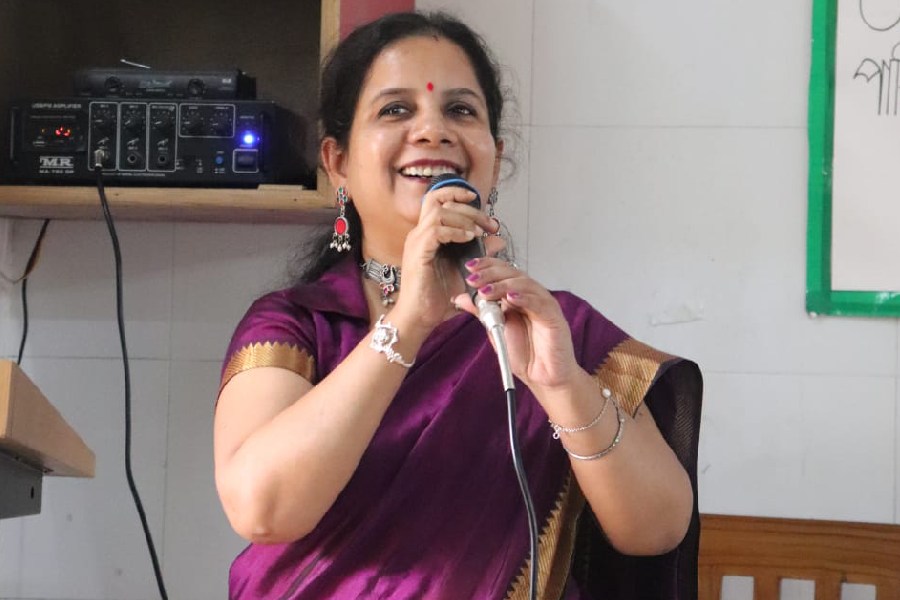
At Behala’s Kishore Bharati Bhagini Nivedita College, professor Nilanjana Sen stands before a classroom full of students every day and speaks of vision — not the kind that depends on the eyes, but the kind that helps us interpret the many layers of human experience.
Her own journey with darkness began when she was just five years old, a lively playschool student in Raniganj, who loved the playground. Yet, as dusk approached, she would quietly return home before the other children.
She could no longer see clearly in fading light.
At first, her parents, Arun and Arati Sen, dismissed it as childish fear after a scolding. Doctors, too, brushed aside the signs, assuming her inability to draw straight lines was merely mischief.
But one day her mother noticed something unusual.
Sen was reading her routine with a torch in broad daylight. That moment replaced denial with dread.
Her parents rushed her to the best eye hospitals in Kolkata, and later, in Chennai.
Medicines were imported from Vienna and Russia. Yet nothing could halt the progression of the disease. Eventually came the diagnosis — Retinitis pigmentosa, a rare and incurable genetic disorder that gradually destroys the light-sensing cells of the eye.
Life changed overnight.
Withdrawn from her regular school, Sen spent a year and a half at home learning Braille. Her father travelled to Narendrapur Ramkrishna Mission to learn the script so he could teach her himself.
For months, father and daughter sat together tracing raised dots that would become her new alphabet. Later, she joined the Calcutta Blind School in Behala, a residential institution where she learnt not only academics but also mobility and independence.
Among students who were often older and from far more deprived backgrounds, she initially felt like a misfit. Yet the school gave her something invaluable — self-respect. For the first time she felt equal to her peers.
Outside the school gates, the world was less understanding.
In her hometown in Asansol, curiosity and sympathy often overshadowed normal interaction. But at every stage of life she found teachers, friends and colleagues who saw her for who she truly was, not merely for her disability.
After Class X, she stepped into mainstream academia. At P.D. Women’s College in Jalpaiguri, she chose English Literature, persuaded by teachers who saw in her a literary mind. She topped the University of North Bengal in graduation and later secured a first class second position in her Master’s degree in 2001.
Integration, however, was far from easy.
With 100 per cent visual impairment and no Braille books available in mainstream academia, Sen relied heavily on readers, mostly her parents, who recorded lessons onto cassettes.
She would rewind and fast-forward the tapes endlessly, memorising entire texts because she could not simply glance back at a page. Notes were prepared in Braille, dictated to scribes and then written in ink before being submitted to professors.
Even examinations demanded enormous effort. Her parents had to search door to door for a suitable amanuensis who was one grade junior and capable of writing accurately. “It was ten times more cumbersome and time-consuming,” she recalled.
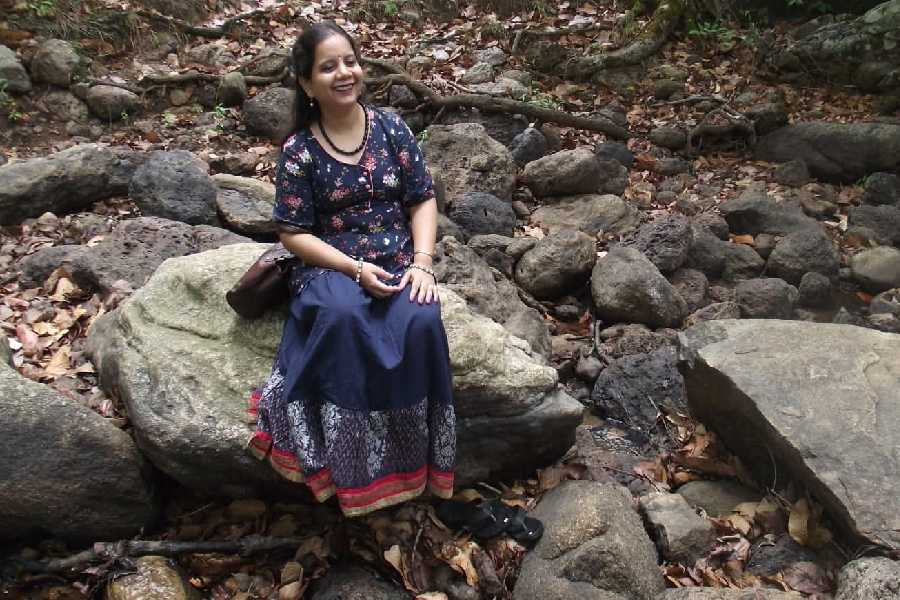
Yet these challenges sharpened her resolve. “I realised I was not disabled, but specially-abled. Since one of my sensory faculties was shut, my cognitive abilities and my memory had to become stronger,” she said.
Sourced by the correspondent
With remarkable grit, she cleared the National Eligibility Test in her first attempt and began teaching part-time at Ananda Chandra College of Commerce in Jalpaiguri in 2003. Doubts were raised about whether she could manage a classroom of students. She answered them not with words, but with excellence. In 2005 she secured a full-time position at Ananda Chandra College.
Following her marriage to professor Pallab Halder in 2010, she relocated to Kolkata, joining Kishore Bharati College in Behala in 2015 as the head of the English Department. Along the way, she also completed her PhD on Mahesh Dattani: The Invisible Issues of India.
Technology has since opened new doors. Screen-reading softwares and PDFs have transformed her laptop and smartphone into powerful learning tools.
Today, Sen continues to teach with dedication and determination. A guide helps her navigate the corridors to her classroom, where she teaches seated, using digital tools such as screen readers, Google Classroom and PowerPoint to engage her students.
But what truly defines her classroom is not technology, it is respect.
“If my students want, they can slip out through the front door and I won’t be able to tell,” she jokes. Yet they never do. Not because they fear her, but because they admire her.
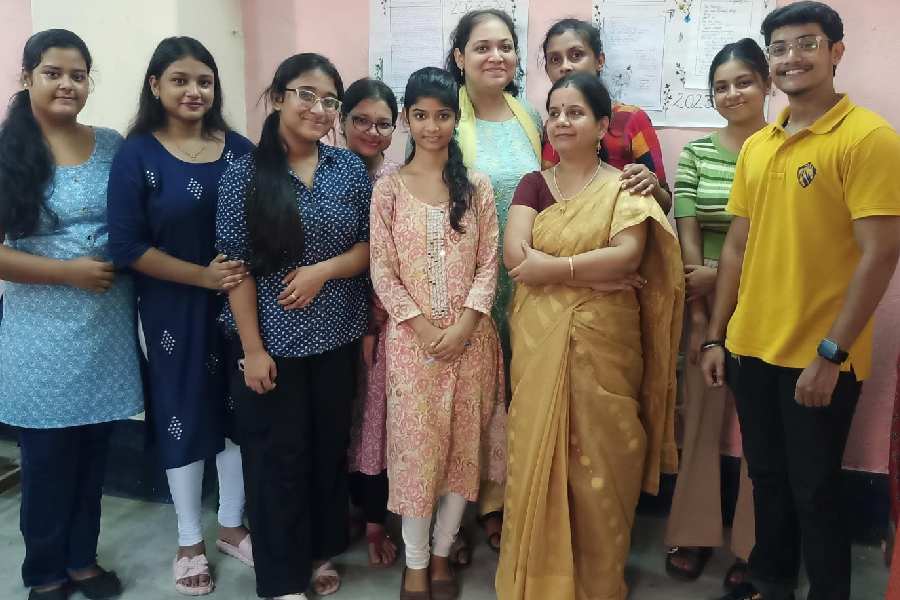
“Professor Sen's vision for education went far beyond sight. We stayed in her classroom not out of obligation, but because her resilience and compassion towards life demanded our highest respect,” said Sukanya Dey, a former student of Kishore Bharati College.
Sen’s colleague, Professor Anindita Mitra, added, “What I really admire about her is her dedication and perseverance. She never backs down. For people who cannot see, having a photographic memory is unthinkable. But her memory is extraordinary.”
Sourced by the correspondent
Yet, professor Sen refuses to call her life a victory. The 48-year-old educator said that she will feel truly victorious when her community no longer has to struggle for basic dignity and equal opportunities.
Until then, in a classroom in Behala, Professor Nilanjana Sen will continue to teach her students not just prescribed plays, poems and theorems, but how to truly see.