 |
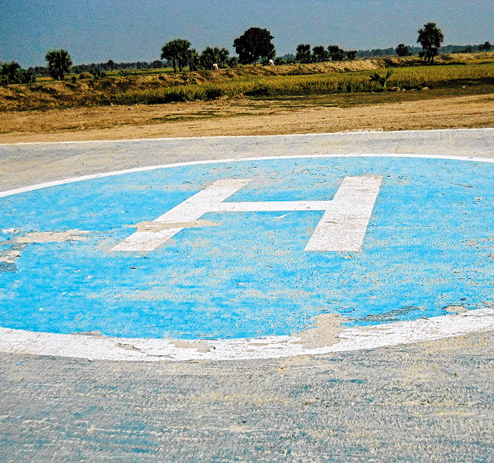
| The new helipad for chief minister Jitan Ram Manjhi’s chopper and (below) the under-construction advanced additional public health centre, at Mahakar village in Gaya. Pictures by Suman |
 |
Mahakar, Nov. 3: When Jitan Ram Manjhi bagged a postal clerk’s job half a century ago, his community of Musahars (rat eaters) were thrilled at the feat by their first ever graduate.
They had no idea what triumphs were coming.
Here are some of the scenes The Telegraph saw at Manjhi’s home village of Mahakar, 105km south of Patna, on Thursday (October 30), barely five months and a half after he became Bihar chief minister.
Scene I: At least 25 government-owned SUVs are parked in front of Manjhi’s two-storey mansion, painted in shining green and standing tall amid a knot of thatched houses.
The cars belong to police officers, magistrates, circle officers, block development officers, subdivisional officers, sundry district officials — all gathered to “receive” Manjhi as he arrives home for Chhath celebrations.
Scene II: The last expert inspection is on at the new, concrete helipad for the chief minister’s chopper. So far, Manjhi has had to do with a makeshift helipad at his village.
Scene III: Thump! Thump! Construction is on in full swing at the sites of a Rs 1.1-crore government high school, a police station, an electric power grid station and an advanced additional public health centre — all coming up within 500 metres of Manjhi’s house in this village at Khijarsarai block, Gaya.
Scene IV: Manjhi’s house is getting ready to party. It’s the final day of the arghya (offering) for Chhath, the day of feasting at the end of three days of fasting.
Some 20-odd government officials are on their toes, overseeing the arrangements, entertaining the guests and taking orders from Manjhi’s elder son Santosh Kumar Suman, 39.
Two constables lead a 10kg magahia khassi (local breed of goat) towards the open-air kitchen where cooks and servants are laying the oven. The aroma of spices and the basmati rice being washed waft in the air.
Manjhi will be arriving any moment now to join the celebrations with his sons, daughters, relatives and co- villagers.
Till then, Santosh will be attending to the villagers gathered with sundry applications while, from time to time, barking orders to the assorted crowd of government officials, cooks and servants.
“My father has a weakness for the village. Even as minister and MLA, he made it a point to come home almost every Saturday,” Santosh says.
“Once in the 1980s, he refused a US trip because it was to last 15 days. As usual, he’ll spend tonight with the villagers and family members.”
Sweet home
Even the middle school and small public health centre that Mahakar boasted of all these years had been gifts from its most illustrious son. They came up in the 1980s and the 1990s when Manjhi was a minister.
Asked about the village’s overnight transformation since Manjhi became chief minister, Santosh said: “My father is committed to making Mahakar a model village, equipped with all the modern facilities.”
Within days of becoming chief minister, after Nitish Kumar stepped down in mid-May accepting responsibility for the Janata Dal United’s rout in the general election, Manjhi had made a public vow.
Mahakar, he had promised, would be equipped with all the facilities that Nitish’s village of Kalyanbigha in Nalanda has.
Santosh, assistant professor of political science at a college in Vajirganj, Gaya, would not be drawn on Kalyanbigha.
But he said: “An ITI (Industrial Training Institute) and a stadium too have been proposed and are awaiting cabinet clearance, as is the status of a block for Mahakar.”
At the under-construction schoolhouse, labourer Shahzad Alam, 25, said: “We are working round the clock in shifts.”
Nitish and Lalu Prasad too have done a lot for their villages: Kalyanbigha and Phulwaria too have an ITI, a power grid station, hospitals, approach roads and block offices.
But Manjhi’s magnificent house with its well-floored verandah and paved courtyard far outshines Nitish’s thatched home at Kalyanbigha and Lalu Prasad’s old-fashioned, single-storey dwelling at Phulwaria.
Manjhi’s mansion has a modern washbasin with running water on the verandah. Sammi, gulmohar and several exotic plants and flowers adorn the courtyard. There are outhouses for the servants. Policemen guard the house’s gates 24x7.
Clerk to Congress
Manjhi’s profile marks a contrast with the career paths of Nitish and Lalu Prasad, who started off as student leaders under the guidance of Jayaprakash Narayan and helped catalyse broad political and social changes in the state.
The young Manjhi pinned his hopes not on mass movements but education, and chose not politics but a salaried job as his vocation. Although born in one of the lowest castes even among Dalits, he completed school and went to a college 25km away before joining the postal service in Gaya in the early 1960s.
JP’s “Total Revolution” of the ’70s passed him by, as did the socialist Karpoori Thakur’s movement for the empowerment of the weaker sections. Manjhi focused on job, family and home.
The breakthrough came in 1979, when Manjhi caught Congress chief minister Jagannath Mishra’s eye, quit his job and joined the Congress. Mishra became his mentor, fielded him in an election in 1980, and soon made him a minister.
By then, Manjhi and his brother — a police sub-inspector around that time — had already begun building the house, the older villagers in Mahakar said. The house came up in 1983-84 and has been expanded and spruced up since then.
“We were landless and poor. Today, we have nearly 20 acres (more than the combined holdings of Nitish and Lalu Prasad at their ancestral villages),” Santosh said.
He insisted that it had all come from his father’s and uncle’s salaries as postal clerk and daroga.
Party-hopper
Manjhi built his political career partly through party-hopping. When Mishra’s stars dwindled in the 1990s, Manjhi joined Lalu Prasad’s Rashtriya Janata Dal (RJD) and became a minister before switching to the Janata Dal United when the political winds changed direction again.
His Mahadalit origins stood the low-profile lawmaker in good stead when Nitish began looking around for a successor who would be able to counter the BJP’s surge among the state’s weaker sections.
Yet, even as a child, Manjhi had stood apart from the other Musahar boys.
“Jitan didn’t like catching or eating rats even during the days we were studying at Baldeo High school,” said Sitaram Singh, an upper caste Bhumihar and Manjhi’s childhood friend.
“He would ask his family and others in the community to practise cleanliness and focus on their studies.”
The villagers are happy that Manjhi is doing “so much” for Mahakar. They praised their chief minister’s affable nature.
“He meets all of us; he listens to us,” said Kundan Kumar, a college student.
For all that, Manjhi seems acutely conscious that unlike Nitish and Lalu Prasad, he doesn’t boast the CV of a mass leader. So he has been walking the extra mile to ensure his popularity stays intact among his caste brethren.
“Dalits should have more children (creating more voters) so they can have their own chief minister,” he said the other day.
“There’s nothing wrong if a worker drinks a couple of pegs after a hard day,” is another of his recent quotes.
The Mahadalit who once shied off agitations but rode his origins and a combination of smart moves and lucky breaks to the high seat of power perhaps has little use for political correctness.