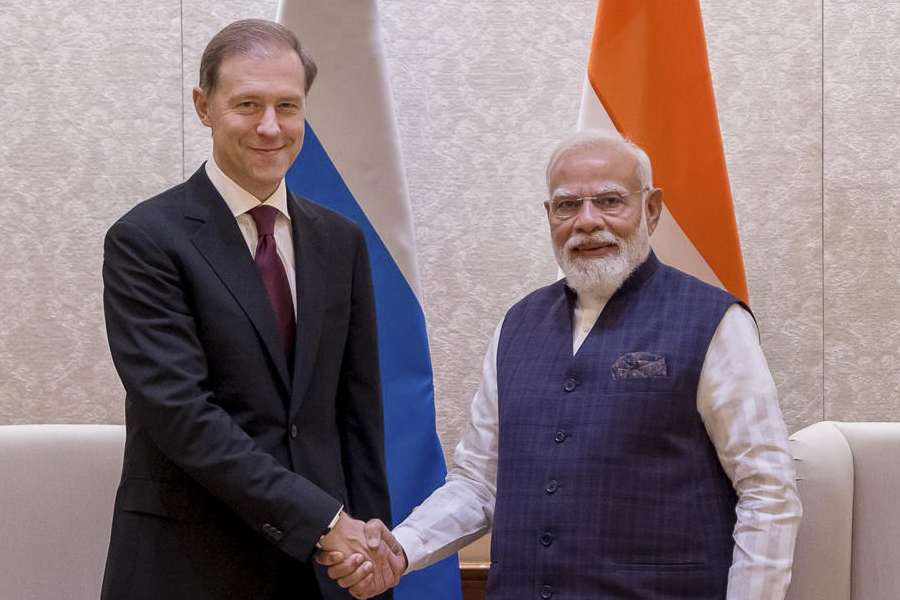
Russia's first deputy Prime Minister Denis Manturov visited India on Thursday and met Prime Minister Narendra Modi to discuss ways to strengthen bilateral ties in investment, energy, and fertilisers.
Manturov, on a two-day visit, also held talks with external affairs minister S. Jaishankar and national security advisor Ajit Doval. The visit comes with tensions rising in West Asia.
"We discussed our mutually beneficial cooperation in trade, fertilizers, connectivity and people-to-people ties," Modi said on social media.
"Welcomed the sustained efforts from both sides to implement the outcomes of the 23rd India-Russia Annual Summit held during President Putin's visit to India last December," he added.
The Russian deputy PM briefed Modi on progress in areas of cooperation, including trade and economic partnership, according to an Indian readout.
PM Modi expressed satisfaction at the ongoing efforts to implement the outcomes of the India-Russia summit in New Delhi in December. The prime minister also extended greetings to President Putin and said he looked forward to continued exchanges.
The Russian embassy said PM Modi and Manturov discussed "specific steps to implement agreements reached" during the December summit.
"Particular attention was paid to further strengthening Russia-India trade, economic, investment, energy and industrial cooperation," it added on social media.
Doval and Manturov discussed bilateral defence cooperation and the evolving regional security situation, including the West Asia conflict.
Manturov's visit comes days after India cleared the procurement of an additional batch of five S-400 missile systems from Russia.
The decision followed the system's role during Operation Sindoor, which contributed to India's advantage over Pakistan during the May 7-10 hostilities last year.
India had signed a USD 5 billion deal with Russia in October 2018 for five units of S-400 missile systems, despite warnings from the US that proceeding could invite sanctions under the Countering America’s Adversaries Through Sanctions Act (CAATSA).
Three squadrons have already been delivered. The two sides are expected to exchange views on the West Asia conflict and its impact on the global economy, particularly the energy sector.
Both countries reviewed the implementation of decisions from the December summit. Following the talks, India and Russia announced a five-year roadmap to increase annual trade to USD 100 billion by 2030.
Russian foreign minister Sergey Lavrov last week praised India's "independent foreign policy" and said Russia looks forward to welcoming Prime Minister Modi this year.
In an address at a conference titled India and Russia: Towards a new bilateral agenda, he said the "time-tested" friendship between the two countries is a model of interstate relations based on mutual trust and respect.