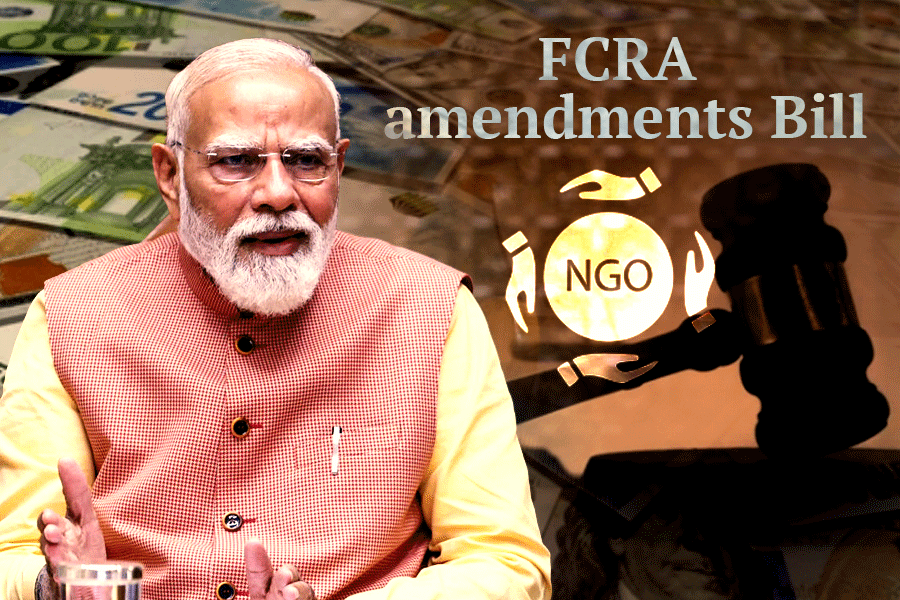
Activists and legal experts have alleged that the Centre has already weaponised the law that regulates foreign contributions, even though the Narendra Modi government on Wednesday deferred the passage of the contentious FCRA Bill in the Lok Sabha, a move seen to be driven by concerns over a potential backlash from the electorally significant Christian community in poll-bound Kerala.
The Catholic Bishops Conference of India, the apex body of the Catholic Church in India, has publicly objected to the amendments, calling them as enabling “undue interference” in minority institutions.
Before the government hit the pause button, CPM Rajya Sabha MP John Brittas argued that the The Foreign Contribution (Regulation) Amendment Bill, 2026 poses a “serious threat” to NGOs, enabling action including the seizure of assets on “minor or technical grounds”.
Kerala chief minister Pinarayi Vijayan said the changes would disproportionately affect organisations working with minorities and vulnerable communities, particularly in sectors such as education and health care.
Brittas also raised concerns over transparency, noting that his repeated attempts to obtain basic data in Parliament — including the number of FCRA licence cancellations, reasons for denial or non-renewal, and state-wise trends — had been disallowed on the grounds that the information is “secret”.
Legal experts called the move coercive and aimed at silencing dissent.
“NGOs are the only ones who have the guts to say things against the government. Everybody else they have in their pocket,” senior Supreme Court lawyer Kamini Jaiswal, a member of the Committee on Judicial Accountability, told The Telegraph Online.
“This is an arm-twisting tactic and blackmail, wanting to keep everyone under control. This is not just a political tool, but a personal one for the ones sitting at the top,” Jaiswal added.
The government has defended the proposed amendments as necessary to safeguard national interests.
On Tuesday, Union minister for parliamentary affairs Kiren Rijiju said the changes were aimed at preventing the misuse of foreign funds in ways that could harm national security.
“There are some rumours spread by the Communist Party and the Congress in Kerala that the government of India is bringing the FCRA Amendment Bill to stop the activities of various religious organisations,” Rijiju told PTI.
The amendments, he said, were required because “money illegally comes and is used against national security. So for national security and in the national interest, the proposed amendments have been brought.”
Supreme Court senior advocate Colin Gonsalves, founder of the Human Rights Law Network, called the government’s approach “draconian”, alleging a deliberate attempt to curb scrutiny, including from the international press.
“The Centre has smashed the NGOs with a sledgehammer. It was a decision taken at the highest level to prevent any criticism of India reaching the media and reaching the international press. NGOs are the victims of carpet bombing,” Gonsalves told The Telegraph Online.
“If the government is so concerned about national security, then ask them how these NGOs have acted against it and how they have hurt the sovereignty of India? The Modi government has decided to be ruthless and to stop any criticism of its actions,” Gonsalves said.
There have been income-tax raids on offices linked to foreign media organisations including the BBC, and some foreign journalists have reportedly been deported.
Aakar Patel, journalist, activist and former head of Amnesty International India, argued that the proposed changes are designed to insulate the government from scrutiny by organisations documenting human rights violations.
“Research shows that organisations most impacted are associated with minority rights, right to freedom of expression, environmental rights and climate action,” he told The Telegraph Online.
“This is not accidental. It is a deliberate and systematic attempt by the Indian government to eviscerate independent civil society and eliminate accountability,” Patel said.
Amnesty International in India was forced to halt its operations on September 30, 2020 after the government froze its bank accounts, alleging violations of foreign funding laws (FCRA).
Patel said that the current FCRA framework already imposes “broad, vague, and discretionary restrictions” on a wide range of organisations, warning that this departs from guidance issued by the Financial Action Task Force (FATF).
The FATF, an intergovernmental body, sets global standards on combating money laundering and terror financing, cautioned India, among other countries, in its June 2023 update that governments should target only those organisations genuinely vulnerable to terror financing, rather than impose blanket restrictions.
The tightening of FCRA norms over recent years has already had a significant impact.
Amendments introduced in September 2020 imposed stricter compliance requirements, contributing to a sharp fall in foreign funding — from Rs 16,490 crore in 2018–19 to around Rs 2,190 crore in 2019–20, according to a report in The Times of India.
Estimates suggest that by March 2026, as many as 21,933 organisations had lost their FCRA licences, with groups working on human rights, minority issues and environmental causes among those most affected.
The debate has also drawn attention to perceived inconsistencies in the regulatory framework.
While NGOs face stringent controls on foreign funding, political parties have been permitted to receive such donations.
According to the Association for Democratic Reforms, the BJP declared Rs 2,642.63 crore in income from “unknown” sources in the financial year 2019-20. A public interest litigation in Delhi High Court had found political parties guilty of accepting funds from foreign sources.
From grassroots organisations to prominent institutions — including those linked to Sonam Wangchuk and the Missionaries of Charity — the FCRA regime has emerged as a central point of contention between the state and civil society.
The proposed amendments have intensified that debate.