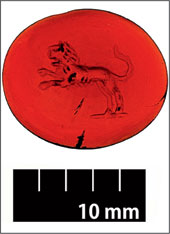

The Leaping Lion, one of the exhibits. The figure is etched on one side of a thin oval-shaped carnelian piece which is slightly curved or convex. The figure is placed horizontally on the carnelian (semi-precious gemstone) piece. This can be dated to the early centuries CE
New Delhi, Dec. 7: If a rough date is of any help, it probably existed around the time Jesus walked on this earth. And possibly disappeared before Vasco da Gama landed in Calicut.
Over five centuries on, the spoils of the search for the lost port city of Muziris went on show in Delhi’s National Museum last month — perhaps the first time that a museum would host an ongoing excavation.
Among the exhibits that are being displayed are large wine jars, believed to be from ancient Rome and Egypt, and the remains of a 2,000-year-old canoe.
The multi-media exhibition — Unearthing Pattanam: Histories, Cultures, Crossing — features a select collection of some 700 original artefacts the Kerala Council for Historical Research (KCHR) excavated over eight years from Pattanam, a village around 20km from Kochi.
“The evidences from Pattanam indicate the intercontinental connections India had 2,000 years back,” said professor P.J. Cherian, the director of KCHR and head of the Pattanam excavations. “This is 15 centuries before Vasco da Gama arrived in India, which many consider as the beginning of our contact with Europe.”
The Portuguese explorer reached Calicut — modern-day Kozhikode — in 1498.
The exhibition also features how the excavation is being conducted. Alongside the artefacts on show are the replica of a trench, tools and videos.
“What is more important is that we are finding evidence that it was not merely a one-way traffic from Europe to India, as we have believed for a long time. We have also indications that Indians too sailed to Europe from the port,” Cherian said.
But where has the port gone? And is it the lost Muziris?
“We cannot say with finality that this site is the same as the Muziris port. It could be an important port, but whether it is Muziris or not is debatable,” said B.R. Mani, additional director-general at the Archaeological Survey of India.
Muziris, Mani says, was considered an important port for trade in spice and has been mentioned by Greek and Roman authors of the 1st and 2nd century AD.
That was the era that gave the world its most famous Cross.
The KCHR thinks the excavations point to the existence of Muziris, which historians believe existed between the
1st century BC and the 5th century AD and mysteriously disappeared in the 14th century.
No other excavation till date has been able to point out the exact location of the lost port city, which some historians say was swept away by floods. The KCHR, too, has not found any clear evidence on how it disappeared.
But the mystery and the excavations have stoked enough interest for the Kerala Tourism Department to start the Muziris Heritage Project by developing 150sqkm around the site as a tourist centre.
Now the “unearthing” of Pattanam has reached Delhi, underscoring the possible historical significance of the finds.
National Museum director V. Venu said it was perhaps the first time that a museum was hosting an active excavation. “The exhibition is an attempt to take archaeology to the public by establishing visual connections to a digging happening somewhere in the country,” Venu said.
Culture minister Mahesh Sharma inaugurated the exhibition on November 28. It will be on till January 10.
Venu said the exhibition would help bring the debate about Muziris, till now limited to academic circles, to everyone. “We want that the postulations of the Pattanam excavations should be scrutinised and critically debated,” the director said. “In archaeology, there is no last word.”