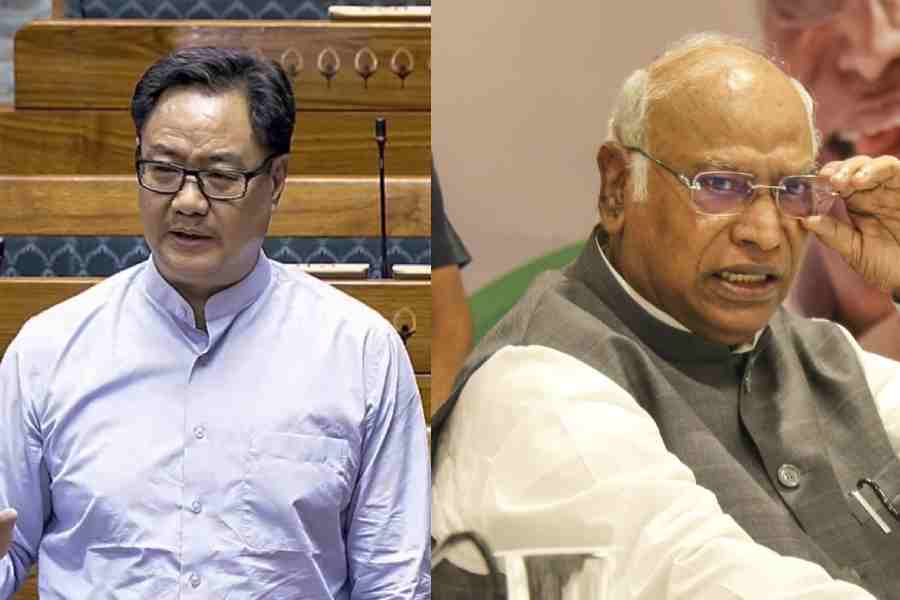
Letters exchanged between Rajya Sabha Opposition leader Mallikarjun Kharge and parliamentary affairs minister Kiren Rijiju over proposed amendments to the women’s reservation law reveal that the Congress and many other Opposition parties have steadfastly pushed for an all-party meeting on the subject.
The letters also show Kharge, the Congress president, questioning the Centre’s sudden announcement of a special parliamentary session amid the Assembly polls to pass the amendments.
Passed in September 2023, the legislation reserves a third of the seats in Parliament, state Assemblies and the Delhi Assembly for women and is to be implemented after the next population census and subsequent redrawing of constituencies (delimitation).
Recently, the Centre announced a special parliamentary session from April 16 to 18 to pass amendments that it says are necessary to ensure the reservation can be implemented before the 2029 general election.
The Opposition believes the timing of the session is meant to give the BJP an advantage in the April 23 and 29 polls in Tamil Nadu and Bengal, and wants the session held only after a post-poll all-party meeting.
On March 16, Rijiju wrote to Kharge seeking a meeting with the Congress on the subject. Kharge replied on the same day demanding an all-party meeting.
On March 24, Kharge and leaders of the CPM, Aam Aadmi Party, J&K National Conference, Jharkhand Mukti Morcha, DMK, Samajwadi Party, Shiv Sena (UBT), NCP (Sharad Pawar), CPI, Revolutionary Socialist Party, CPIML Liberation, Indian Union Muslim League and the VCK — from both Houses — wrote a joint letter to Rijiju.
“It appears that the Government is now planning a further Amendment to the Constitution Amendment passed in September 2023,” they wrote.
“All Opposition parties now reiterate their demand for an All-Party meeting to discuss the proposed Constitution Amendment. To make the meeting more productive, it is necessary for the Government to circulate a note detailing what exactly is being proposed. The All-Party meeting should be held after the current round of Assembly elections is completed on April 29, 2026.”
Rijiju replied on March 26, saying: “I would also like to recall that I have had the opportunity to personally meet you and other senior leaders of your party on this matter, and have also communicated through previous letters. During these interactions, it was suggested from your side that an all-party meeting may be convened after 29th April, 2026.
“However, I wish to convey that such a timeline will delay the implementation of women reservation in Parliament and Legislative Assemblies. The process of implementation of this Act involves several time-bound and intricate steps, including delimitation process and other necessary procedural and administrative measures.
“These processes are inherently time-consuming, and any delay at this stage may adversely impact the feasibility of implementing the provisions of the Act in time for the 2029 General Elections.”
In his reply on the same day, Kharge said: “I simply fail to understand why the Government is in such great hurry to further amend a Constitutional Amendment Act 30 months after it was initially passed.
“We are all extremely busy with the election campaign. That is the reason why we had suggested that the meeting be held after the election campaign is over. This will, in no way, affect the implementation of the amended Nari Shakti Vandan Adhiniyam, 2023, from the 2029 Lok Sabha election onwards.
“In fact, on 21 September, 2023, during the debate in the Rajya Sabha, I had myself demanded the immediate implementation of Nari Shakti Vandan Adhiniyam, 2023, but the Government had not agreed with my demand.”
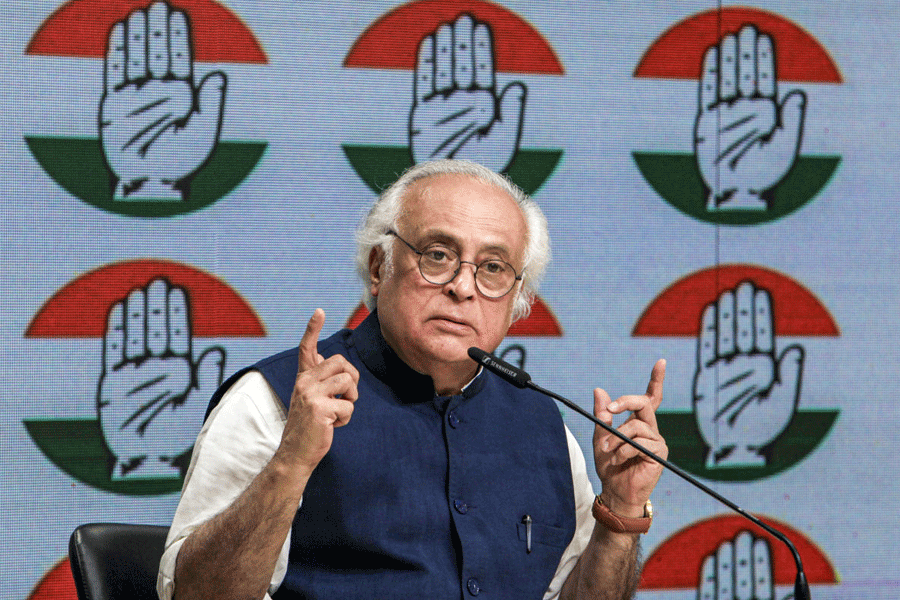
Congress communications head Jairam Ramesh posted copies of the letters on X on Saturday. He wrote: “This is the exchange of letters between the Union Minister of Parliamentary Affairs and the Congress President-LoP (Rajya Sabha) that gives the background to the unilateral decision taken by the Modi Govt to convene a special session of Parliament when the election campaign in Tamil Nadu and West Bengal will be at its peak.”
The Congress has also cautioned the government against a hasty delimitation exercise that might reduce the effective clout of MPs from the smaller states.