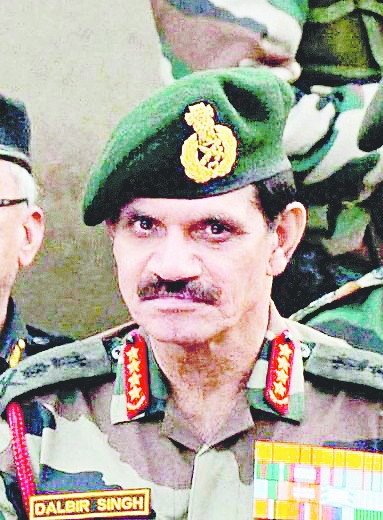

New Delhi, Jan. 13: The fear of foreign military officers and civilians being taken hostage by the Pathankot attackers and the possibility that firefights may make it impossible for aircraft to land and take off from the air base prompted the government to deploy NSG, army chief General Dalbir Singh Suhag said here today.
The attack began on New Year's Day and continued for three days during which seven soldiers and the six attackers were killed.
The army chief said the modus operandi of the attackers was yet to be established, when asked how they could enter the air base despite an intelligence alert of several hours.
"The National Intelligence Agency is still working on how and why it happened. We eliminated four terrorists on the first day, but firing began again from the building where our unarmed men were. Their safety was important," General Singh explained, when asked about the long duration of the encounters.
The deployment of the National Security Guard (NSG), flown in from near Delhi, at the air base and the conduct of operations under it has led to allegations from within the forces of a command failure because the army was not employed in adequate number.
But the army chief today said this did not present the true picture of the encounters that continued from January 1 to January 4. "There was no lack of coordination between the forces in Pathankot. The army troops were commanded by the western commander (Lt Gen K.J. Singh). acting on my behalf," General Singh said.
The operations took the time they did because there were about 10,000 civilians inside the air base. Also, there were 20-odd foreign military officers, some from Afghanistan, for training. The Afghan officers were probably being trained on Mi-25 and Mi-35 Soviet-origin helicopter gunships. India recently gifted four of these ageing helicopters from its fleet to Afghanistan.
Prime Minister Narendra Modi was photographed at the Kabul airport against one of these helicopters during his visit to the Afghan capital last month.
The possibility that the attackers may take civilians and/or foreign citizens hostage and a firefight may make it too dangerous for aircraft to land and take off prompted the Centre to send the NSG. "The NSG is the best force to deal with hostage situations," the army chief said.
At one point during the encounter, two terrorists were in a two-storied building in which there were unarmed Indian soldiers. It took time to evacuate the soldiers. The building was a barrack from which the militants made the last stand. It was blown up by cannon-mounted armoured personnel carriers after the soldiers were brought out.
General Singh also described as wrong "reports that only two columns of the army were deployed" and said there were eight. Each column had 70 soldiers, he added.
Initially, two columns of the army, and a team of the army special forces (para) were asked for, sources in the army said. The deployment was later scaled up to eight and finally to 11 columns, the sources said. "It is easy to say a lot about the way the operation was conducted but the commanders on the ground were given full independence to make the right decisions," General Singh said.
The army chief said all army commanders had been asked to conduct a security audit of their establishments in the wake of the attack.
Asked to speak in the context of defence minister Manohar Parrikar's recent statement - that the forces must inflict pain on those who harm them - the army chief said: "I do not want to comment on any personality but I can tell you that the Indian Army is ready to take any task."
He said that during his visit to Pathankot after the attack, he was shown the attackers' medicines and other equipment with Pakistani markings. "The medicines and the arms make it clear that the terrorists came from Pakistan. We have strong evidence about that."
General Singh said there were lessons to be drawn from the attack but those would await the findings by the National Investigation Agency. "It was a good operation. To ensure less casualties, we had to take time. No casualties occurred during the operation, after the first firefight. The area of contact had to be contained and cordoned so that no one could escape. It was done deliberately to avoid casualties."