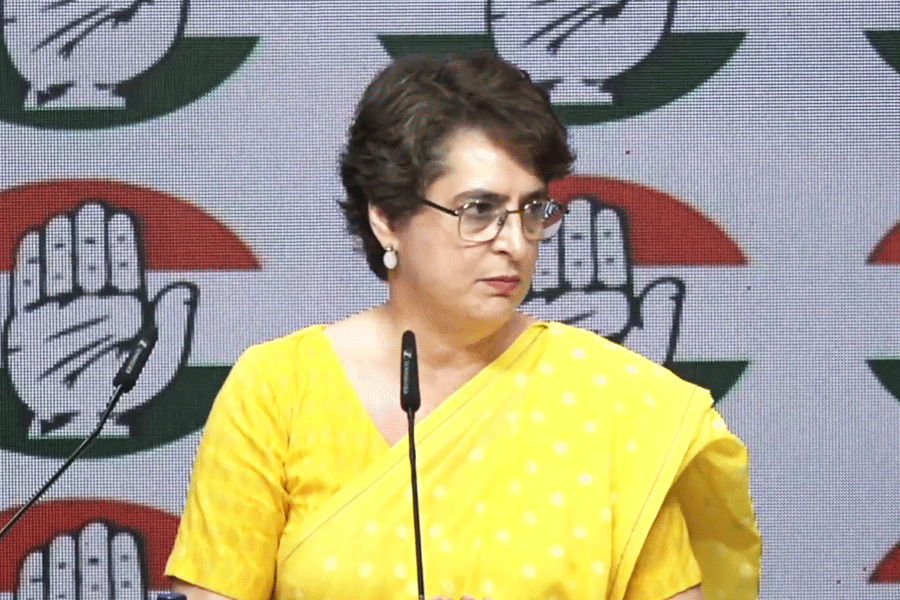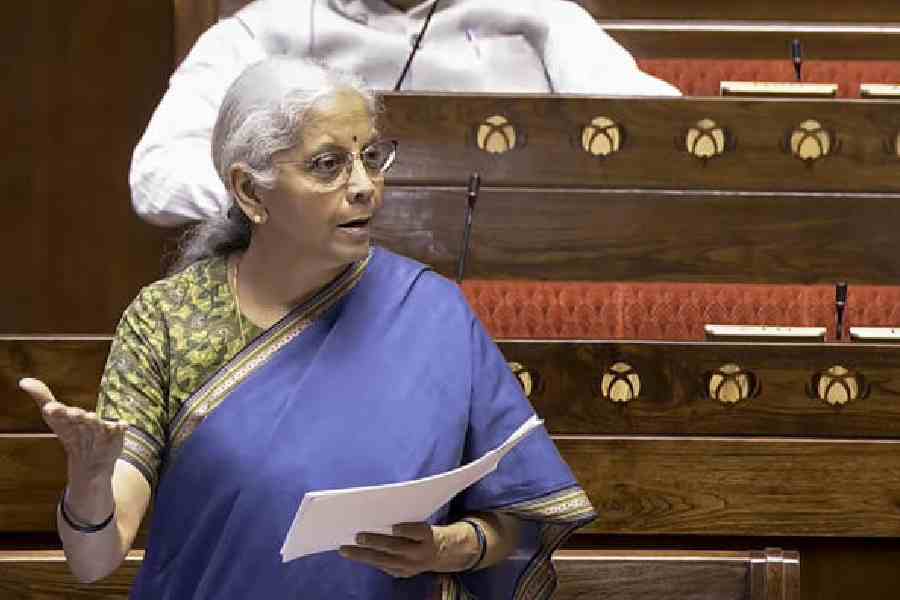
Finance minister Nirmala Sitharaman on Friday ruled out the possibility of a lockdown in the country in the wake of the West Asia conflict, appearing to rebut Bengal chief minister Mamata Banerjee’s comments about such a move in the offing.
Replying to a discussion on the Appropriation Bill and Finance Bill in the Rajya Sabha, Sitharaman cited the examples of Pakistan and Bangladesh and said India was maintaining stability while managing the energy crisis.
Without taking Mamata’s name, Sitharaman asked politicians to refrain from
rumour-mongering and creating panic about a possible lockdown.
The finance minister said there had been a 200 per cent hike in high-octane fuel prices in Pakistan and a 20 per cent increase in petrol and diesel prices. She said a smart lockdown had been announced in Sindh Province to conserve fuel. Schools have been shut in Pakistan, public movement restricted for two weeks, government officers are working for four days, and 50 per cent of private employees are working from home, she said.
“We are not doing any such thing. But some leaders are spreading rumours about a lockdown. There is no scope for a lockdown in India. Leaders should stop spreading such baseless rumours. They say anything to create fear in the minds of the citizens. Where is the lockdown? It is happening in Pakistan. Shopping centres are closing down by 9.30pm in Pakistan. Is there any such thing in India? There is no such situation in India,” Sitharaman said.
Earlier this week, Prime Minister Narendra Modi had warned about the long-term impact of the West Asia war and compared the crisis to the Covid-19 pandemic, fueling speculation about the imposition of a lockdown.
Sitharaman said Bangladesh had shut down universities and switched to online classes in the absence of electricity. Five-hour rotational power cuts have been enforced in Dhaka and fuel stations have been shut due to a shortage of diesel, she said.
“India, among the neighbouring countries, is maintaining a level of stability,”
she added.
She said international crude prices had surged to $122 per barrel from $70 within one month, largely due to disruptions in the Strait of Hormuz. Consequently, petrol and diesel prices have risen by 30-50 per cent in Southeast Asian nations and by 30
per cent in North America, she said.
Sitharaman said petrol excise duty had been cut to ₹3 per litre from ₹13 and diesel duty had been removed with immediate effect from Friday.
“As a result, the petrol and diesel retail prices in India remain completely unchanged. This is to make sure that the volatility does not affect the supply here,” she said.
Petroleum and natural gas minister Hardeep Singh Puri also brushed aside speculation about a lockdown. “Rumours of a lockdown in India are completely false. Let me state this clearly, there is no such proposal under consideration by the Government of India,” Puri tweeted, appealing to the people to remain “calm, responsible, and united” in such a scenario.
Puri claimed that all steps were being taken to ensure an uninterrupted availability of fuel, energy and other critical supplies for citizens, and that the government was fully prepared to handle emerging challenges.
“The global situation remains in flux, and we are closely monitoring developments across energy, supply chains, and essential commodities on a real-time basis,”
Puri said.
The government has decided to increase the allocation of commercial LPG to states to 70 per cent, with 20 per cent meant for steel, automobile, textile and other labour-intensive industries, Puri said.