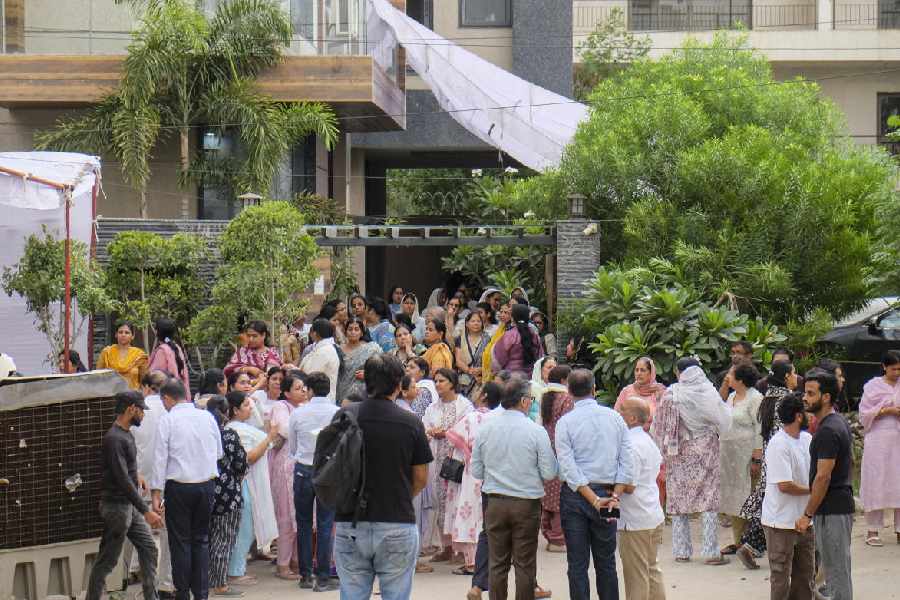
The portraits were arranged in a neat, unbearable row against a backdrop of pristine white flowers at the DLF Community Center in Gurugram on Sunday afternoon. Six faces from three generations of the Aggarwal family looked out at the hundreds who had gathered for their shraddhanjali sabha (prayer meet).
There was Radheshyam, the 76-year-old patriarch; his wife, Premlata; their son, Vivek, a corporate chief financial officer; his wife, Tarjani; and their young daughters, Jivisha and Varya.
Just 11 days earlier, they were all alive. They had gathered from different cities, drawn by deep familial devotion, at the intensive care unit of Max Super Speciality Hospital in South Delhi, where Radheshyam was battling a severe lung infection.
To remain close to him, the family checked into Flourish Stays, a small guesthouse tucked into a narrow, suffocating alleyway in the neighboring settlement of Hauz Rani, right across from Malviya Nagar. It was supposed to be a temporary sanctuary of convenience; it became an inescapable urban coffin.
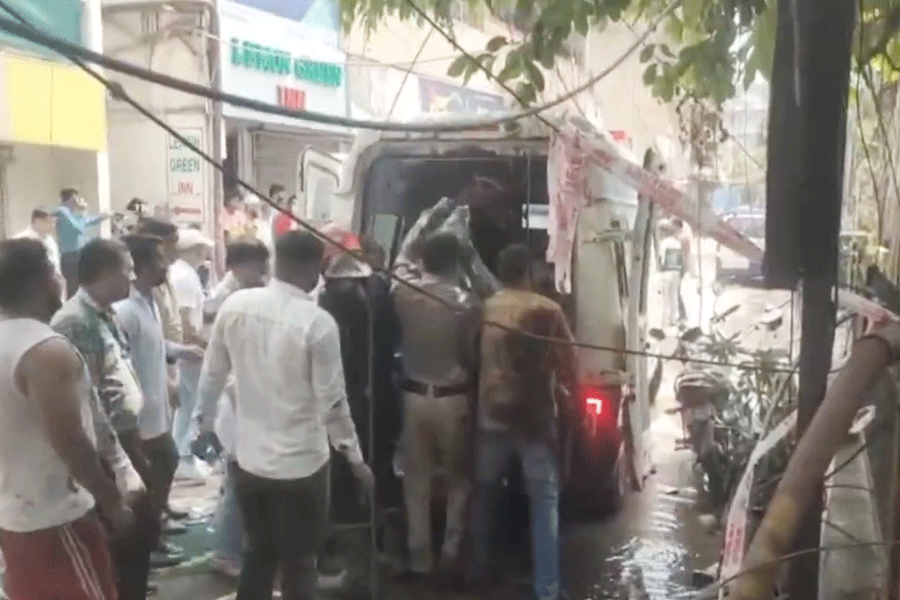
On the morning of June 3, a fire ripped through the commercial building, killing 22 people. The Aggarwals were entirely wiped out.
Radheshyam survived – because he was in the hospital. He passed away days later from his illness, never knowing that his wife, his only son, his daughter-in-law and his grandchildren had perished just metres away.
To protect his fragile heart during his final conscious hours, his surviving brothers spun a desperate, heartbreaking lie: that Vivek was away on urgent business in Jaipur.
For the relatives who filled the community hall in Gurugram on June 14, the grief was sharpened by the clarity of hindsight. Swati Agarwal, Vivek’s sister-in-law, quietly recalled her final happy memory from the evening before the disaster. She had cooked spinach parathas for Tarjani and a potato dish for Jivisha, who had just flown into Delhi from her college in Bengaluru.
"Everyone thanked me so much for the food that night," Swati whispered, her hands trembling. "I didn't know why then. It all happened by chance, but Tarjani was so incredibly happy. She told me, 'I mentioned I liked spinach parathas, and you remembered.' Now, that dinner is all we have left."
The next morning brought a nightmare. At 8:30am, Vivek called his brother, Shyam Sundar Aggarwal, mentioning that the family was heading down to the basement cafeteria for a cup of morning tea. Ten minutes later, the phone rang again. This time, Vivek’s voice was unrecognisable, choking with panic.
"Brother, there is smoke all around," Vivek gasped over the line. "There is a massive fire at the main gate. I can’t get out. The exit shutter on the other side is locked from the outside. Save us immediately. Send the fire brigade."
The brothers abandoned their vehicles in the gridlocked, heavily congested streets surrounding the medical hub and sprinted on foot. When they arrived, the building was an inferno.
Preliminary investigations have since exposed a web of safety violations: The property had a municipal permit for six rooms but had been illegally modified to house 26 tightly packed units. The electronic sensor doors had failed entirely when the power cut out, sealing the guests inside. The upper-floor windows were encased in unyielding toughened glass and decorative iron grills.
"They crammed so many human lives into such a small place without a single exit facility," Shyam Sundar said, describing how he had to help firefighters manually slice open a jammed metal shutter to pull out Vivek's lifeless body for futile CPR.
"The minimal hotel staff—just four people—simply ran away when the smoke started rising at 8am. We had more than enough time to save them if there was a functional alarm, or even a shred of human alertness."
The tragedy has ignited furious indignation at the municipal corruption.
"Obviously, our administration is responsible," said Vikram Agarwal, Vivek’s older brother, looking at the row of floral-draped frames. "The people who took bribes and turned a blind eye are playing with lives. People say our brother was being stingy by staying there. He wasn't stingy. He just wanted to be close enough to run to his father in 10 minutes if the doctor called."
As the ritual incense smoke drifted across the hall in Gurugram, the surviving members of the joint family vowed that their demands for justice would outlast the news cycle.
"The media will forget this in 20 days," Vikram said resolutely. "But we cannot. We are still nine brothers and nine sisters. We are a joint family, and no matter how broken our hearts are, we will stand together. We will never give up."