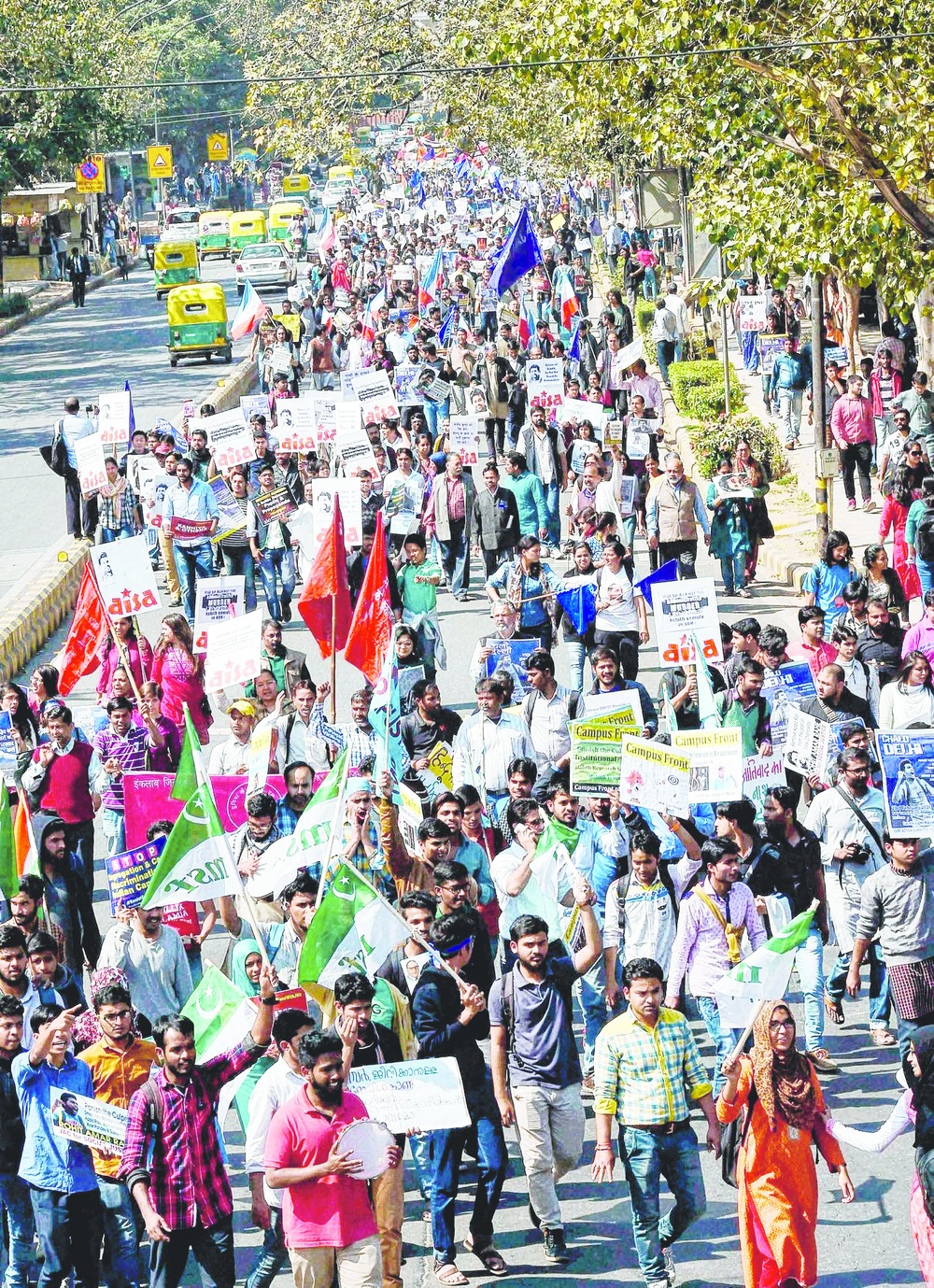

New Delhi, Feb 23: As a marginal farmer from rural Varanasi, Ghanshyam has no direct stakes in students' agitations. He still came all the way to Delhi to participate in what he called an "uprising" to demand freedom from exploitation and caste discrimination.
He used the word " azadi" --- a word meaning "freedom" that the administration recently cited to brand student protesters at JNU "anti-national". It's a word that resonated defiantly along the route of today's march in the heart of the capital.
Ghanshyam, a sharecropper from Ramana village in the Prime Minister's constituency, was concerned that the weak were being further marginalised in today's India.
Young and old, day labourer to banker, transgender to Dalit, filmmaker and foreign visitor joined the Justice for Rohith Vemula movement today, demanding and end to caste bias and the government's crushing of dissent.
The student-organised march in memory of Rohith, a Dalit PhD scholar driven to suicide at Hyderabad Central University last month, started at Ambedkar Bhavan in central Delhi around 11am. It ended at 2pm at Jantar Mantar, more than 2km away, where Opposition politicians addressed the marchers for another three hours.
Hundreds of ordinary people came out to join the march with posters, banners and leaflets opposing government interference in educational institutions.
"This is fascism happening in India. History says fascism has always come under the garb of nationalism," an elderly K.M. Shrimali, former history professor with Delhi University, said.
One slogan seemed common among almost all the groups of marchers.
" Leke rahenge azadi, jaativad se azadi, Manuvad se azadi, fascivad se azadi, punjivad se azadi, Bhagat Singh bola azadi, Subhas Bose bola azadi..." it went.
(We'll wrest freedom --- freedom from caste hierarchies, fascism, capitalism --- Bhagat Singh and Subhas Bose too called for freedom....)

Alleged cries for azadi --- a refrain among Kashmiri separatists --- were a key reason why the government had slapped sedition charges on six JNU students including Kanhaiya Kumar, the only one arrested so far.
While the authenticity of the video that led to the FIR has been challenged, some students have clarified that " azadi" chants can be a call for freedom from oppression in general rather than a championing of Kashmiri secessionism.
If caste bias was the theme of the day, anger at intolerance, racism and the government's economic failures too found voice.
Among the marchers was Nosipho, a visitor from South Africa who teaches biology at the University of Cape Town and wanted to show solidarity with the marchers. She said that black students in South African universities still faced racial discrimination.
"White students attacked black students at the University of the Free State (in Bloemfontein) yesterday. Universities are facing a police crackdown in my country too," she said.
Lopa Rebi Kojun of Arunachal Pradesh, an undergrad at Ramjas College here, highlighted the racial prejudice that students from the northeast face in Delhi. "On the basis of our looks, people here ask us whether we are from India."
As the protesters reached Jantar Mantar, Meera, a transgender, shouted the azadi slogans, explaining: "I face discrimination every day. There's no law to help us live with dignity."
B.S. Butola, a JNU teacher, accused the government of a witch-hunt "with doctored videos" against students and teachers "who oppose their ideology".
Documentary filmmaker Anand Patwardhan, who walked with the marchers, was upbeat. "The Sangh wants to capture young minds, but our country is not going to be raw material for fascism," he said.
"Indira Gandhi tried it and was removed. Modi is trying to do it by capturing the media, but you can't fool all the people all the time."
O.P. Singh, a retired bank official, said it was a "popular uprising" by citizens aggrieved by the government's poor response to their day-to-day problems.
"The price of essentials is very high despite crude oil prices falling," Singh said.
Students from about 30 universities, including all the Delhi-based universities and several in Andhra Pradesh and Telangana, took part in the march.
Congress student arm NSUI will have 20,000 postcards signed in Delhi and sent to the President demanding a new law against caste discrimination, its national secretary, Mausam Baruah, said.
Duntho Prasanth, a friend of Rohith from the Hyderabad university, said the student agitation on various campuses on this issue can only intensify.
At Jantar Mantar, the Congress and the Left attacked the Centre on the first day of the budget session.
"The President's speech (which highlighted the government's accomplishments) today has nothing about Rohith Vemula's death, academic institutions and the agitation in Haryana," Rahul Gandhi said.
Prepared by the government, the President's budget session speech only spoke of past achievement whereas Rohith was fighting for the future of Dalit students, he added.
"We do not want an India where one ideology is imposed," Rahul said.
Delhi chief minister Arvind Kejriwal said the Prime Minister must "mend his ways" or the students would "teach him a lesson".
"What has happened that the youth, who had supported Modi, have risen against him? This government seems to be at war with students of the country," he said.
"The government has started giving certificates of patriotism. For them the biggest patriot is Nathuram Godse and the biggest traitor is Kanhaiya. For them, hoodlums are patriots."
CPI leader D. Raja pledged to go on championing Dalits, tribal communities and the backward classes even if his activities continued being dubbed "anti-national".