The Congress has warned the EU’s carbon tax regime could undercut Indian steel and aluminium exports despite the scale of market access promised under India and the European Union Free Trade Agreement (FTA).
The “hugely-hyped” FTA, announced after nearly two decades of on-and-off negotiations, may also impact India's trade deficit, indigenous EV industry, and export of fuel to the EU, Congress leader Jairam Ramesh said.
“This hugely-hyped FTA is the biggest trade opening India has given to any trade partner (tariff reduction or relief on over 96 per cent of EU exports to India) and it is expected to double India's imports from the EU. Its impact on India's trade deficit will have to be monitored closely,” party’s general secretary in charge of communications Ramesh wrote on X.
A central concern, Ramesh said, was the Modi government’s failure to secure an exemption for Indian exporters from the European Union’s Carbon Border Adjustment Mechanism (CBAM).
“India’s aluminium and steel exports to the EU have already fallen from $7 billion to $5 billion and are only expected to fall further beginning this year due to the enforcement of the CBAM since January 1, 2026. Over time, CBAM will also expand to include other categories of India’s industrial exports and can effectively nullify any gains India secures from the FTA.
The carbon tax, enforced from January 1, 2026, will impose levies on carbon-intensive imports, including steel and aluminium, two of India’s key industrial exports to Europe.
The Congress has also expressed concern over EU's strict health and product safety rules, which will continue over Indian exports even after the FTA and this could lead to unresolved issues surrounding intellectual property rights for India’s pharmaceutical sector.
"This (EU rules) can easily become a non-tariff trade barrier, and the EU has been accused of the same by other trade partners. Questions over Intellectual Property (IP) rights for our pharmaceutical sector are also unanswered. The EU has also claimed privileged access to Indian services market in key sectors like financial services and maritime transport - exceeding India’s commitments with any other trading partner, including the UK and Australia.
According to Ramesh, Indian drug manufacturers could face tighter patent norms that may affect access to affordable medicines.
The inclusion of automobiles in the FTA may also be concerning for domestic producers, particularly at a time when India is attempting to position itself as a global hub for electric vehicle manufacturing, said the Congress.
"The Modi Government opened up India’s automobile sector for the first time ever in its FTA with the UK, and the FTA with the EU only opens up further risk for domestic automobile manufacturers. At a time when Electrical Vehicles (EV) are emerging as one of the most critical technologies of the 21st century, great care will have to be taken to ensure that India’s EV industry is not vanquished."
The final red flag, the Congress said, relates to refined fuels, India’s largest export category to the EU.
Much of this fuel is processed from Russian crude, raising questions over the durability of these trade routes amid geopolitical pressure from Washington to both India and the EU.
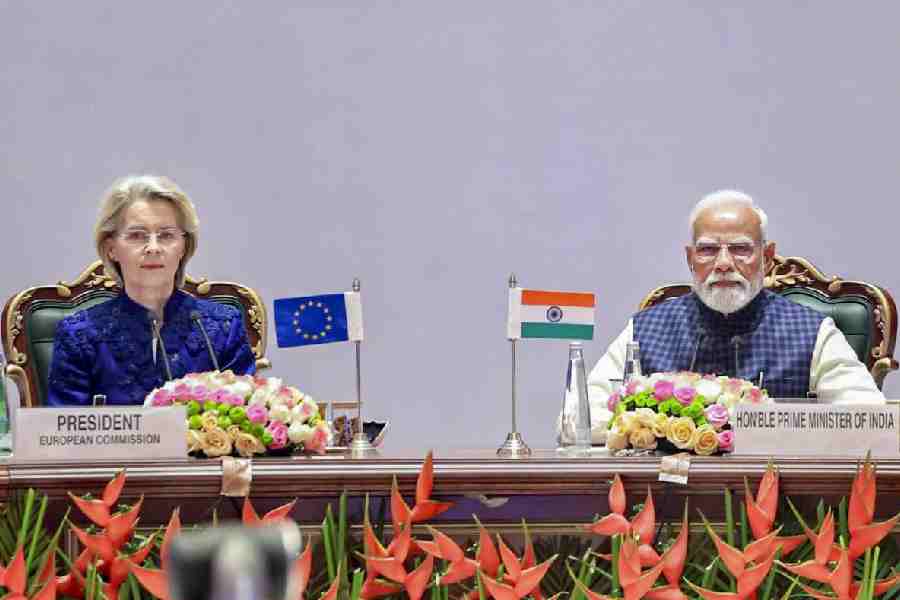
The FTA, announced on Tuesday after nearly two decades of on-and-off negotiations, has been projected by the government as a landmark breakthrough in India’s global trade strategy.
Talks were first launched in 2007. Sixteen rounds of negotiations followed before discussions were suspended in 2013. In June 2022 talks revived once again, eventually resulting in what government officials have called “the mother of all trade deals” between India and the 27-nation European Union.