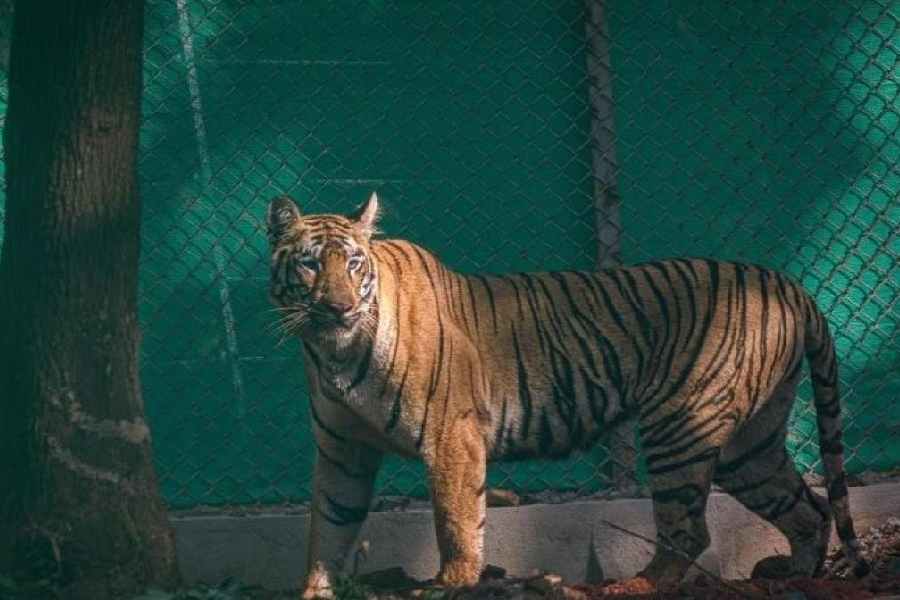
The National Tiger Conservation Authority reviewed measures to tackle human-wildlife conflict and appraised the expansion of Project Cheetah during high-level meetings chaired by Union Environment Minister Bhupender Yadav at the Sundarbans Tiger Reserve on Sunday.
The 28th meeting of the National Tiger Conservation Authority (NTCA) and the 22nd Steering Committee meeting of Project Elephant brought together officials, scientists and field experts from tiger and elephant range states to assess progress and future conservation strategies, the environment ministry said in a statement.
Chairing the NTCA meeting, Yadav stressed the importance of science-based management, landscape-level planning, community participation and inter-state coordination, pillars of what the government describes as India’s globally recognised tiger conservation model.
Discussions focused on challenges faced by tiger reserves, with emphasis on addressing human-tiger conflict through a three-pronged strategy and the project titled ‘Management of Tigers Outside Tiger Reserves’, the statement said.
The meetings also reviewed staff shortages, financial constraints, habitat degradation and invasive species management, and issued directions for follow-up action.
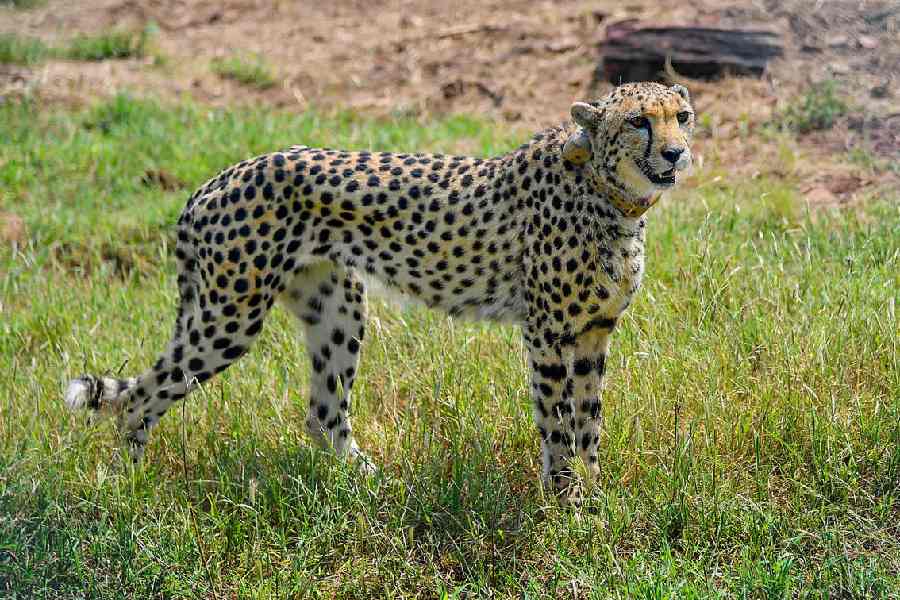
The NTCA ratified decisions of its technical committee, including approval of tiger conservation plans, extension and expansion of Project Cheetah, tiger translocation, prey augmentation, landscape management planning, carnivore health management training programmes and inputs on proposals placed before the Standing Committee of the National Board for Wildlife.
Updates were presented on compliance with directions by the NBW, including expansion of Project Cheetah to Gandhisagar Wildlife Sanctuary and Banni grassland in Gujarat, and the progress of the initiatives supported by the National Compensatory Afforestation Fund Management and Planning Authority (CAMPA).
Preparations for the proposed Global Big Cat Summit were also reviewed.
The minister reviewed ongoing NTCA activities, including progress under the sixth cycle of the All India Tiger Estimation, commencement of ground surveys from November 2025, landscape-level training programmes and international cooperation under Project Cheetah, including visits by delegations from South Africa, Namibia and Botswana.
The Project Elephant Steering Committee confirmed the action taken on decisions of its previous meeting and reviewed regional action plans for elephant conservation in southern and northeastern India, identifying priority areas for coordinated inter-state action.
The committee examined updates on the 'All-India Synchronised Elephant Estimation', progress under the Model Elephant Conservation Plan for the Nilgiri Elephant Reserve and ongoing work on DNA profiling of captive elephants, with emphasis on strengthening scientific management and welfare standards.
A comprehensive review of human-elephant conflict was undertaken, including findings from studies on conflict drivers and mitigation measures, and the status of compensation mechanisms adopted by states.
The committee also discussed evaluation of elephant population estimation methods, conservation strategies for the Ripu-Chirang Elephant Reserve and future action plans, including management effectiveness evaluation of elephant reserves with CAMPA support and a proposed study on elephant corridors and conflict hotspots in the Bandhavgarh region.
On the occasion, Yadav released six publications, including reports and journals on Project Cheetah, the sixth cycle of the All India Tiger Estimation, India's tiger conservation framework, biodiversity in tiger reserves and best practices in captive elephant management.