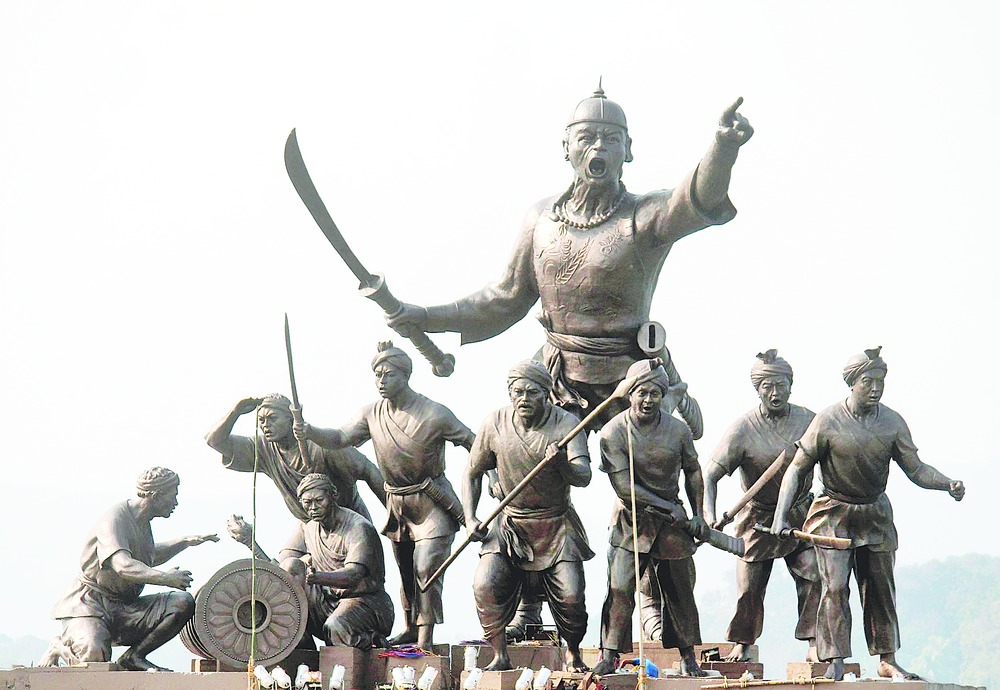


Guwahati, Jan. 30: Assam Tourism Development Corporation (ATDC)'s ambitious re-enactment of Lachit Borphukan's feat against Mughal siege during the Battle of Saraighat in 1761 by building a 35-foot bronze statue of the Ahom general has drawn flak for showing people the wrong side of the story and quite literally so.
In effect, people travelling upstream of the river (and there are quite a few luxury yachts doing the trip upstream from Calcutta, through Guwahati and Kaziranga right up to Sadia in Upper Assam these days), will for all purposes see the posterior of Borphukan and those who fought alongside him, rather than a national hero who led his men to victory in one of the greatest river battles ever.
Borphukan had, during the reign of Ahom King Chakradhwaj Singha, led an army from Kamrup (now Guwahati), which is on the south bank of the Brahmaputra, and thwarted the Mughal army, commanded by Ram Singh I of Awadh, assigned by Mughal emperor Aurangzeb. The Mughal army had been assigned from Dhaka and had set up a camp on the north bank of the Brahmaputra at Hajo, now in Kamrup district of lower Assam.
To re-enact this historic battle, the ATDC had in 2011 decided to build the bronze statue of Borphukan, eight 18-foot statues of Ahom soldiers and two 32-foot cannons over a concrete pedestal in the Brahmaputra river near Machkhowa here. After several delays, the sculpture installation work began in November last year.
Trouble though is that all the statues, and a cannon, face inward towards Guwahati city and not how it must surely have been - outward - with Borphukan leading the charge against the enemy in the epic battle.
"It's a testimony of errors," said social activist and former teacher of English at Cotton College, Deven Dutta. "The direction the statues have been placed in shows that chief minister Tarun Gogoi, who will inaugurate the monument tomorrow, and his administrative bandwagon have no knowledge of history. How can the people who are running the state make such a silly mistake?" he asked.
"This should have been obvious. The statues should have been facing the river," said Sheila Bora, former head of the department of history at Gauhati and Dibrugarh universities and a former teacher of history at Harvard University.
Pointing out some other flaws, Dutta said, "The dress worn by Lachit Borphukan in the statue is the traditional dress of South China. The people of Assam used to wear those dresses in the 16th and 17th century but history has it that Borphukan had worn suria, the dhoti-like dress of Assam, during the battle. Also, the facial expression isn't one of valour but has a demonic appearance."
Renowned dramatist Arun Sarma said the positioning was "obnoxious".
"Every kid in Assam knows that Lachit Borphukan led an army from here to fight the Mughal army in North Guwahati. How could they get this basic thing wrong?" he asked.
The pillar over which the statue was erect was built by the construction company Gammon India while the statue, designed by master sculptor Biren Singha, was made by the ATDC.
"I wanted to re-enact the war zone with Borphukan fighting along with his generals. The direction has nothing to do with it," Singha said when asked why the statue was facing the wrong way.
The ATDC defended criticism by reasoning that constructing the statue was a drive by the department to promote tourism. "We want to promote this statue as a tourist attraction for those who will visit Guwahati," said Prabhash Sarma, the ATDC engineer who is looking after the project.
"It might not be historically correct," he concedes, "but those who will be seeing the statues from Guwahati will get to see the tallest statue of the Northeast. They should have the front view of the statue," he said.
Asked why the department could not make the statues face the right way - front - and build a ramp around it for people from the bank to go around and get a view of it, Sarma held "lack of funds" responsible for the lacuna.
Jahnvi Phukan, director of Jungle Travels which runs three cruise ships on the Brahmaputra, without delving into the criticism said, "I think the tourism department had a bigger picture in mind while constructing the statue. Technically the statues should have been facing the river, but the government meant well. What we need perhaps is a sound-and-light show to show the battle of Saraighat."