 |
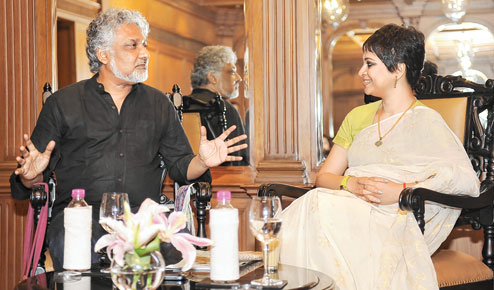
| Kunal Basu and Churni Ganguly at The Chambers, Taj Bengal, for An Author’s Afternoon on Tuesday. Pictures: Rashbehari Das |
He is deep into writing his sixth book, one that is taking him to a Calcutta he never knew. In between discovering this “city of strangers” and packing his bags to go back to Oxford University to teach business management for another semester, author-academic-hidden actor Kunal Basu got talking with a bunch of Calcuttans on Tuesday at An Author’s Afternoon, presented by Shree Cement along with Prabha Khaitan Foundation and Taj Bengal, in association with the Jaipur-based literary consultancy Siyahi.
Churni Ganguly: The first time I saw this man was on screen actually, when I was mesmerised by the play of kites against the blue sky, in The Japanese Wife. It is a very lyrical film made by Aparna Sen out of a short story written by Kunal Basu... and there he stood in the crowd. How was that experience?
Kunal Basu: As an actor? Well, it was a very hot afternoon in Kalighat and I remember there was complete mayhem! Assistant directors were screaming, the crowd was peeping into the cameras, Aparna Sen was losing her temper…. Suddenly she told me, ‘Why don’t you go and change?’ That’s when I knew I was in for some trouble. She asked me to do this role of knocking into Rahul [Bose]. Now, this man is a rugby player. So, I told him, ‘I get to knock you but you don’t get to knock me back’!
Churni: The way you express yourself in your literary creations is you use words to paint a picture, to make us see what you want us to see… like [Dante Gabriel] Rossetti or [William] Blake or Aban Thakur [Abanindranath Tagore]…
Kunal: I get this question a lot. Recently I was in Australia for the Perth Literary Festival and a gentleman in the audience asked, ‘Do you write for cinema?’ I said, ‘Well, I don’t write directly for cinema…’ I write pretty much for myself, to please myself. Because I have a very boring life! Academics have desperately boring lives. But each of us has different senses that are strong. Some people have a strong smell memory, some have a good hearing memory… like musicians. Madhur Jaffrey told me that she has taste memory. For me the most important sensation is sight. I have to see the story unfolding before me as a film before I can actually write. Which is why I’m always in the company of film people (laughs)!
Churni: I would say he’s genetically programmed to write. He’s born of a father who was a publisher and a mother who was an author…
Kunal: …and an actress!
Churni: So you can see, he would write! But he’s actually the jack of all trades and the master of many… because he was also a child actor...
Kunal: But my mother ruined my acting career! I was an actor for Mrinal kaka’s (Sen) Punascha and Abasheshe. After that, Satyajit Ray asked me to do a role for him in Kanchenjungha. That little girl in the film was a little boy in the story. But I was very sickly as a child, I spent long months in bed while the others were in school. So my mother said no to Satyajit Ray. I used to give her grief saying, ‘You ruined my acting life with Satyajit Ray. Just imagine how good that would have looked on my book jacket!’
Churni: Then there was theatre. You trained under Utpal Dutt…
Kunal: Yes, in People’s Little Theatre. That was a brief period when I was unemployed. I had come back from America after I finished my Masters [in engineering] and I had no clue what I would do. I did not want to do the boring 9 to 5 thing, so I started writing film reviews and book reviews. But in those days one was paid like Rs 40 for a review, and with that you couldn’t keep body and soul together, you couldn’t date anybody.... So I acted with PLT for two seasons and then decided that I needed to have a profession which would be least destructive of the arts.
It was a clear, strategic decision. Remember, we’re not talking of the brave new India of the 21st century, when people can have careers in the arts… thank God for that! In the ’70s and ’80s, you either became an engineer or a doctor or you died on the streets.
 |
Churni: So you did a Masters in engineering just so that you could date someone?!
[Everyone bursts out laughing]
Kunal: Well, it was a funny decision. Because after I finished my bachelors in engineering, which was a mistake to start with, I had no clue what I would do. I usually am clueless about the next step in life! I had a scholarship to do a Masters in the US. And I said, ‘Look Kunal, you are a middle-class Bengali boy in Calcutta, who is going to give you money to travel around the world? Nobody!’
Becoming an academic gave me control over my time, partly. As you can see I am here while Oxford University goes merrily along…. But you know, when I wrote my first novel [The Opium Clerk], I was a junior academic and there were many more demands on my time — publishing academic papers, Phd students etc — I used to be at the university all day and then write all night. And I thought I could do this. Except, writing is the mother of all addictions! Now, I don’t want to go to a class, I don’t want to go to a Phd examination. I don’t want to see the sight of Oxford University. I could get into trouble for this (grins) but all I want to do is get up in the morning and write all day.
Because your art changes the way you are inside. In the six books that I have written in 10 years, it has made me an entirely different person. My wife [Susmita] will vouch for it but I was a more interesting person before I started writing books. I had an interest in so many things… I could talk about Mohun Bagan. These days, I only think and write and talk about my books.
Churni: Would you say you live in that world for the time that you write the book?
Kunal: Stanislavski, the famous theatre director, coined the phrase “method acting”... that you had to live that role, live that life to bring it out. I remember when I was writing The Miniaturist, which was set in Mughal times, my entire palate changed.
I would only have kebabs and biryani… I put on weight! I would listen to a lot of Nusrat Fateh Ali Khan, travel to eastern Turkey, Iran and other such places.... But at the end of it, there is sadness. Because I need to leave that world and walk away. And I would never write sequels. So there is an element of immersing yourself in that world, which you have to do with caution. The novel that I am writing now, the protagonist is a gigolo and I have no interest in joining the profession!
Churni: The Japanese Wife, The Yellow Emperor’s Cure, The Opium Clerk... what is it about the Orient that attracts you?
Kunal: Hemendra Kumar Roy. We grew up on Jokher Dhon, Abar Jokher Dhon… He had these amazing stories about piracy in the South China Sea. And about drugs and opium stored in warehouses along Kidderpore. When I was young and was asked what I wanted to be when I grew up, I’d say one of three things — Charlie Chaplin, a Tibetan monk or a smuggler. Because the heroes in Hemendra Kumar Roy’s novels for kids were smugglers, who took daring risks on the South China Sea!
Churni: So, what is your new novel about?
Kunal: It is set in Calcutta, in the present times. All my previous novels were historical novels and this is a departure. It’s as recent as the
May 13, 2011 elections. There’s a high possibility that I will have to seek exile when the book comes out [laughs out loud]. Bangladesh is a possibility.
Usually I don’t talk about a book that I am writing… but this much I am prepared to say that the novel is about Calcutta, this strange place that we call a city. It’s a city of strangers, it’s a city of people who have nothing to do with each other, who have grown up differently, whose worlds are different and it’s only coincidental that they are coming into contact. And this novel is really about when these strangers come into contact with one another, sometimes in conflict, sometimes in love… and lust.
My protagonist is a male sex worker. They don’t say “gigolo” anymore, they say “male sex worker”. We see Calcutta through his eyes, it’s written in the first person. And he could be in this room! He could be anywhere. And one may engage in all sorts of relations with him, not necessarily a transactional one. And through his eyes we see this city… a city that we think we all know.
 |
| Adda between Bhooter Bhobishyot maker Anik Dutta and Kunal Basu continued well after the session! |
Churni: There must be things from your childhood that you still relate to when you come to Calcutta, or things that you miss?
Kunal: You know, Calcutta has never left me. There was a phase when my face had turned away from Calcutta, for a variety of reasons, some personal, some that had to do with the city. And now I have fallen in love with Calcutta again. I mean serious love. And when you fall in love when your hair is greying, it’s a desperate kind of love. You love it to death, which is what I do now. I love Calcutta to death.
To me it is the most fascinating place on earth. There’s a line in this novel… ‘Kolkata has the richest turmoil in this world’. And because it has the richest turmoil, it has people like you… and others in the audience. I was recently in Australia and my agent was trying to get me to do a book talk in yet another city and a gentleman from that city said, ‘We have wonderful agriculture. We’ve got wheat, barley, then we have livestock, fish…’ I said, ‘Then what need do you have for literature?!’
We need literature here as if it was our lifebreath. We need cinema as if it was our lifebreath. Last night I went to see Shabdo and I was left inspired. I felt that I have hope. If Kaushik Ganguly [Churni’s husband] has made this film, there is hope for us. I feel inspired by Tony’s films. I feel inspired by Anik’s [Dutta] films. You know, that’s what I grew up with… sibling arts. It was a world of people excited by the arts, excited by culture, by politics and who believed that they could change the world.
Churni: Do you think that’s still here?
Kunal: One finds one’s place, one finds one’s people in Calcutta… which again, is a city of 18 million people, and 54 per cent of Calcutta’s population is non-Bengali. In my novel, this woman from Keyatala, south Calcutta, says, ‘I thought everybody in Calcutta went to Presidency College or Lady Brabourne and read Jibanananda Das and TS Eliot’. NO! A very large portion of Calcutta’s population is in places like Chitpur and Zakaria Street and Burrabazar. Burrabazar is the largest trading district not just in India but in Asia, its turnover is more than the city of Bangkok! That’s a part of the city we live in and it rarely comes into our world. And through this novel that I am writing I am trying to understand and describe this indescribable place.
 |
MADHU NEOTIA: Writers feel aggrieved when their books get translated into movies and it is not the way they had seen the story… did you feel the same with The Japanese Wife?
Kunal: I didn’t feel aggrieved at all. There are a couple of reasons for that. With the filmmaker [Aparna Sen], there was a correspondence at the level of sensitivity. A book and a film are not the same thing, they cannot be. A film is not just a story, it’s a filmmaker’s take, a filmmaker’s leap using a certain narrative framework. And I don’t begrudge any filmmaker who does that. I would be excited if the filmmaker took just a gist of what I had written, not the whole story and like a classical musician, does bistaar on it. I would be curious to see what happens when my small little creation enters into somebody else’s mind. So my starting point is not one of antagonism. I had this conversation with Salman Rushdie once, who felt ‘Midnight’s Children is mine, how can I ever let anybody intrude into that world?’ But it’s not about intrusion, it’s about co-creation. Authors tend to be protective, I am not, I am open to all this. And so that helps.
 |
SUNDEEP BHUTORIA: You have been going to places like Zakaria Street, Burrabazar... for your new book. Is it the first time that you are going to these areas or are you revisiting these places?
Kunal: I am a middle-class Bengali boy who was born on the floor of his parents’ library, accidentally, in north Calcutta. And then I grew up in south Calcutta... so what reason would I have to go to Chitpur or Zakaria Street or Colootola? I remember only going to Chitpur to buy manja before Vishwakarma Puja, and once to impress a girl in college... I went to buy itar. And she was very impressed.
My protagonist is a Bihari Muslim who grows up on Zakaria Street… but I didn’t know Zakaria Street at all. During last year’s Jaipur Literature Festival, you had invited me to your house in Jaipur and there I met this Marwari gentleman. Just to make conversation, I asked him where are you from? It turned out he was from Zakaria Street! And this gentleman, Jai Govind Indoria, has become my guardian angel in Zakaria Street. It is not an easy area to navigate. He’s taken me to all these old houses lived in by Baghdadi Jews and Armenians, then a place called Jhagra Kothi.... For me it’s been an exploration. You see, research for a contemporary novel is different from research for a historical novel. In many ways, researching for a historical novel is easier. In that regard, this novel has taken me out of my comfort zone and taken me to parts of Calcutta that I have never been to. I have had to seek help from the police. I have had to be in situations where I could have been arrested. But it was fun!
 |
SAIRA SHAH HALIM: In The Japanese Wife, it was devastating to watch a love which was so full and at the same time unconsummated.... Did you know of a love like this or was it your imagination? I must admit I cried when I read the book...
Kunal: The most difficult question for me to answer is, why did you think of this story? This is how it happened. About 25 years ago, when I had no interest in writing and I was a political activist from the Left, I was out in a village with a fellow comrade. He pointed out a man and said, “Do you see this man? He has a Japanese wife”. In a city like Calcutta or any urban place it is not unusual to find somebody who has a foreign spouse. But in a village in Bengal?! That too a Japanese wife!
But to my credit, and good fortune, I never asked any follow-up questions. ‘How did they meet? Does he speak Japanese? Does he go to Japan, does she come, do they have kids, what language do they speak?’
Twenty-five years later, on an evening of snowstorm in Montreal, I sat at my desk and wrote the story of The Japanese Wife.
 |
ANIK DUTTA: Since you say that you view things cinematically when you write, are you planning to or open to writing a screenplay?
Kunal: I would love to, but there is a major limitation... I am a careful writer, it takes me time. I am always making up stories and many of these I think are in my eyes, I see them as cinema.
We will use this difference: A full-length novel is like an affair, a serious affair that engages the heart. And it should last about two years — great if it lasts more — otherwise it’s not worth the effort. A short story is a one-night stand. When I think of a short story I can sense having this fleeting excitement. A film is fascinating because it has both. It has the excitement of a one-night stand and it has the tug of a full-length novel, an affair.
I would love to write cinema, a screenplay, but cinema has so many imponderables. If I write a book, the book will be published, it will come out and I have multiple book deals in every continent. But if I think of a story and I invest my passion into it, despite the director and producer’s best intentions it may never see the light of day. That’s like losing a child.