 |
 |
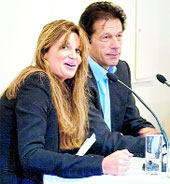
| Imran Khan and ex-wife Jemima at the Blenheim Palace in Oxfordshire; (below) Imran signs copies of his book Pakistan: A Personal History for fans at the event. Pictures courtesy: Independent Woodstock Literary Festival |
Imran Khan’s transformation from playboy of the eastern world to Pakistan’s president-in-waiting has been remarkable. This has been apparent over the last week or so, as he has toured Britain, promoting his book, Pakistan: A Personal History. Even the BBC’s heavyweight Andrew Marr Show on Sunday morning from the annual Liberal Democrat conference in Birmingham found time for Imran. Later in the week, he gave a very assured performance talking to students at the London School of Economics on everything from Islam to why the Americans should get out of Afghanistan.
The highlight was his entertaining appearance at the Woodstock Literary Festival in Oxfordshire, where Imran was “in conversation” with his ex-wife, Jemima Khan, who later confessed that she had found the experience “odd”.
The setting for the interview could not have been more romantic. Jemima’s session with Imran was held at Blenheim Palace in Oxfordshire, a breathtakingly beautiful country house more than 300 years old that has been the family seat of the Dukes of Marlborough.
Imran looked smart in a dark blue suit but did not wear a tie which is currently the fashion (even among BBC broadcasters), while Jemima looked pretty in a black jacket, casual grey top and jeans tucked into boots. Their body language as they sat next to each other at a table was polite but formal. A reconciliation is ruled out.
Jemima was only 21 and probably besotted with 42-year-old Imran when they married in 1995. Jemima’s billionaire father, Sir James Goldsmith, ultimately accepted his daughter’s choice, with the reported comment: “He will make an excellent first husband.” Goldsmith is the man who had observed: “When you marry your mistress, you create a job vacancy.”
He certainly had married his mistress, Lady Annabel Vane-Tempest-Stewart, who became his third wife and gave birth to three children, of whom, Jemima, born in 1974, is the eldest.
Though born into the Jewish faith, Jemima converted to Islam, attempted to learn Urdu, helped Diana travel to Pakistan (when the Princess was trying to ingratiate herself with the family of Hasnat Khan, a Pakistani surgeon in London) and set up small embroidery businesses to help local tribeswomen. In every way she appears to have been the perfect wife. But the marriage did not work, possibly because her life in Pakistan became claustrophobic, while Imran drowned himself in running the cancer hospital named after his late mother, Shaukat Khanum, and in his political ambitions.
They were divorced in 2004 but bringing up two sons, Sulaiman Isa and Kasim, aged 14 and 12, has persuaded them to remain on cordial terms. Jemima, now 37, had a well-publicised romance with the actor Hugh Grant but the relationship fizzled out (as it also did with Grant’s previous relationship with Elizabeth Hurley, who later dumped her husband, Arun Nayar, for Shane Warne).
Imran, who is 58, has convinced himself on the strength of polls that his Tehreek-e-Insaf party will triumph at the next elections. Whether that happens remains to be seen but Imran certainly commands the attention of the British media, a legacy from his youthful days in London when he had a string of gorgeous girlfriends.
For a man who read PPP at Oxford, Imran’s vocabulary when it comes to describing Asif Ali Zardari is surprisingly limited — as far as the former cricketer-turned-would-be-saviour of Pakistan is concerned, the president is “the biggest crook in the country”.
As for Jemima, who is intellectually more than a match for Imran, she has evolved into a slightly less aggressive version of Arundhati Roy, taking up causes such as opposing the extradition to Sweden of the WikiLeaks founder Julian Assange on rape charges. She completed her English degree at Bristol University, which was interrupted when she married Imran, and also did an MA in Islamic societies and cultures at the School of Oriental and African Studies (SOAS).
As a freelance journalist, she has written regularly for British national newspapers and is currently an “associate editor” at The Independent. When General Pervez Musharraf locked up political opponents during his period of emergency in Pakistan in 2007, it was Jemima who successfully led the campaign to free Imran.
There will be “his/hers” books on Pakistan from Imran and Jemima, since she is writing one, too.
“Imran Khan provides a unique insider’s view of a country unfamiliar to a western audience,” is how his book is billed. “Woven into this history we see how his personal life — his happy childhood in Lahore, his Oxford education, his extraordinary cricketing career, his marriage to Jemima Goldsmith, his mother’s influence and that of his Islamic faith — inform both the historical narrative and his current philanthropic and political activities.”
Perhaps Imran can return the favour and conduct a matching “in conversation” with his lovely ex-wife when her book comes out. Jemima’s book on Pakistan “will be accessible and anecdotal, a witty and revealing portrait of a country at the febrile epicentre of world affairs,” according to her literary agent.
During the decade Jemima was married to Pakistan, “she came to know and love Pakistan, ‘the land of the pure’, in all its bewildering complexity and contradictions. In this book she revisits the country she got to know in the 1990s, undertaking a journey which begins in Lahore, moves north to Peshawar and Islamabad, and then heads down to Karachi. Along the way she encounters a dazzling array of people — the ordinary and the extraordinary — who illustrate the paradoxes of this remarkable country. Pakistan encompasses 165 million people, several hundred tribes and more than a dozen languages and is a very different place from the land of bearded zealots and military dictators of western stereotype.”
So how should Imran begin his “in conversation” with Jemima? How about, “That’s enough of me talking about myself and how I am going to fix all the problems of Pakistan, Jemima. Now, you can talk about me and how I am going to fix all the problems of Pakistan”?