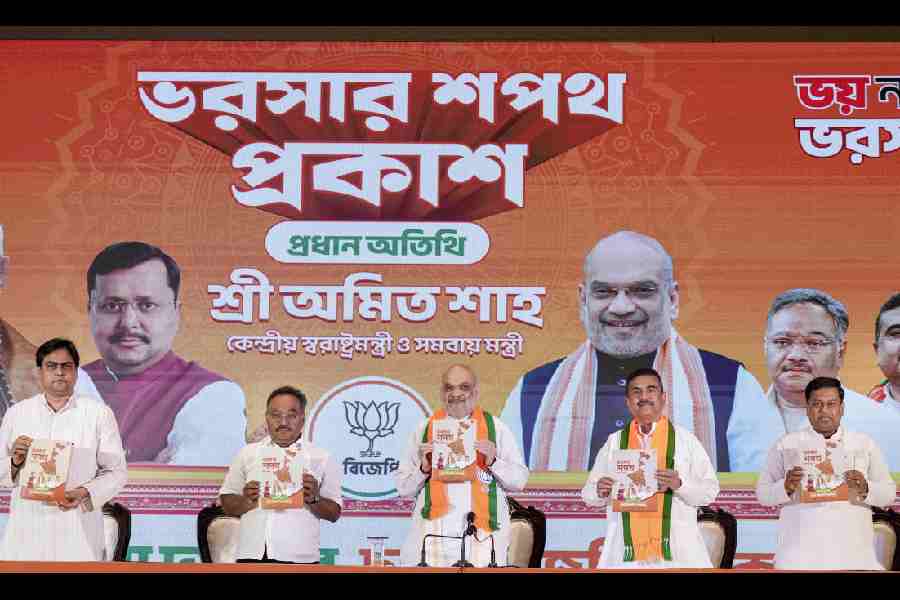
It was the politically charged surprise not many had seen coming in the BJP’s Bengal manifesto. Unveiling it with a flourish, Union home minister Amit Shah announced that a Uniform Civil Code would be introduced if the party won the elections, a proposal that had not figured in the campaign until then.
Shah and Prime Minister Narendra Modi quickly shifted into hard-sell mode, pitching the Uniform Civil Code as a major boon for Bengal’s voters and a reform whose time had come.
Bengal chief minister Mamata Banerjee lost no time in mounting a counter-offensive. At an election meeting in Jhargram, she warned that the Uniform Civil Code would deprive tribal communities of their religious freedom, sharpening the political stakes instantly.
The Uniform Civil Code has long been one of the BJP’s and the Sangh parivar’s core ideological themes, and its renewed prominence is no accident. For supporters, it represents a step towards a Hindu Rashtra; for critics, it raises deeper questions about intent and scope.
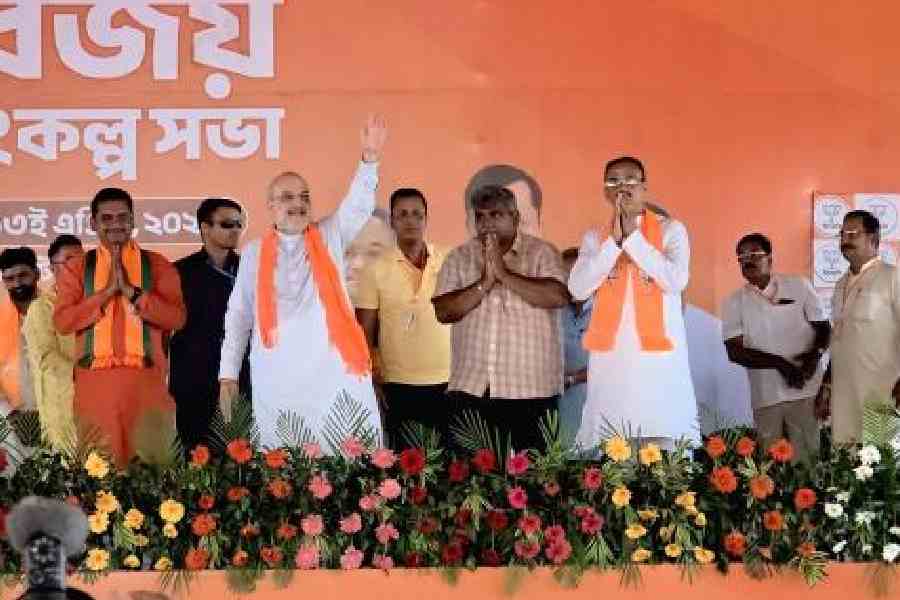
The push in Bengal is not happening in isolation. It comes amid a broader, state-by-state strategy. In Madhya Pradesh, the Mohan Yadav government is attempting to roll out a Uniform Civil Code by next Diwali, signalling that the party is keen to advance the idea across the states it governs.
If Yadav succeeds, Madhya Pradesh will become the third BJP-ruled state to implement the Uniform Civil Code. The idea has consistently been viewed with suspicion by minority communities, and with a measure of scepticism even among Hindus who are not aligned with the Sangh parivar.
Only last month, Gujarat became the second state to pass its own Uniform Civil Code, nearly a year after Uttarakhand, which led the way and effectively served as the BJP’s testing ground for how such a law might work in practice.
Yet, even as the party pushes ahead, there are notable omissions. What the BJP has done in Uttarakhand and Gujarat, and what it is likely to do in Madhya Pradesh, is sidestep the Hindu Undivided Family (HUF). The status quo remains, ensuring that the financial advantages available to the party’s core voters stay intact even as broader changes are proposed.
The HUF, a tax-saving entity, was incorporated into the Indian taxation system by the colonial government in 1922 and later retained in Independent India’s Income Tax Act of 1961. For many families, it has long been a vehicle for managing wealth, inheritance and tax liability.
To understand what is at stake, it is worth stepping back. For centuries, Hindu personal and inheritance laws have been governed by two major schools of thought, both based on the commentaries interpreting the ancient legal text Yajnavalkya Smriti, which lays down rules for social conduct, law and governance.
The Mitakshara school, a commentary by Vijnaneswara of the Kalyani Chalukya court, is followed across much of north, west and south India, though regional variations have emerged over time.
In the east, particularly in Bengal, the Dayabhaga school, written by 12th century scholar Jimutvahana, holds sway.
The divergence between the two lies in their interpretation of joint family and coparcenary, or joint heirship, and the implications are far-reaching.
Inheritance, property division, gifting of assets, wills, the creation of trusts and the partition of a Hindu undivided family are all governed by these principles, which remained uncodified for centuries until the British stepped in.
At the centre of this structure is the Karta, the head of the HUF, who manages family assets and investments and represents the family in legal matters as the guardian of the property.
A key distinction between the two schools underscores how differently these systems operate. The Dayabhaga school, followed by most Bengali Hindus, grants ownership rights to sons only after the father’s death. Under the Mitakshara system, those rights accrue by birth.
There have been attempts to dismantle or dilute this framework. In 1975, Kerala enacted the Joint Kerala Hindu Family System (Abolition) Act, significantly limiting the role of HUFs for residents of the state in income tax matters.
Alongside this, another pattern is visible in the BJP’s approach. Tribal communities have been kept outside the ambit of the Uniform Civil Code in Uttarakhand and Gujarat.
In Assam, too, the party has promised similar exemptions if it returns to power.
The Uniform Civil Code laws in Uttarakhand and Gujarat, crafted specifically for those states, focus largely on marriage-related issues. They mandate compulsory registration, seek parity in divorce rules across communities, and prohibit bigamy and live-in relationships.
The more complex issue of inheritance has been addressed by granting equal rights to sons and daughters across religions., a move presented as a step towards gender equality.
Critics, however, are unconvinced.
“The BJP keeps talking about the UCC to use it as a political weapon. In states where it has been implemented, it largely goes against minority communities. This practice itself is in violation of the Directive Principles,” said a Delhi-based political analyst. “State-level UCCs are ineffective. The BJP is introducing them where it is in power to keep the issue alive.”
The debate, itself, is not new. When the Constitution was being drafted, both B.R. Ambedkar and Jawaharlal Nehru supported the idea of a Uniform Civil Code as a way of ensuring equality before the law. But opposition from conservatives across religions forced a compromise. The code was placed in the Directive Principles of State Policy under Article 44, making it an aspiration rather than an enforceable right.
Decades later, the issue remains unsettled. During Prime Minister Modi’s first tenure, the 21st Law Commission headed by Justice Balbir Singh Chauhan revisited the question and struck a cautious note.
“The formation of a Uniform Civil Code is neither necessary nor desirable at this stage… mere existence of difference does not imply discrimination, but is indicative of a robust democracy,” it observed.
Instead, the commission recommended reforming family laws within each religion as a way of achieving gender parity, rather than creating a single overarching rule.
HUF flagged as tax-avoidance tool
It also turned its attention to the HUF, flagging it as a mechanism often used for tax avoidance.
“It is high time it is understood that justifying this institution on the ground of deep-rooted sentiments at the cost of the country’s revenues may not be judicious,” the commission said, while recommending its abolition.
The 22nd Law Commission initiated fresh consultations with stakeholders, including leaders of various religious organisations, but its tenure ended in 2024 before it could submit a report on the Uniform Civil Code.
In the absence of a national framework, the political contest has shifted to the states, and the criticism has sharpened. Several lawyers argue that the versions of the Uniform Civil Code introduced in BJP-ruled states are tilted against certain communities, particularly Muslims.
Bhopal-based lawyer and Congress leader J.P. Dhanopia said the BJP would not act against the HUF. “Their main aim is to segregate the minorities,” Dhanopia told The Telegraph Online.
Public interest lawyer Prashant Bhushan agreed that the need for a Uniform Civil Code was not in dispute, but stressed that the manner of its implementation was crucial.
“Hindu laws are not uniform. The priority should be to reform Hindu laws first. Any UCC must be uniform, liberal, non-discriminatory and fair to all religions,” Bhushan told The Telegraph Online.
Delhi-based senior advocate Sanjay Ghose raised a similar concern, questioning the design of the laws emerging in BJP-ruled states.
“How is it uniform if tribal communities are exempted? Can the BJP touch the HUF? It seems these versions of the UCC are only targeting Muslims,” Ghose told The Telegraph Online. “The BJP is bringing a code that is convenient for it.”
Asked if a civil code can be called uniform without abolishing the HUF, Bengal BJP president and Rajya Sabha MP Samik Bhattacharya evaded a direct answer.
"The context is different in all the states,” Bhattacharya told The Telegraph Online.
“Uniform Civil Code is the demand of the people. We do not have any hidden agenda. Congress, many of its senior leaders were in favour of the UCC. We have seen whatever Congress promised, BJP has fulfilled it.”