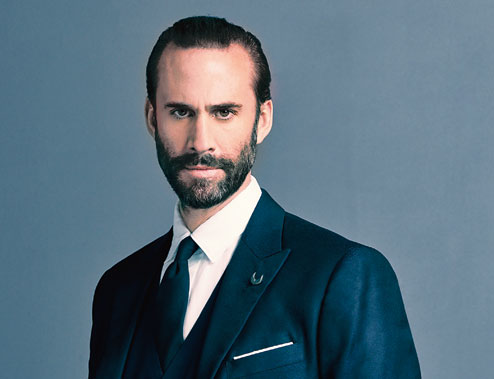

He first arrested attention as a young Shakespeare, opposite Gwyneth Paltrow’s Viola de Lesseps in John Madden’s seven-time Oscar winner Shakespeare in Love. Since then, Joseph Fiennes has starred in films like Enemy at the Gates and Luther. At present, the 47-year-old father of two plays one of the most despicable men on the small screen, starring as Fred Waterford — who sexually subjugates the protagonist Offred, played by Elisabeth Moss — in The Handmaid’s Tale, based on the 1985 Margaret Atwood novel of the same name.
Even as Season I of the winner of eight Primetime Emmys sets up an Indian premiere date (starting February 5 on AXN; every Monday at 10pm), t2 caught up with Fiennes on being Commander Fred, what family time with actor-brother Ralph is like and his India connection…
WHAT’S IT ABOUT?
Based on the 1985 novel by Margaret Atwood, The Handmaid’s Tale focuses on a dystopian future in which the US government has been overthrown by the theocracy called ‘Gilead’ that subjugates and sexually represses women.
As more and more women lose their fertility owing to environmental pollution and sexually transmitted diseases, the male heads of Gilead exercise their power over a class of women called ‘Handmaids’ — who can still bear children — and subject them to ritualised rape.
Season I, streamed on Hulu, has been a runaway hit, with the show’s parallels to politics and the state of women in the modern world, finding a lot of takers. Elisabeth Moss, who plays the protagonist Offred, has been singled out for praise. The Handmaid’s Tale has won two Golden Globes and eight Emmys so far.
In a recent interview, you described watching The Handmaid’s Tale as a “50-mile run… you come out exhausted”. How exhausting — and life-changing — has it been to play Fred Waterford on the show?
It’s certainly an exhausting watch, especially if you watch a lot of episodes together, and that’s what I felt when I first watched it. And if you decide to watch the whole season at one go, then it’s like climbing a mountain because it’s mentally and spiritually very taxing. That’s because what happens on the show reflects very closely on our society. The world can really change quickly and get very dark very fast these days and that’s the kind of world we visit in The Handmaid’s Tale.
Fred Waterford is a very complex character, a man repulsive on many levels. He likes to think that he’s participating in redressing the moralistic structure of society but as we can see in the show, what he’s doing is anything but. He is the head of a male-dominated totalitarian theocracy. This man propagates and encourages rape culture, a culture to keep women down and men in power. I believe that there are many parallels that Gilead (which is what the theocracy is called) has with certain aspects of the modern world… the injustices that you see on the show have happened in the past and happen even today. Needless to say, I find the character very, very creepy (laughs).

What was your reaction when you were offered this character — did you jump at it, take your time, were you intrigued or repulsed?
I hadn’t read the novel. So the first thing I did when I was approached was to ask permission to read the book and then make my decision. I found the book to be very compelling, especially from the point of view of the fundamental effects that absolute power vested in a few hands has on society. Especially, male power. Margaret Atwood wrote the novel about 30 years ago and what was prescient then is a reality now.
More than anything else, the book — and now the show — is a cautionary tale about what happens when you allow the powers-that-be — specifically, governments and regimes — to control you.
I thought that the first-person voice of Offred — who plays the protagonist — was very compelling. Honestly, Commander Fred isn’t very well sketched out in the book, but I thought that there was potential to build on. I just found the whole dichotomy in his character very interesting — the fact that he reads the Bible and then goes on to doing things that are just the opposite of what the Bible teaches. The relationship between Commander Fred and Offred is also very interesting. I studied a lot about Fred’s backstory and what makes him what he is and I feel I have understood him a little better as the season has worn on. He does all he can to prevent Offred from committing suicide, but that doesn’t change who he is… he’s still an abuser, but he’s also trying to make her life bearable. I love that juxtaposition.
Though it focuses on male power, the landscape of The Handmaid’s Tale is dominated by women. That must be an intriguing set-up to work in…
Yes, it’s interesting because on the one hand, it’s a male-dominated, totalitarian theocracy, but we don’t actually hear any of them. The story is told through Offred’s lens… it’s her perspective. It is, after all, ‘the handmaid’s tale’. We get to see Commander Fred — and all the other men in the show — through her eyes.
Do you guys try and keep it light and fun given how serious and disturbing the material is?
Yes, it’s a very dark and complex narrative and so we do try and keep it fun. The good thing is that there is a lot of love and camaraderie between everyone on set and that perhaps comes from the fact that we know that the material we are working on isn’t very happy and sunshine-y. There is a conscious effort to keep a certain lightness, otherwise it would be very depressing (smiles).
The man I play is a difficult character to shake off. And when I play him every day, I am constantly reminded of a sexual predator in our midst (Hollywood producer Harvey Weinstein) who’s recently been exposed. And we see these kind of predators everywhere… in industry, in politics…. Even if I try and escape from the character — get out of my costume and slip into my hoodie and trainers as quickly as I can (laughs) — all I need to do is to pick up a newspaper and I read about people corrupted by power who think they can do whatever they want to women. So yes, it’s hard to shrug off the character.
Shakespeare in Love to The Handmaid’s Tale, it’s been an eclectic career so far. How do you look back?
I love the way my career has played out, I own both the ups and downs and I’ve learnt from them all. The most important thing for me is not what I have done in the business, but what I have done outside it. I am a proud father and husband and it’s in my beautiful family that I find the true passion in my life. Come what may in the business, I am happy to be wherever I am today. I feel very blessed and lucky and all the positive feedback that I’ve received for The Handmaid’s Tale has definitely given a boost to my career.

— Joseph on conversations with brother Ralph
Speaking of family, you belong to one that has many members in the movie business. What are conversations like when you get together with your brother Ralph?
There’s a huge world outside the industry we work in, and we talk a lot about a lot of other things (smiles). There are some new members in the family and our conversations often revolve around them. We don’t really talk so much about movies, as we talk about politics, and nature and the world. We just try to connect and have a good time.
What else are you working on now?
I’m on a bit of a hiatus and then I go back to shooting the last few episodes of Season 2 of The Handmaid’s Tale. And then there are a few projects I should start work on soon.
Have you ever been to India?
Yes, I have! As a kid, I was told many stories about India. My mother was brought up in India… in Shimla. I have been there twice, once on the invitation of Shekhar Kapur (Joseph played Robert Dudley, the 1st Earl of Leicester in Kapur’s 1998 film Elizabeth). I loved it so much the first time that I went back after a few years and travelled on my own for a couple of months. India plays a big part in my family’s life and I have many, many fond memories of my time there. I have nothing but love for the country.
WHAT THEY SAID
A cautionary tale, a story of resistance and a work of impeccable world-building. It is unflinching, vital and scary as hell
— The New York Times
This is a show that could work anytime and one that will likely be watched and discussed for years to come
— Time magazine
It has a measly five stars merely because six were not available
— The Times, London
Priyanka Roy