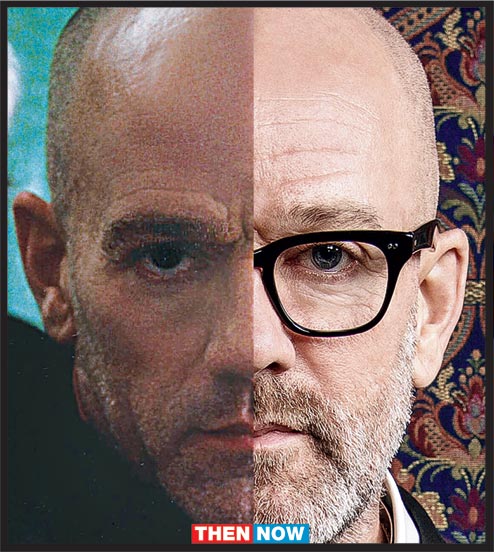

— Michael Stipe
You wouldn’t guess that the unassuming man arriving on his own at Les Enfants de Boheme –– a sweet little corner bistro deep on Manhattan’s Lower East Side –– used to front the biggest alternative rock band in the world. With his trimmed grey beard and alert, darting eyes, he looks more like an academic than an iconic singer of international renown. If it weren’t for the septum studs, there would be no clues to Michael Stipe’s past life at all.
“Do I miss it? Of course,” says Stipe, who in 2011, and by mutual consent with the guitarist Peter Buck and the bassist Mike Mills, called halt on the house band for Generation X, whose massive hits Losing My Religion and Everybody Hurts gave buskers the world over their signature tunes and would-be suicides a reason to keep going.
You have to do so much that isn’t about the music
“Ending R.E.M. was really hard on all of us. It was a transition, knowing nothing we did would reach that level of popularity or culture-shifting again.”
Perhaps that is why Stipe, Buck and Mills –– the drummer Bill Berry left the band in 1997, of which more later –– have agreed to talk to me for the 25th anniversary reissue of Automatic for the People. R.E.M.’s mordant, reflective, 18 million-selling masterpiece from 1992 cemented their status as “the acceptable edge of the unacceptable”, as Buck put it, but by the laws of science, or at least pop music, R.E.M. should never have got so big in the first place. The band, who went on to sell 85 million albums, formed in 1980 in Athens, were not built for mass appeal.
“I was hoping we might get as popular as Big Star,” says Buck, on the phone from his house in Baja California, Mexico, citing the 1970s power-pop legends loved by music geeks, but not so much by the public at large. “I’m hardly complaining, but none of us felt super-comfortable sitting behind Michael Jackson and Whitney Houston at the Grammys. And the problem with being in a popular band is that you have to do so much that isn’t about the music.”
Automatic for the People, an album concerned for the most part with death, was a reaction to that situation. In 1991 Out of Time transformed R.E.M. from a hip alternative band into a phenomenon.
“Losing My Religion was the big change,” says Stipe, whose clipped monotone makes him seem far more earnest than he really is. “Suddenly everybody recognised me when nobody did four months previously, and it threw me off centre, for sure. Fame was something I thought I wanted, but you soon learn there is not much to it. Celebrity, adoration... it’s not enough. Because it is not really about you.”
With the chief goal being to not repeat themselves, the four band members went through studios in Athens, New Orleans, Seattle and Miami, trying out new instruments (the mandolin features heavily) and new ideas. Before long they knew they had something special. “The music was beautiful,” says Mills. “At the same time I was asking myself: ‘Who is going to want to hear a record about mortality, dying, changing? Would that fly?’ It seemed unlikely.”
Surely, I suggest, Mills could hear the eternal appeal of Everybody Hurts, which has the simple, profound message that sadness is not only universal, but fleeting, and that even suicidal despair will pass if you can just hang on.
“Honestly, we didn’t think that song would resonate in the way it did. It has a silly little drum machine going through it, which hampers the earnestness of the lyrics. We just thought it was sweet.”
A clarion call
Back in the bistro, Stipe is revealing some surprising things about Automatic for the People, which was augmented by orchestral arrangements from Led Zeppelin’s John Paul Jones. Everybody Hurts, he claims, is really just a version of the saccharine standard Love Hurts as played by the cheesy soft rockers Nazareth. Drive, the deadly serious ballad opening the album, is Stipe’s response to David Essex’s 1973 hit Rock On, “which was a clarion call to me as a teenager exploring my sexuality, telling me there was another world from the one I knew”. And he confirms that the album was indeed about death.
“My grandparents were dying, I was taking care of a sick dog, and the 1980s were f***ed up, man!” says Stipe, in a rare moment of animation. “AIDS took out an entire community of people. I looked at those three things and became very fearful of death.We were recording in New Orleans while Brad Pitt was down there shooting Interview With the Vampire, which is about death bringing eternal life.”
Sweetness Follows is a mostly acoustic lament from a man burying his mother and father. Try Not To Breathe is a musical accompaniment to a suicide note. Nightswimming is a sweet reverie on youthful adventures skinny-dipping in Athens, which Mills recorded in Miami on the piano used for Derek and the Dominos’ Layla. Man on the Moon is a maudlin tribute to the comedian Andy Kaufman. There are upbeat rockers such as The Sidewinder Sleeps Tonite, a take on the Tokens’ 1961 hit The Lion Sleeps Tonight (Wimoweh), but for the most part Automatic was flying in the face not only of the grunge-obsessed mood of the times (Nirvana’s Nevermind came out a year earlier), but also of R.E.M.’s popularity.
“It wasn’t a calculated move,” says Stipe of the album’s serene mood. “It was a product of trusting our instincts, being good editors of our work, and not thinking we were geniuses. To make an album that holds together thematically and makes sense from one song to another is a high calling. We only managed it with Automatic, New Adventures in Hi-Fi and Reveal.”
The 25th anniversary edition includes a disc’s worth of ideas that never made it past the demo stage, alongside two unheard songs: Mike’s Pop Song and Devil Rides Backwards, rejected, claims Mills, for sounding too much like R.E.M.
R.E.M.-shaped hole in their lives
Stipe says he and Mills were the lazy ones, always showing up 40 minutes late for everything. Bill Berry was the editor, trimming the fat and ensuring no song dissolved into a five-minute jam, which explains why Up, made in 1998, a year after Berry left the band, is filled with five-minute jams. Buck also drew up a set of rules for R.E.M. to adhere to. I tell Stipe I heard that the rulebook included a ban on the wearing of leather.
“No, that doesn’t make sense,” he says. “It was more that we split all songwriting credits equally, which means I have 25 per cent on New Orleans Instrumental No 1, despite not playing a thing on it. It also means we stayed friends for life while constantly getting on each other’s nerves and annoying each other more than any wives or boyfriends could. It was all for one and one for all.”
At least, it was until Berry left. In July 1995, during a tour of the album Monster, Mills had surgery on an intestinal adhesion. A month later Stipe had surgery on a damaged hernia. Yet the most serious incident happened in March that year, when Berry collapsed on stage during a concert in Lausanne in Switzerland. It turned out he had a brain aneurysm.
“What I had was nothing, a garden-variety hernia,” says Stipe. “What Mike had was nothing. Peter, r.e.m.arkably, stayed healthy. Bill came close to death. We didn’t let on how bad it was at the time, but he stayed in hospital in London for a month and there was no guarantee he would make it. After that he didn’t really want to do it any more and his leaving changed the dynamic in a really bad way. There was a power shift, communication went down to absolute zero, and I could critique the work that came out of that period a lot more than the other records, although it wouldn’t be fair for me to do so. Nobody needs to hear my opinion.”
Our interview comes to an end when he has to leave to meet a lawyer about a forthcoming collection of his artwork and photography. All seem happy enough. Yet I can’t help but feel there is an R.E.M.-shaped hole in their lives.
As he stares into the distance he comes to a realisation, seemingly for the first time. “You know what?” says Stipe, looking at me with what, I think, is a touch of surprise. “It was pretty f***ing cool.”
Will Hodgkinson
(The Times, London)
R.E.M. is special to me because.... Tell t2@abp.in