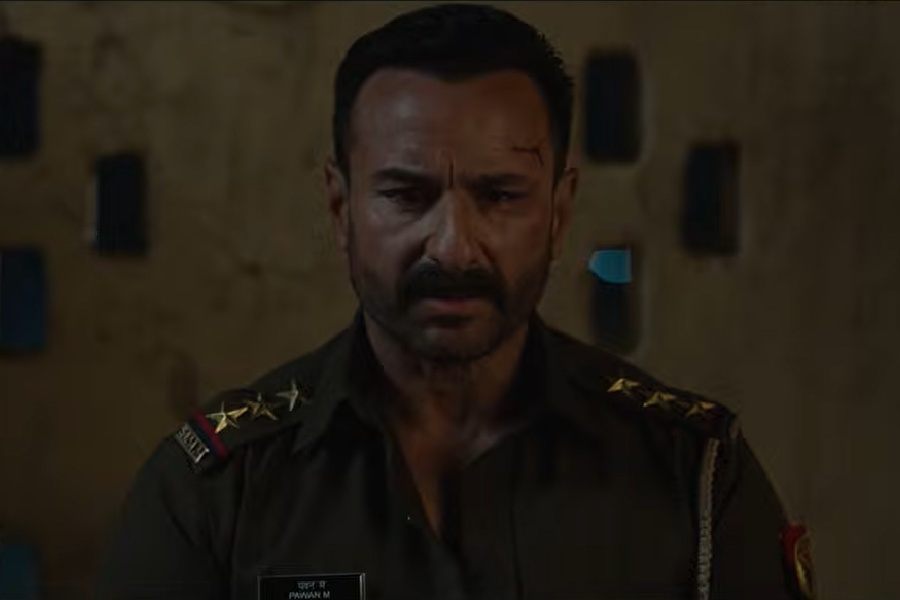
Ever since his unforgettable turn as Langda Tyagi in Omkara, Saif Ali Khan returns to the dusty, morally murky world of the Hindi heartland in Pulkit’s Kartavya, stripping away the polished urban persona audiences usually associate with him. And for the most part, it pays off.
Set in the fictional town of Jhamli, the film opens on an ordinary note. Police inspector Pawan Malik is celebrating his birthday with colleagues when duty abruptly takes over. A journalist investigating allegations of child abuse at a powerful godman’s ashram is murdered moments after arriving in town. Pawan fails to save her, and that failure hangs over the rest of the film like a shadow.
From there, Kartavya unfolds on two parallel tracks. One is the murder investigation that slowly exposes a network of corruption, exploitation and political protection surrounding the godman Anand Shri. The other is personal: Pawan’s younger brother has eloped with a lower-caste woman, setting off tensions within their conservative village and even inside his own family.
What keeps the film engaging is how naturally these two storylines feed into each other. The title isn’t subtle — Kartavya literally means duty — but the film genuinely wrestles with what that word demands from a man like Pawan. Is his responsibility first to the law, to his family, or to his own conscience? Every major turn in the story forces him to choose, and those choices come at a cost.
Saif Ali Khan anchors the film with authority. He doesn’t overplay the character’s heroism, which helps. Pawan is stubborn, decent and emotionally exhausted, often all at once. His command over the dialect feels effortless, and he looks completely at home in the film’s rough-edged setting.
Rasika Dugal is equally effective as Varsha, Pawan’s wife. She could easily have been reduced to the stereotypical supportive spouse, but Dugal gives her warmth and emotional intelligence. Her scenes add much-needed humanity to a film packed with violence, betrayal and rage.
The supporting cast does solid work across the board. Zakir Hussain is especially convincing as Pawan’s rigid father, a man so consumed by caste pride that he’s willing to sacrifice his own son. The film’s take on honour killing and social hypocrisy isn’t particularly nuanced, but it hits hard enough because the emotions feel recognisable.
One of the film’s more surprising casting choices is journalist Saurabh Dwivedi as the manipulative godman Anand Shri. It’s an interesting experiment, though not an entirely successful one. Dwivedi has the screen presence, but not always the menace the role requires.
Where Pulkit succeeds most is in maintaining tension without letting the film become unbearably heavy. Small flashes of humour arrive at just the right moments. One exchange, where Pawan jokingly compares his lovestruck brother to Shah Rukh Khan and their angry father to Amrish Puri from Dilwale Dulhania Le Jayenge, lands beautifully.
The emotional core of the film, though, lies in Harpal — a frightened teenage boy trapped within Anand Shri’s abusive system. As Pawan begins to understand the child’s trauma, the film briefly rises above the conventions of a standard cop thriller. Their evolving dynamic gives Kartavya its strongest emotional moments.
Most importantly, Pulkit knows when to stop. At a little over 100 minutes, it moves briskly and avoids unnecessary detours. Pulkit keeps the storytelling lean, allowing the tension to build steadily without drowning the audience in melodrama. In the end, Kartavya works because of its performances more than its originality.
Kartavya is streaming on Netflix.