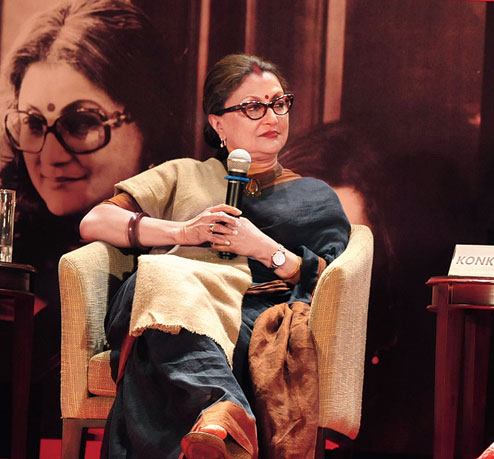


Films, family, freedom of expression... filmmakers Aparna Sen and Konkona Sensharma took the stage for a session as part of FICCI FLO The Power To Empower, presented by SREI and Kanoria Foundation, at Kanoria Residence in Alipore. Titled 2 Women of Many Parts, the mom-daughter duo were in conversation with moderator Mir. Excerpts from Aparna and Konkona speak...
IN A MAN’S WORLD
Aparna: Feminists are very disappointed with me because when they ask me if it has been a very rough ride being a woman in a man’s world, I say no, it hasn’t actually and I haven’t had any problems at all. The only problem I have had is not on account of gender but rather on account of the kind of films I make. I don’t choose to make mainstream cinema, therefore I have had problems with funding. And you know, a film unit is a very disciplined bunch of people if they realise that the director knows his or her job. The moment they realise that you don’t know your job, they will not respect you. Fortunately I didn’t have that problem.
We live in a largely patriarchal society and you have to negotiate your space. For instance, I am being charming to a gentleman and he lets me have the edit table, why not?
VIEW FROM THE OTHER SIDE
Konkona: It’s nice to be on the other side of things because I feel it gives a great perspective to life, and the experience which normally I wouldn’t have had of being a mother and a director because I have always been the child and I have always been in front of the camera and not behind. These two things I feel really broadened my life and shifted my perspective.
I never imagined that I would be able to make a film. It has been amazing to have had her (Aparna) do all these before me. I have seen her how, with ease, or maybe sometimes things have been difficult for her but I have seen her being a working mother. I have seen her directing films, so it’s like she paved the way. You know it’s been done, and it’s been done well. I always had that as an example in front of me and also she has only pushed me so much into direction. Pushed me in the sense that I wrote the script and then I sat on it thinking nobody would give me money. Ma would always say, ‘Arrey why are you sitting on it? You must go and meet people, must find a producer and be proactive about it’.
SMALL BUDGET, INDIE FILM
Aparna: The thing is if it’s not a small-budget film, then in order to justify that budget you have to take big stars and the moment you take big stars it’s a whole different ball game. It’s no longer your film. It’s the producer’s. The producers then say, ‘okay, let’s have an item number.’ And suddenly you find that the entire thing has gone out of your hands and the film is becoming not the film you wanted to make.
Konkona: I would rather have the freedom to write and express my own view point and not be dependent on other people. This is also what independent filmmaking is. You are not part of a studio culture. Or you are not dictated to in terms of content, in terms of even execution. That is what independent filmmaking is; that you are independent from these norms and conditions which go on to make mainstream cinema.
PERKS OF BEING HER MOM’S DAUGHTER
Konkona: She (Aparna) has always encouraged me to find my own footing. For example, I thought I would finish my schooling in Calcutta and then I was very happy to go to Jadavpur or Presidency. She is the one who said no, no, you must leave town. It’s very important that you go out of town for your college. She really encouraged me to go to Delhi. And thanks to her actually, I went and applied to Delhi University and got into a good college like St. Stephen’s. You know it’s not that she went there and said this is my daughter. She encouraged me to do that on my own.
Aparna: Actually, a lot of young actresses who are very fond of me keep saying, ‘Oh, now that you have a daughter who’s an actress you will always cast her’. But that is not the case. I realised that Konkona has the gift and I pushed her to some extent. I mean if she had totally refused, then I wouldn’t have said anything. But the point is, she is there, she understands my kind of filmmaking and she has the same kind of taste in cinema, our mindsets are similar, our values are similar. She is not going to give me grief about dates and she is a very dependable actor. So if the part fits her, why should I not cast her?
I cast Raima (Sen) in The Japanese Wife and not Konkona because I felt Raima would suit the role better. It’s not that I cast Konkona no matter what. No, it’s very embarrassing to go and say, this is my daughter, please do something. I can’t do all that. I can’t speak for myself, I can’t speak for my daughter.
REMEMBERING RITUPARNO
Aparna: Yes, 19shey April is a landmark film for many reasons. Also because this was the film that was produced by all three of us... Rituparno Ghosh, Renu Roy and me. With this script I have gone from door to door and done much more for Ritu. I would introduce him as a talented young man. And I did the film for free. Ritu was very, very charming and very good at his job.
Konkona: It’s hard to talk of him like this because he was so much a part of the family. My mother and he were so close and they would be chatting in the evenings and into the night like girlfriends and I was always around. He used to help me with my homework. He was very encouraging. He would tell me ‘Tui kore dish art direction-ta amar...’ I had no experience in art direction but he was able to make other people believe in themselves.
Aparna: In 19shey April he said, why don’t you decorate your room.... I think that was his way of getting me to identify with the character.
THE SELFIE CULTURE
Konkona: I don’t enjoy being photographed, specially selfies. Because I find selfies so invasive. There are times when you are at an event and you are taking a selfie, that’s fine. Kind of a work scenario. But there are other times when you are on your own or you are in the ladies’ room and then you know you are being asked for selfies. I personally find it very invasive. I often unfortunately seem to take the unpopular view of things, but I am okay with it.
You know, the core of my personality, specially till my teenage years, I was very shy, introverted, quite withdrawn. So that forms very much a part of my core personality. I am comfortable photographing other people and looking at other people, being the observer rather than being observed.
Aparna: Both Konkona and I are intensely private people. I am certainly zealous and possessive about my independence as a human being and a free citizen. I have always fought fiercely against it to the extent that when I had already become a star, I would travel by bus or tram till first year of college when I was acting in Baksho Badal. People would recognise me. Somebody even said, ‘Didi apnakeo bus-e kore college-e jete hoy?’ I was barely 18 and I replied, ‘Hain college-e toh loke bus-e korei jay’. There was a car and a driver and my parents offered. I said no, I don’t want to go in a car because if I go in a car I won’t be like the others. People would think I am special.
Konkona: The experience of life is then affected.
Aparna: Exactly.
Konkona: And if you are well known you can be asked questions about your personal life. I enjoy acting but I will not answer questions about my personal life. I need a certain amount of dignity in my life. We should not always fall into that trap of living up to other people’s expectations of us.
Aparna: Absolutely.