Blumhouse Productions insists that you call it Lee Cronin’s The Mummy. And that insistence alone says a lot about what they’re trying to do here.
This isn’t your 1990s-era adventure saga led by Brendan Fraser. And Egyptian legends form only a small part of the film. Instead Lee Cronin’s The Mummy is all about blood, gore and body horror, right up Cronin’s signature alley.
The story revolves around the Cannons — Jack Reynor as Charlie Cannon, a journalist based in Cairo, his wife Larissa (Laia Costa), their son Sebastian (Dean Allen Williams), and daughter Katie (Emily Mitchell). One day, while Larissa is at work and Charlie is distracted on a call, Katie slips away to meet her “secret friend” Layla.
It soon becomes clear this mysterious figure has been luring the child with candy for days, patiently grooming her for something far more sinister. No prizes for guessing, the mysterious woman abducts Katie.
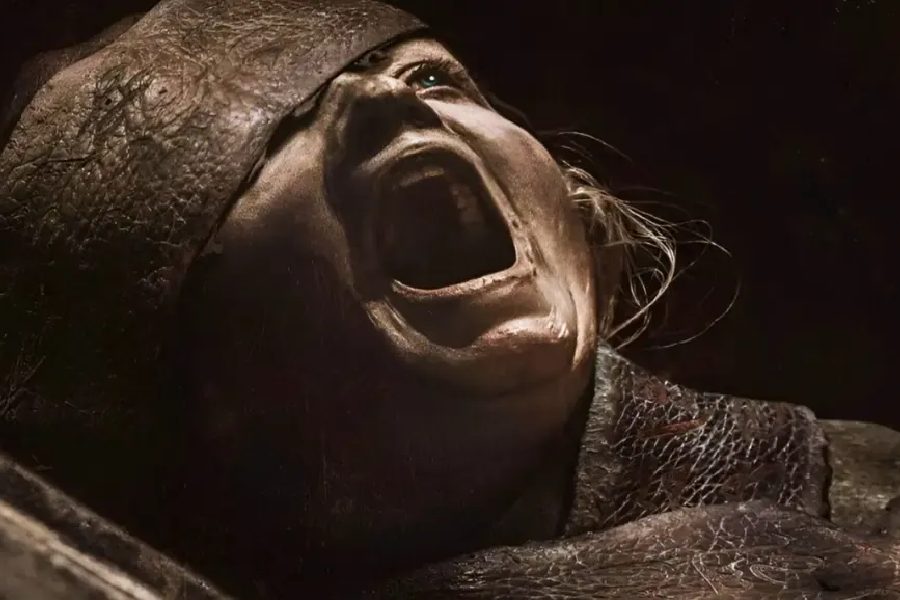
Eight years on, the Cannons have relocated to New Mexico and welcomed another child, Maud (Billie Roy). (Sebastian, now older, is played by Shylo Molina.) Then a plane crashes, and amid the wreckage, a sarcophagus is found eerily intact. When officials pry it open, they discover Katie (now played by Natalie Grace) inside. She’s alive, but barely. It is evident that an unseen force has taken hold of her body and it seems capable of manipulating the world and people around her.
Cronin splits his story in two directions: part supernatural procedural, tracing how this malevolent force found its way into Katie, and part domestic horror, watching a family slowly unravel as their worst nightmare takes shape under their own roof.
On paper, this dual narrative structure should have kept the audience engaged. Instead, it pulls the film apart.
The investigative thread, led by May Calamawy’s Egyptian detective, has its moments. But it drags more often than it grips. Too much time is spent explaining what’s happening, when the film is far more effective when it doesn’t.
If you’ve seen Evil Dead Rise, you’ll recognise Cronin’s taste for excess. Here, he pushes even further. Katie’s body becomes a canvas for degradation: skin peeling, limbs contorting, teeth chattering and snapping in ways that are designed to make you wince. And it works initially.
But brutality quickly loses its edge. Instead of building dread, the film hammers the audience with one grotesque imagery after another until the effect dulls. What should feel shocking starts to feel repetitive.
At well over two hours, the film feels stretched far beyond what the story can sustain. The tension slips, and once that happens, it’s hard to recover. You start to feel the runtime, which is never a good sign in a genre that thrives on momentum.
The cast, however, does solid work across the board. Jack Reynor brings a believable sense of desperation as a father in distress. Natalie Grace as Katie is genuinely unsettling in a physically demanding role. Laia Costa does what she can, but the script gives her little room to explore the emotional devastation at the story’s centre of the narrative.
The real missed opportunity, though, is the family dynamic itself. The idea of parents confronting the horrifying reality that their long-lost child has returned as something monstrous should be devastating. Here, it barely lands. That’s ultimately the film’s biggest weakness.