|
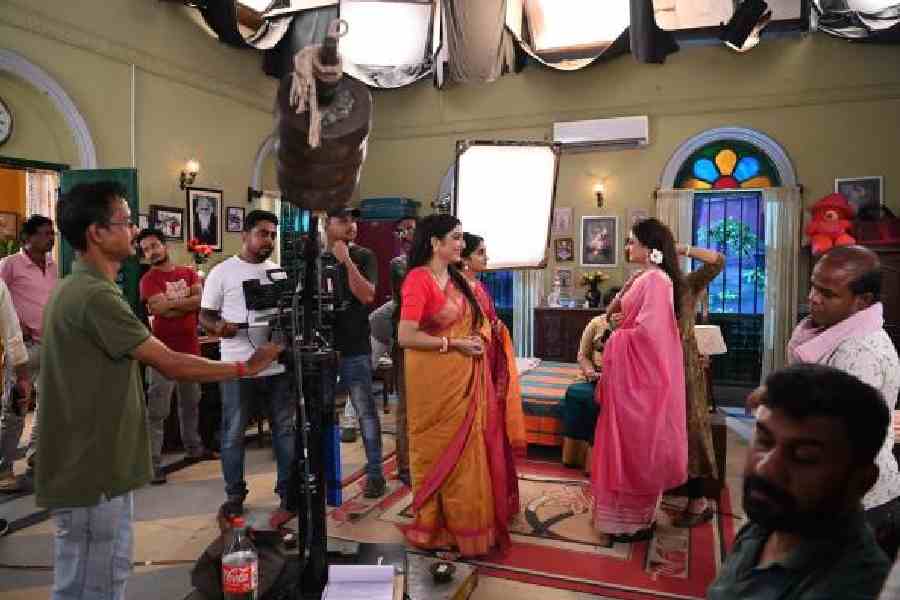
| Natobar Not Out leading man Mustafa Prokash flew down from Bangladesh to attend the premiere and after-party of his debut film at 60 Chowringhee Banquet. Seen here with director Amit Sen and Moon Moon Sen |
When have you last seen a really rip-roaring comedy in Bengali? Cross Connection, Brakefail, Chalo Let’s Go..., even parts of Bong Connection — all had genuine comic possibilities. But finally, they simply failed to make the grade.
So, when I first saw the hoardings of Natobar Not Out I got quite excited. To begin with, the ads were quite brilliant. Design wise. Even lettering wise. And one specially liked the open pen, symbolic of the ‘muse’ being made an integral part of the visual.
When the lights went off and the credits started one was even more impressed. The song with its pleasing voice harmony, the visuals, Mir in his paint-splattered outfit, the choreography, all contributed to a terrific start. One rubbed one’s hands in glee in expectation of better things to come.
That’s when disappointments started slowly seeping in. Kamaleshwar’s script is impeccable. You couldn’t find any fault with it. Not only were the dialogues crisp and funny the film had the germinal of a great comedy. The idea of a very ordinary person suddenly flowering into a brilliant poet, because he gets possessed by the spirit of Tagore. But the transformation is only temporary. And the protagonist has to make the best of it while the muse stays with him.
In no time at all he becomes the blue-eyed copywriter of an ad agency, literally going places. But it also leads to his ultimate downfall, what with his suddenly acquired expensive lifestyle. The film ends on a happy note, the para boy marrying the para girl. And all is well. The hero pays off all his debts by agreeing not only to sell his poems but also by relinquishing the authorship to the poems.
The film had all the ingredients of a successful comedy. Sadly, the total adds up to somewhat less than the sum of the individual components. You can see that great efforts had been made to make the film work. But two things conspire to bring about its undoing.
The entire film revolves around its protagonist. If he fails as an actor, if his timing fails, the film fails as well. That’s what happens. Newcomer Mustafa Prokash of Bangladesh in spite of trying very hard somehow fails to make Natobar come alive.
And the second serious flaw is the Tagore part. What should have been the high point of the film, the portrait of Tagore speaking to Natobar, becomes technologically an embarrassment of sorts. When Tagore speaks, his face changes visibly. The eyes, the eyebrows, the nose, everything is different. And everyone knows what Tagore’s voice was like — thin, flute-like. Not the booming baritone that reverberates through the Dolby quadraphonic sound system.
Even the ending, with its brilliant twist, fails to spark.
Ramaprasad Banik, acting as the hero’s father, fails to deliver the punch lines. And the film remains in a limbo, constantly reminding the audience of its infinite possibilities most of which, unfortunately remain unfulfilled.
Barring the Tagore special effects, Natobar... is technically proficient. The dream song and dance sequence in spotless white-on-white, featuring the song Megher palok, has been shot with great care.
Cinematography, specially some of the night sequences, are pleasing to the eyes. Art direction is competent without being flashy.
The acting domain is brilliantly led by, now here’s the surprise, Kaushik Ganguly as the flashy, pony-tailed chief of the ad agency, causing someone in the audience to comment, quite uncharitably though, that his acting was showing up better than his direction these days.
Kharaj Mukherjee, Saswata Chatterjee, Sudipa Basu and Kamalika, all put in more than competent performances. Raima adds her lovely presence and grace to the film. In handling the music, Debojyoti Mishra excels, specially in the title song and the jazz music sequence.
All said and done, Natobar Not Out might still become a commercial success. There’s a feel-good factor to the film. The ending is warm and likeable, even if predictable. And the audience starved of genuine comedy stuff for so long might yet cling to it as the real thing.
But really speaking, for Natobar... to remain ‘not out’ you would require indulgent benefits of doubt from the audience.