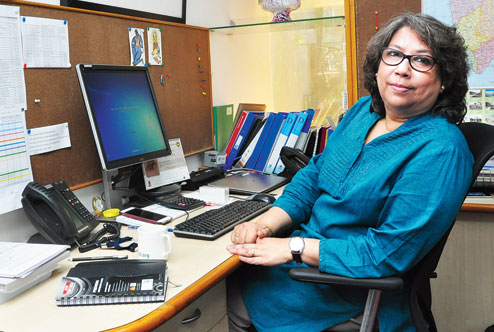

Sujata Sen’s colleagues Samarjit Guha and Shonali Ganguli set up a table laden with chicken shawarma, chicken sandwich, orange juice, chocolate pastry and Sujatadi’s “special coffee” for this interview. My colleagues Chandrima S. Bhattacharya, Sudeshna Banerjee and Anasuya Basu sent me off with a bagful of questions for the outgoing director, east India, British Council. What followed was an hour-long adda over food and laughter.
BRITISH COUNCIL
Which is your favourite British Council tagline?
‘Creating opportunities for people’. Because in everything we do, whether through the English language training or our work in education, or our social enterprise projects or through our arts work... it’s about giving opportunities
to people from both countries — India and the UK.
You were the first non-British director of British Council anywhere in the world. How difficult was it to break this ceiling? Looking back, what do you think clinched it for you?
I was the first non-British director globally in 2002, but since then there have been quite a few locally appointed directors around the world. I remember it had appeared in the British Council global annual report back then.
I think what was important for the organisation was to get people who knew the local context very well. I don’t think, in terms of work, it was a challenge for me… but in terms of the minds of people, some felt there was something wrong if British Council didn’t have a British director....
So, there was resistance certainly, even within the organisation. See, it takes time for people’s minds to change… may be there was a little bit of, let’s say, wonderment (smiles). Lots of people used to ask me, ‘Why have you been appointed? Are you a British citizen?’ Straight, point-blank questions (laughs). I said, no, I am not a British citizen. I’d get lots of such questions.
But you know, that doesn’t matter. It’s ultimately the work that you do and the impact that that work has which matters.
Five things you learnt on the job in these 20 years?
• I learnt that values are very important for an organisation and that makes the work atmosphere so very enriching.
• I also really value the equality, diversity, inclusion agenda of the British Council. It’s called the EDI agenda, where we equally value people of different ethnicity, age, sexual orientation, ability or disability….
• The British Council systems and processes are world-class. Once you have learnt to work with those systems and processes, you can work in any other organisation very easily.
• It’s also a very people-oriented organisation — people who are your colleagues and people who you interact with. So valuing people is another thing I have learnt at British Council.
• Working with a whole range of organisations and partners across India and the UK and learning from them. There’s a lot to learn and here we also enjoy our work and have a little bit of fun.
THE PARA PUJA
As vice-president of the local puja in your Dum Dum Park neighbourhood, how involved have you been with Puja planning? What does wearing this hat mean to you and what does it entail?
(Smiles) I think it is very important to be involved with the community where you live. There’s so much of mudslinging at para boys, at local clubs etc, but I feel if you make friends with them, they are really friendly people, they do a lot of things which we are not able to do. If you be their friend, not only does it feel that the community is there, which is so supportive, but you also feel that you live within a context, which is so important. And I’ve really enjoyed going to the local club and attending meetings and planning the Puja. I think it’s a very important aspect of your life to be involved with the community.
As for the work, I think there are much better people than me actually running the Puja, I am there as an adviser, as a supporter, to give ideas….
Calcutta
The best thing about living and working in Calcutta?
Calcutta is a very vibrant city for me, for the arts, for education. People here are hungry for education, people here love the arts. So it’s always good to be working for the British Council in Calcutta.
Something about the city that you don’t like?
Oh, I often get frustrated with the city, when things don’t work, but when I land in Calcutta airport after travelling somewhere, I feel so good to be back.
Your favourite spot in the city?
By the river, of course, because we are one of the few cities which has such a beautiful river running alongside it. I also love sitting in the Shamiana in The Tollygunge Club, especially when it rains.
Books

Do you borrow books from the British Council library? What is your favourite corner in the library?
I borrow books not very often but I see what is there and that gives me a tip to buy my books. I buy a lot of books, I even like to buy books that I have already read. If I really like a book, I like to buy it and keep it. So the library is an integral part of my life… our library offers a lot of online resources now, for magazines, newspapers, films and of course books, both physically and online. You know, just being within this atmosphere, I feel very lucky to have access to this atmosphere.
What was the last book you bought?
Last I bought 12 books from Story, to give away as gifts. The book that I am reading at the moment is The Pleasures and Sorrows of Work by Alain de Botton. It’s an extremely well written book and the depth and breadth of scholarship is so amazing that one will remember this book for a long time. I read a lot on the Kindle app on my iPad as well.
ALEX AND COCO
Work, para Puja, Future Hope (which Sen will join as CEO on April 1), Calcutta School of Music... does your day have 48 hours?! How do you juggle so many commitments?
You know, time expands for things you want to do and you love doing. So time has never been restrictive for me and I think it need not be restrictive for anybody. You’ll always find that extra hour or that extra moment if you want to do something. Also, you’ve got to prioritise.

Your Twitter DP had two dogs (picture right). Tell us about them...
My dogs are the most beautiful dogs (laughs). Alex is a white and black Cocker Spaniel and Coco is a Golden Shepherd. I go home and I feel that life is SO wonderful, because they come and greet you and they take away all your stress. They are great stress busters but that’s not why they are there, they are there because they are family. I talk to them over phone when I am travelling and they know that I have called.
GOODBYE NOTE
Any tips for your successor at British Council?
Just enjoy the work. Learn as much as possible. It’s going to be demanding, but it’s going to be very satisfying.
The last thing you want to do before leaving British Council?
Finish all the pending things (laughs out loud and shakes head)… and there’s a huge amount to be done, also because this is the financial year-end.
Three things you’ll carry from your British Council office?
Nothing! No, you’re not allowed to carry away anything (laughs)! I’ll only carry memories and the love and affection of my colleagues and all the learning that I have had.
THE SPORTS FAN AND THE SOURAV FANGIRL

You are quite a cricket fan. Tell us your best match memory at Eden Gardens....
Well, India vs Pakistan in this T20 World Cup (March 19) was most memorable. The atmosphere at Eden was like it was bigger than the final (laughs). The moon came up and the whole stadium started clapping, because that meant it wouldn’t rain anymore and the match could happen.
I also remember Andy Roberts at Eden Gardens... one of the greatest bowlers the West Indies — in fact, the world — has ever produced.
Which cricketer are you the biggest fan of? Any fan moment with him?
(Laughs) Well, I am a big fan of Sourav (Ganguly). I enjoy his commentary because it’s such thinking commentary. And of course there was this moment in cricket history when Sourav took off his shirt and waved it in Lords (picture above)… it is unforgettable. That was the moment when the Indian cricket team started believing in themselves and Sourav made everybody in the team believe in themselves. He is a person I am really a fan of.
Does he know?
I don’t think he knows… because he must be having millions of fans like me!
Have you ever skipped work to go watch a match?
(Laughs out loud) Yes I have (laughs some more)… and I’ve come back to office after the match. I think I’ve seen it as my ‘time off’. I believe we can have flexible working hours and yes, I am guilty of that (laughs).
Are you interested in any other sport?
Very much. I love watching almost all sports. Tennis, football, Formula One, rugby… one of my favourite tennis players has been Pete Sampras. And in women, Martina Navratilova. I worked in publishing (Orient Longman), where I did a whole series of books on sports.
In football, being a Calcuttan, I root for the South American teams — Brazil and Argentina. I like both. I also think the German team is fabulous at the moment. Because Germany has a whole strategy of training footballers from a very young age. The German league has more German players than players from outside. Germany has been at it, training and encouraging and building up German football, and that’s also the reason why they are World Cup champions.
Among the European leagues, the Spanish league is always a joy to watch. Barcelona is my team. And the European Cup is a fabulous tournament to follow. At home, I’ve gone for the Mohun Bagan-East Bengal derby to Salt Lake Stadium… but I’m not going to tell you which team I support (laughs).
Have you played any sport?
I used to play a lot of badminton, table tennis and volleyball.
Samhita Chakraborty
My goodbye message for Sujata Sen is.... Tell t2@abp.in