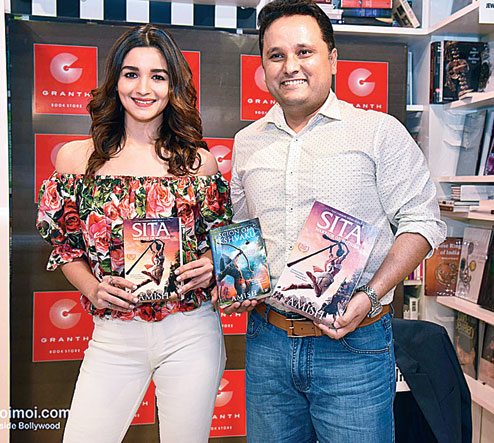

Towards the beginning of Sita: Warrior of Mithila, there is a scene where Maharishi Vishwamitra sees a young Sita in Shvetaketu’s gurukul. Here’s what Amish writes:
“Vishwamitra observed Sita with a keen eye. Tall for a thirteen-year old, she was already beginning to build muscle....”
This seemingly simple line, where a woman is described by her height and her muscles, rather than by her doe-like eyes and lissome figure, speaks volumes about the kind of book this is.
“I am going to take that as a compliment,” Amish laughs, when I call him up to talk about this line.
GIRL WHO WOULD BE WARRIOR
“I think I just saw her that way. And it’s been there consistently in my mind,” he says about visualising Sita in the Ram Chandra Series.
“We shouldn’t deride the archetype of beauty, though. There are women and men who pursue that and there are women and men who have a warrior approach to life. Their mindset is different, their bodies are also different. They will be tougher, because of the kind of games they play, the kind of sports they practise, the kind of food they eat... Lady Sita just emerged like that in my mind. She is going to grow up to be a warrior, so she is going to show those attributes from a young age.”
This is the second book in the Ram Chandra Series, after Scion of Ikshvaku (2015), which is the story of Ram, from birth to banishment and Sita’s abduction by Raavan. Following the hyperlink or multilinear narrative technique of storytelling, Book 2 follows Sita’s life, from childhood to abduction by Raavan.

POSITIVE FEMINISM
In Amish’s interpretation, after her education in the gurukul, Sita is appointed the prime minister of Mithila, the kingdom of her adoptive parents — King Janak and Lady Sunaina. She is still prime minister when she organises a swayamvar for herself, and meets Ram.
Let us be silent on the reason she orchestrates this contest for marriage, with help from Vishwamitra and the Malayaputras (the tribe of Lord Parshu Ram) so as not to give away a crucial plot point, but it’ll suffice to say that she is up for a very big pan-India role. And Amish says her gender was never a concern during her appointment.
“When Vishwamitra is discussing her suitability, there are various issues that they (the Malayaputras) debate — is she too young, is she qualified enough... but the fact that she is a girl is not even discussed. Because it is not even an issue. And that, I believe, is genuine feminism. I should not be either pro-men or pro-women. That’s positive feminism. That we treat men and women as genuinely equal and form our opinions based on their karma and their attributes, not on their birth,” says the 42-year-old banker-turned-bestselling author.
START FOLLOWING RULES
Amish feels that was the ancient Indian way, and it is something modern India could learn from. Another thing is adherance to laws. “In today’s day perhaps we Indians can learn the value of following laws a little bit. Apneko mazaa ataa hai kanoon todne mein, even if there’s no benefit from it. And that’s not healthy for a society as a whole. If all of us learn that from Lord Ram and start following rules, at least a little bit, our society will be a little more organised, a little better run.
“The debate between liberalism and conservatism, the debate between freedom and laws, I essentially try to speak for balance, in every way,” he says about his understanding of the ancient Indian way.

— AMISH, ON MEETING PM NARENDRA MODI
‘MAIN SHANTI SE BOLUNGA’
“Balance”, is Amish’s favourite word, one might say. Of course, that also means he’s practically ruled himself out from prime-time debates on news channels, I quip.
“I think I am not so adversarial and aggressive... main thoda shanti se bolunga na, jo bhi bolna hai, toh headline nahin banega,” he laughs.
Recently, though, there was something that was “headline-worthy” — a picture of him on Instagram presenting his Ram Chandra books to Prime Minister Narendra Modi.
I utter the word “politics” and I can almost see him shaking his head sitting in his car in the Mumbai traffic.
“He’s a constitutional authority ya. I never comment on politics. We sat and discussed for some 20 minutes. We didn’t talk politics.
“I discovered that he had heard of me during his Gujarat CM days. He had met some college kids who had told him about reading a book on Lord Shiva, he was surprised that kids were (reading about Shiva), he asked which author is this?
“When I went to meet him, we spoke of the Katha Upanishad, of environmentalism, of women’s rights, what our ancient scriptures say about women’s rights, of Lord Nachiketa and Lord Yama’s conversation... things like this. It had nothing to do with politics,” he is quick to clarify.
His meeting with Modi comes a couple of months after he invited Union minister Smriti Irani for a Facebook Live chat. Then too, he insisted it was “not politics”. At all. “But I am not a part of any political party, nor do I ever intend to be,” were his firm words.
He pointed out that he has met leaders from across the political spectrum — the former CM of UP of the Samajwadi Party to MP Shashi Tharoor of the Congress.
THE 30-SECOND LAUGH
As we are chatting along merrily, I proceed to tell Amish my theory about why he met Modi — because we Indians these days seem ever-ready to take offence at the slightest opportunity and because he is reimagining the story of Lord Ram and his wife Sita, an exercise fraught with all kinds of risks in today’s day and age of hypernationalism, his meeting Modi was a message to the “offence brigade” that this writer enjoys the “big man’s blessings”. So, lay off!
Amish laughed for a neat 30 seconds at my theory.
“I write with respect. My books sell in large numbers, four million of them are in print, I don’t need to, at this stage… so no, no, no… and this is my fifth book ya,” he says, still laughing.
But he also points out that his version of Sita actually goes back to a more ancient image of her.
“The image of Lady Sita that exists among modern urban Indians is largely based on Amar Chitra Katha comics and various television serials. The archetype for many of these TV serials has been the 1980s Ramanand Sagar TV serial, (Ramayana) which was largely based on the Ramacharitmanas, a 16th century modernisation of the original Valmiki Ramayan. And this is why we have this (a demure, submissive) image of Lady Sita in modern urban India.
“But there are many other versions of Lady Sita in ancient India and I have often spoken about them. Even in the Valmiki Ramayana she is a far stronger character than what we think of her as, and in the Gond Ramayani and the Adbhut Ramayana it is Sita who kills the elder Raavan, the more powerful Raavan. So we have those versions as well and they were also celebrated.
“I am celebrating a more ancient version of Lady Sita. I think that probably has relevance in today’s day as well. Many of us who are proud Indians are fighting for women’s rights, saying that equality for men and women is definitely needed and it’s in line with our ancient culture. In that sense, harking back to her more ancient image serves that purpose as well,” says the IIM-Calcutta grad.
BOOK 3: 2018
On the subject of equality, I mention how Priyanka Chopra got trolled for meeting PM Modi in a knee-length dress in Berlin. Amish has an interesting take on trolls.
“That’s just Twitter ya. Twitter is not India. We should just bear that in perspective. You know, I have a theory that it (the online hate) has something to do with 140 characters. Because you can’t say anything nuanced in 140 characters, you are forced to reduce your words, and thereby your thoughts... and therefore the kind of people who can write Twitter well are people who will have relatively more extremist positions. It’s the character limit.”
The third book in the Ram Chandra Series, Amish has already announced, will trace the life of Raavan, and end where the first two books ended. Book 4 will carry the story forward and the series will possibly end with Book 5.
Raavan: Orphan of Aryavarta will be out in 2018. Sita took far longer (two years), he says, because though he had plotted the series with a multilinear narrative from Book 1 itself, he only realised the complexities of this form of storytelling while writing the second book.
“Now I have got a hang of it... the next one will be out next year,” Amish promises.
Samhita Chakraborty