Released nearly two decades ago, Bhool Bhulaiyaa established itself as a cult horror-comedy. It had atmosphere, humour that felt organic, and a story that balanced the spooky thrills with the entertainment.
Over the years, the horror-comedy space has expanded, with films like Stree and the reboot of the Bhool Bhulaiyaa franchise with Kartik Aaryan. But Priyadarshan’s 2008 classic, starring Akshay Kumar, remains a reference point in the genre.
Hence, the reunion of Priyadarshan and Akshay Kumar for Bhooth Bangla brings a certain weight of expectation.
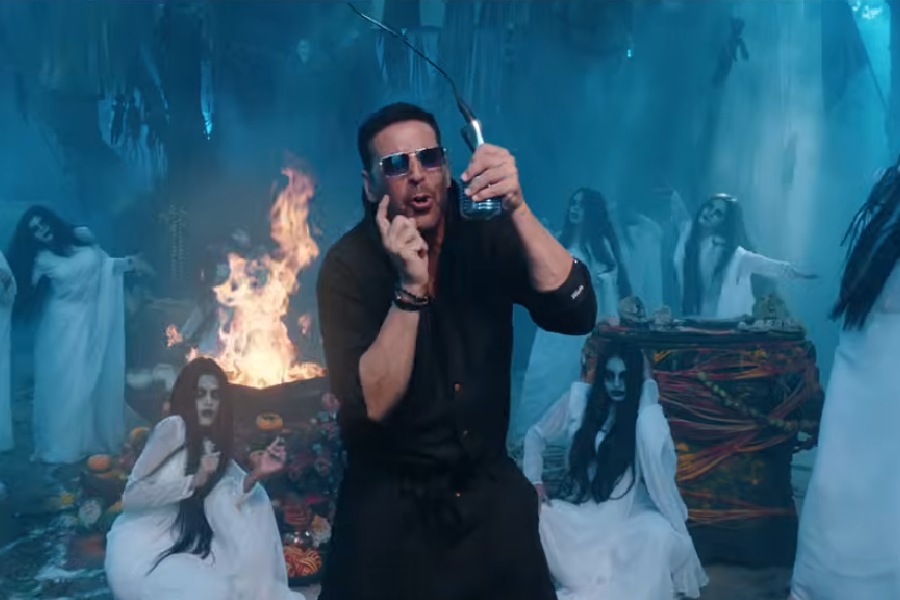
The film is set in the early 2000s and kicks off with a spooky legend. In the village of Mangalpur, a spirit called Vadhusur is said to abduct brides on their wedding night. Arjun Acharya (Akshay Kumar), who’s been living in London and is neck-deep in financial trouble, returns to India after inheriting his ancestral palace. With his sister Meera’s (Mithila Palkar) wedding coming up, he decides to fix up the property before the family gathers for festivities. However, Arjun’s arrival in Mangalpur acts as a trigger to wake up the spirit of Vadhusur, with the life of his sister on the line.
It’s a solid enough premise, and for a while, you think the film might build something interesting out of it. The setting helps — the long corridors, dimly lit rooms, and the sheer scale of the haveli do create an atmosphere. And Priyadarshan does spend a lot of time in setting up the premise in the first half.
There are clear visual and tonal callbacks to Bhool Bhulaiyaa, right down to the staging of certain scenes and even musical cues that feel faintly familiar.
Add to that a returning ensemble — Paresh Rawal, Rajpal Yadav, and the late Asrani — and the film leans heavily into that sense of déjà vu. It’s clearly aware of the legacy it’s drawing from.
But here’s where things start to slip. Unlike Bhool Bhulaiyaa, which had a psychological core, Bhooth Bangla goes all in on the supernatural. There’s no attempt to ground the horror in logic. Ghosts exist, curses are real, and that’s that.
To the film’s credit, some of the horror portions actually work. A few sequences are genuinely effective, more so than what we’ve come to expect from recent supernatural comedies.
The bigger issue is the writing. The story doesn’t quite hold together. It reveals too much, too soon, and all naked in the final 40-odd minutes. The so-called twist is easy to spot early on, which takes away any real sense of tension. What follows feels scattered, with characters drifting in and out and subplots that don’t fully land. At times, it almost feels like the film is making things up as it goes along.
And yet, it’s not without its moments. The humour, while uneven, is still a notch above the usual slapstick we often see today. Priyadarshan’s style — loud, chaotic, sometimes indulgent — still manages to deliver a few genuine laughs. They’re spaced out, but they’re there. Rajpal Yadav, in particular, gets some of the better bits and makes them count.
The late Asrani stands out the most. As the palace caretaker Shambhu Babu, he brings a certain sincerity that the rest of the film lacks. His scenes feel organic. He carries an effortless charm that defined his work. It’s just unfortunate that his character doesn’t get the closure it deserves.
The rest of the cast doesn’t fare as well. Akshay Kumar has flashes of his old comic timing, but the material doesn’t quite support him. Wamiqa Gabbi doesn’t get enough to do. Her romantic track with Akshay feels forced and awkward.
Tabu, despite her screen presence, is barely used. It feels like a missed opportunity. The same goes for Jisshu Sengupta.
What Bhooth Bangla ultimately struggles with is its dependence on nostalgia. It borrows the structure, the setting, even the tone of Bhool Bhulaiyaa, but it doesn’t bring enough of its own identity to the table. The earlier film worked because it connected with the audience. Here, those pieces exist, but they rarely click into place.