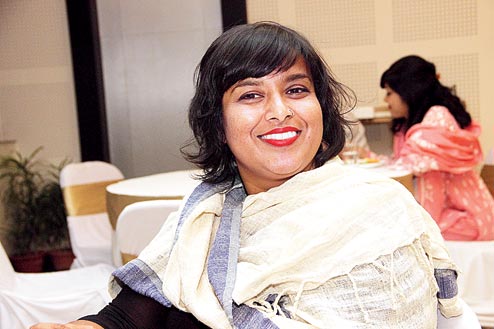

Picture: Shuvo Roychaudhury
I discovered Sri Lankan writer Nayomi Munaweera when her second novel, What Lies Between Us, landed on my work desk. It had me at the prologue, a spine-chilling tale about a moon bear breaking out of her cage on a bile farm to rescue her wailing cub. The novel was not about moon bears, but the story fit right in, after I’d reached the end. The protagonist remains unnamed until the end, for she has committed a crime unpardonable even in her eyes.
There was, of course, much to talk about when I finally caught up with the writer, now based in the US, at the recent Tata Steel Kolkata Literary Meet held in association with The Telegraph, to discuss the outcome of a war-torn childhood and a fragmented identity.
First, take us through your childhood...
I was born in Colombo, Sri Lanka, but left for Nigeria when I was three. My father was a civil engineer and my mother a teacher, so we moved around quite a bit in Nigeria. Nigeria was just emerging from its civil war and looking for Asians to help them build the place. We ended up in a very small village in the north of Nigeria in a state called Sokoto. But in 1984 there was a military coup, so they wanted us to leave really quickly. And we didn’t want to go back to Sri Lanka because the war had started. We ended up in Los Angeles to live with family.

Is that where your protagonist’s struggle with identity stems from?
I was 12 when we moved to LA and there was this sense of rupture and dislocation. I had a strange childhood because on the one hand I was very innocent in a way, I grew up in a Nigerian village, I wore a school uniform every day and then I was dropped in the middle of LA, which is super-sophisticated! They have style, they know about music... and I didn’t know any of those things. I didn’t really know where I was for quite a long time. I think the overarching theme of childhood for most writers is loneliness. You then turn to books and that was my experience too.
Your first book, Island of a Thousand Mirrors, came out in 2013. Was the process of getting published difficult?
I had a lot of Nigerian friends who I’ve never heard from again. My best friend was this Sri Lankan girl and when the ’84 coup happened, she moved to Sri Lanka and I moved to America and lost contact for years. We found each other on Facebook in 2011. We started talking again and bonding — your childhood can be so different when you look back as an adult than what you thought was happening. I told her my first book had been rejected by every publisher in America and she put me in touch with a Sri Lankan publisher who agreed to publish it.
And then it went on to be nominated for the DSC Prize for South Asian Literature and win the Commonwealth Regional Prize for Asia in 2013!
Yes, it got picked up by Indian publishers as well. It was interesting, she became an instrument of my fate even though we have very different lives.
You explore how childhood memories can be skewed, how events from our past can shape our present. What made you do this?
I know tons of women who have undergone sexual trauma, but women are told it’s a secret and you can’t talk about it. I know women who have been molested by servants and close family members. I read a lot about mothers who commit this particular crime I’ve described, it’s more common than we think. Often they ask for help but it’s not given to them. I wanted to write a character who had done something really terrible and I wanted to give myself the challenge of creating empathy for that character.
What was the most difficult part of writing a novel as intense as What Lies Between Us?
Writing the crime itself was very serious. To write everything, I have to become my characters, take on their skin and that’s a tremendously painful thing to do. It takes an emotional toll.
Are you all about the plot or the narrative?
I’m a character person. I start with the character and then weave the plot around them.
Tell us a little about the struggle with identity that the protagonist undergoes.
When you migrate, everything is destroyed. You have to start over and the new person is a conglomeration of what you have left, what you have gained. It’s a much more fluid personality. In America I’m considered a South Asian writer and in Sri Lanka I’m considered an American writer and I’m taught in diaspora literature. For logistical ease, I say I’m Sri Lankan-American, but what does that mean? In a certain way it makes you belong less and yet you belong to everything a little bit more. The outsider perspective is important for a writer, I think. For instance, people in Sri Lanka might be used to seeing things I write about — the beauty of the landscape perhaps. But I see it afresh.
Writers who have left their mark on you?
Salman Rushdie, Arundhati Roy, Lionel Shriver, Anita Desai, Margaret Atwood. What Lies Between Us is sort of a conversation between Toni Morrison’s Beloved and Shriver’s We Need To Talk About Kevin. There are certain things that have been left very ambiguous. In the latter, we don’t know whether the child is born psychotic or turned psychotic because the mother doesn’t love him. But she never makes it clear and she admitted to leaving things undecided because she didn’t really know. And in the same way, I don’t have some answers myself.
Ramona Sen