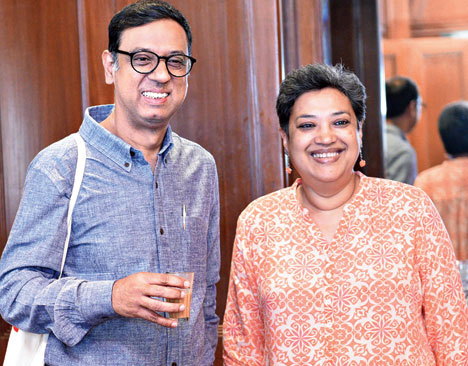

From the lifestyle of a journalist covering conflicts to what made him a writer, Kishalay Bhattacharjee, author and journalist, spoke about his books Che in Paona Bazaar: Tales of Exile and Belonging from India’s North-East, Blood on My Hands: Confessions of Staged Encounters and An Unfinished Revolution: A Hostage Crisis, Adivasi Resistance and the Naxal Movement. He was in conversation with author Sarita Dasgupta and a select audience at An Author’s Afternoon — presented by Shree Cement and Taj Bengal, held in association with t2, Prabha Khaitan Foundation and literary agency Siyahi — at the Alipore star hotel. Excerpts from Kishalay speak...
JOURNALIST TO AUTHOR
I was in Delhi, I was working for a television network, and there weren’t many private television networks in those days. Our resources were meagre. I used to cover conflict. We go and cover whenever there is an incident. I felt that it was a little unfair to the region, to the people that you cover because you tend to just go pick up that story when x number of people die, but you really don’t understand the place. That was something that I was confronted with.
I went to Guwahati for a year to set up the studio. A couple of days later, I went to a place called Nalbari in Lower Assam, where 11 people were killed on a night of celebration. When I was returning after covering that, I was directed to another place where another 17 people were killed. This whole series of massacres on a daily basis kept happening. After a year, it didn’t make any sense for me to return to Delhi, so I continued to stay. Neither did my office ask me to come back, nor did I express any desire to go back. I was completely sucked into the whole, you know, dance of death as it were, which continued for a very long time.
And then I got tired. I got exhausted. I realised I was repeating the same story over and over again, just the scene was different, the visual was the same because you just had bodies covered in white cloth. We were getting less and less airtime to be able to cover. Unless you have a double-digit number of people dying, it didn’t make it to the headline, so they were just snippet news somewhere or the ticker news. And I wanted to get out of that place, get out of that region.
Conflict is extremely sexy, but it’s also very difficult and exhausting on the ground. That’s why I actually hung up my boots and decided to start writing books and pick up teaching.
TALES FROM MANIPUR
Che in Paona Bazaar: Tales of Exile and Belonging from India’s North-East was written from little notes that I would take down while reporting. It is mainly out of Manipur but it touches on other states as well. These are the stories that join the dots of who these people are and what they do.
What fascinated me was that, in the middle of a four-hour curfew relaxation, in Manipur, during 1999 to 2002 — these were really bad street fighting years — you actually have a marriage party with the band playing and people getting married, because people got married, even in those times!
Also, Manipur is the best sporting state in the country. In Manipur, once I stopped because of a flat tyre and I was talking to a lady. She was tending her plants in the garden, preparing food for her children, and then I found out that she had won three golds in the Asian Games! Every single household out there will have a sports champion of some level, from boxing to archery. At the same time, most families will also have somebody who’s in the underground movement. It’s a peculiar society they live in.
In Delhi, even today, every month when Manipuri people call up their families back in the state, they expect to hear the worst. Some of the family members might have gone missing, somebody might have been killed, somebody probably would have gone and joined the underground.
In which other place do you have this kind of sanity along with dysfunctionality? How do you represent these people and places? One way is to let them speak their own stories, tell those stories, which will otherwise not be reported. We obviously have not been able to really pick up those stories and tell those stories, that they’ve learnt to live with the odds, and that needs to be celebrated as well.

THE PERPETRATORS SPEAK
Blood on My Hands: Confessions of Staged Encounters was published in 2015. It’s on encounters. The word encounter had the connotation of killing in streets, in Calcutta during the Naxal movement. But the dead don’t talk. It’s difficult to find out how they were killed. We can’t get accounts from the family and there are no eyewitnesses for these kinds of killings.
The only way of finding out is from the people who killed them. And so in this book, the people who killed them tell the story about how they killed and why they killed. In this book, perhaps for the first time, some of the perpetrators have narrated accounts of how they hunted down their prey.
This book, too, was completely unplanned. I was sitting at Fort William one evening with a certain army officer. I was having a drink with him when he mentioned that in a headline, it had been said that ‘seven terrorists were killed’, and I had reported it. He asked, “Did you report it?” I said yes, and he laughed. He said, “How could you do that?” I said it was reported, there was an official statement by the defence ministry. He said, “Not one of them were terrorists.” I asked him who they were. He told me that they were migrant labourers, people without an ID card, people who would not be missed or reported missing.
I mean, we were always suspicious of encounters but unless the people out there reacted, with, for example, what happened in Kunan Poshpora, we didn’t really have the resources to go out there and investigate. It didn’t make sense to pick up that story and as an individual reporter, we don’t really have the kind of forensic or ballistic expertise to check the details.
So when he said this, I started visiting him again and again. I asked him if he would mind if I took down notes. He said it’s fine and he became interested in it. At one point I thought, why is he telling me all this? So I asked him, because he was putting his life at risk. If it slipped out, even accidentally, that he was my source, he would be dead meat. He said, “When I go back home, and I look at my daughter’s face… it doesn’t feel good.” As I went further, probing into incident after incident, even for me, someone who has covered conflict for 25 years, it was hair-raising.
ABDUCTION AND RESCUE
I was posted in Calcutta. In the middle of the night I was told that two Italian tourists were abducted in the Kandhamal district of Odisha. I had never heard of Kandhamal! I left early in the morning, there was a flight to Bhubaneswar. It was a very small place. Daringbadi (in Kandhamal) did not have a single hotel, barely one eating joint, hot like hell!
It was in March-April and Odisha can be very inhospitable. Since it was the first international abduction by the Maoists, the international media as well as people from the Italian embassy were there. Every day we used to cook, play cricket, pass my time, because it was not like I could call up the Maoists and say, “Hey, guys, let me come!” In hindsight, the incident looks dramatic and nice but then out there, it’s very tough.
One night, I got a knock on my door. I got the information that the next day I was supposed to be somewhere and they (maoists) would take me in (to their hiding place). I wasn’t very sure if I should go or should not. I don’t trust people with guns at all!
But I went out there. The promise was that in four hours I’d go and come back. And I kept walking, and walking, for 16 hours through the jungle and the heat! But when I met the commander, he was very composed. He spoke in English, he fed us whatever was there. There was no semblance of a revolution happening out there. Even the cadres were really poor, deprived people. They just had guns, that’s all.
That’s when I realised that I’m not going back tonight, I’m going to be having a stop out here. I couldn’t sleep at night, there were flies all over the place. So I started a conversation with him when everyone else was asleep. And I kept talking, I was arguing, and at one point, I think out of frustration he said, all right, I’ll release one of the hostages for you!
Now, suddenly I was like... I haven’t come to take any hostages back, I’ve come to do my story! Now what do I do? If I leave him, and he dies, it will be on me; and if I take him and something happens to him, that will also be on me. Either way it’s my responsibility, and my office will probably tell me, who the hell told you to carry him back?
But I decided to take him back with me and I handed him over to the police station and he didn’t die. And when I was returning, I figured out that it was just an hour’s distance! They just don’t want someone following you. It’s not an experience I would recommend for anyone, including myself! It was a near-death experience.
Then I looked at the adivasi resistance, and I looked at the 50 years of the Naxal and the Maoist movement, and tried to put all three together, tying them around the hostage situation and trying to show how ridiculous a movement it has been, really, for 50 years, which we have not been able to address.
The book (An Unfinished Revolution: A Hostage Crisis, Adivasi Resistance and the Naxal Movement) is divided into several parts — there’s the part in which Claudio (hostage) tells his story about how he gets abducted, my story and then the commander’s voice — so three voices. And it was also about what was happening in Italy, with Elena, when she found out that her father-in-law had been abducted in India. It’s a parallel story.

Pictures: Rashbehari Das