Parliamentarians and scholars on Saturday regretted the attempts to present India’s complex history solely in terms of conflict and advocated efforts to highlight how the country’s past had been enriched by the confluence of cultures.
At a seminar on “Revisiting the Muslim contribution to India’s history, society and civilisation”, organised by the Indian History Forum, speakers underlined India’s syncretic culture, which they said the media had failed to foreground.
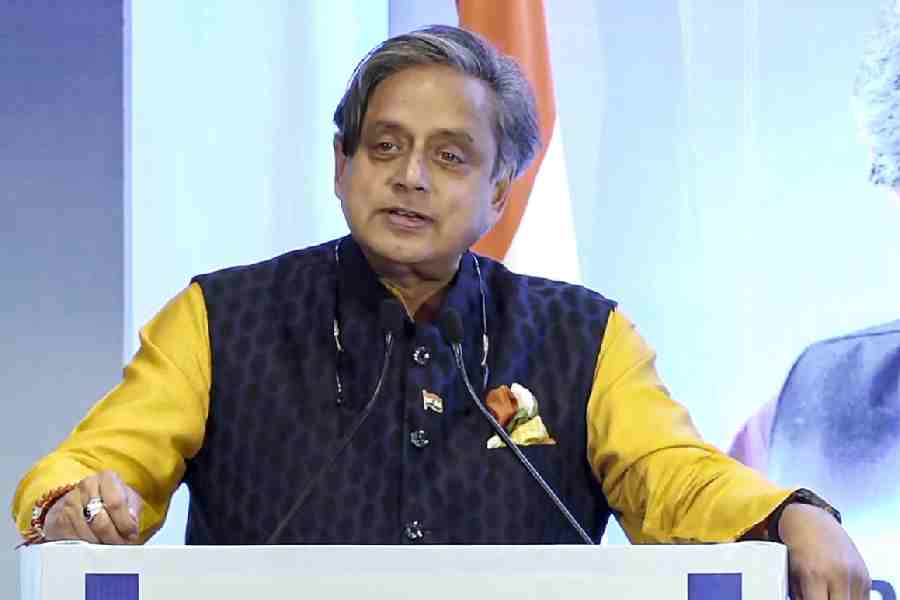
Among the speakers were Congress Lok Sabha MP Shashi Tharoor, RJD Rajya Sabha member Manoj Jha, former Independent Rajya Sabha MP Mohammed Adeeb, author Ashok Kumar Pandey and scholars S. Sadatullah Husaini and Shadab Moosa.
Moosa said today’s history textbooks often presented inaccurate and misinterpreted information. Nor did India’s museums adequately present Muslims’ contribution to the freedom struggle. The medieval period was the most contested area today, he said.
The chapter on medieval India in NCERT’s Class VIII social science textbook, Exploring Society: India and Beyond, describes the Muslims of South Asia as invaders who came to spread their religion.
It says they imposed the discriminatory jizya tax on non-Muslims, thus encouraging conversions, and that this period witnessed many instances of religious intolerance.
Tharoor said India never had a monolithic culture, and that the country’s evolution was marked by cultural interactions.
“The architectures stand as examples of synthesis. The Qutb Complex, Humayun’s Tomb, Taj Mahal provide evidence of a civilisation in conversation with itself. Any attempt to reduce India’s past to a single narrative is bound to fail,” he said.
Tharoor said attempts were being made to view India’s history through conflicts. He said historiography — the study of how history is written and interpreted — is central to understanding the past.
“To view the entire past through conflict is to miss the actual history. The complexity of civilisation is reduced to isolated incidents,” he said.
“Selective interpretation has become the practice. When history is presented selectively, there is a narrowing of perspectives.”
Jha said the country’s social fabric had deteriorated in recent years, and would take much longer to repair. He said today’s society was unlikely to produce people like Mahatma Gandhi and Jawaharlal Nehru, who were committed to secularism and India’s shared past.
Husaini, Adeeb and Moosa highlighted the attempts by some historians to marginalise the Muslim contribution to the nation’s past.
Husaini said Muslims did not come to India as invaders and did not loot the country’s resources. They settled here and contributed to the economy, trade, culture and education. Islamic rulers brought diverse regions together to create a single union.
Pandey said the media’s failure to highlight India’s syncretic culture led people to get the wrong message about communities and regions like Kashmir.
Congress leader Gurdeep Singh Sappal said the misinformation being spread about history and society was amplified by social media, which was controlled by IT companies.
He appealed to social media users to counter false narratives by circulating correct information.