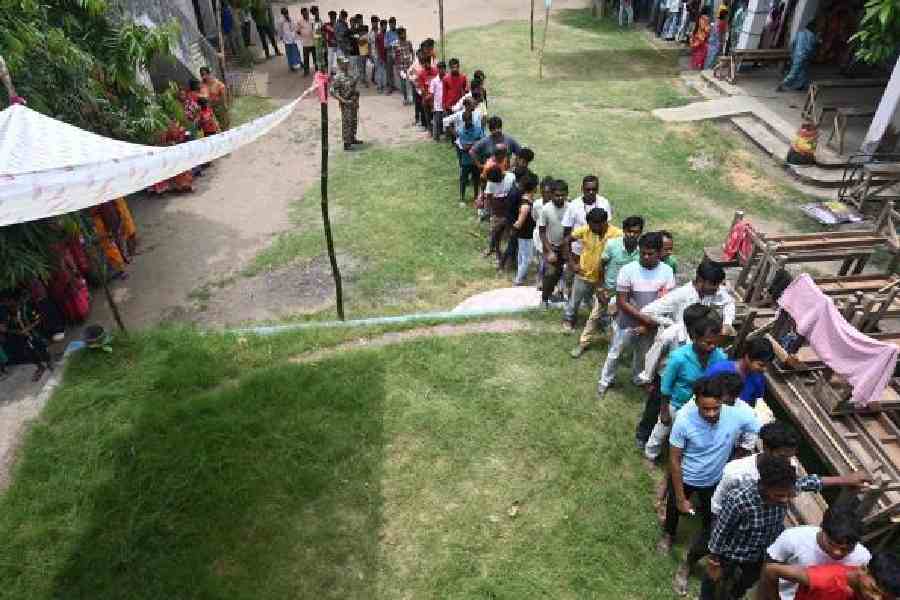
Three persons in the Canning (Paschim) Assembly constituency did not cast their votes after marking their presence at a booth on Wednesday, as they purportedly did not want to earn the wrath of the ruling party, officials in the South 24-Parganas district administration said.
This was the first instance in recent memory when people refused to vote by filling out the requisite form.
The three electors left the booth without voting after the Trinamool Congress's polling agent refused proxy voting. This has raised questions about whether the Election Commission could erase the “fear” from the minds of common people, although the voting was conducted peacefully.
On Wednesday, a voter in his early 60s arrived at a booth in Hatpukuria in Canning (Paschim), signed the register and got his index finger inked. Then, he asked the ruling party agent at the booth to cast a vote on his behalf.
“The agent then signalled that the elector should go and cast his vote on his own. But the voter insisted that the agent press the EVM button. The voter asked why the agent was not casting the vote on his behalf like in previous elections,” said an official.
The polling officials at the booth presented a demonstration on a dummy EVM to
teach the elector how to cast his vote.
“But the elector remained firm on his stand and repeatedly asked the agent to cast his vote. As the agent refused to cast somebody else’s vote, the elector said he would not vote because workers of the ruling party would not believe that he had exercised his franchise in their favour. He would not take a risk and would walk out,” said a district official, quoting a polling official at the booth.
But as the voter registered himself in the roster, it would have been a problem for the polling officials, as the figure of total voters and the votes cast would not match.
“When the man could not be convinced, the presiding officer proposed that he fill in Form 17A under Rule 49-O of the Conduct of Elections Rules, 1961, to declare that he would not record his vote. The voter did that and left the booth. The polling officials remained dumbstruck as they had never experienced any such incident before,” said an official.
But it was not the lone incident in the booth. Several other electors did the same thing, asking the Trinamool agent to cast votes on their behalf. When the agent refused to do so, most of the electors were convinced to cast their votes.
But two persons, in addition to the first one, refused to vote, saying the ruling party would target them if they cast their votes.
The duo also filled out Forms 17A to declare that their votes should not be recorded.
“The booth had a little over 1,000 voters. Of them, 999 had turned up. But 996 votes were cast as three of them refused to vote,” said an official.
An official explained the reason for the Trinamool agent’s refusal to cast proxy votes.
“Unlike previous elections, there has been a strong presence of paramilitary personnel this time. Besides, live and uninterrupted webcast from the booth ensured that nobody indulged in malpractices,” said the official.
When the polling officials at the booth were packing election-related materials at the end of the day, an agent of a political party told him that they were lucky that the voting was peaceful.
“The agent told the polling officials that that particular booth had had a history of EVM snatching, assault on the poll officials and random false and proxy voting,” said an official.
Senior EC officials said they were yet to be informed about the incident, but admitted that it was tough to erase the fear from the minds of voters in certain areas because of their experiences.
“It is tough to change the picture entirely in one election. This year, free and fair elections were held without major untoward incidents. People could cast their votes for the candidates of their choice. If this continues in the next election, the fear from the minds of some voters, which they had this year,
would be erased too,” said an EC official.