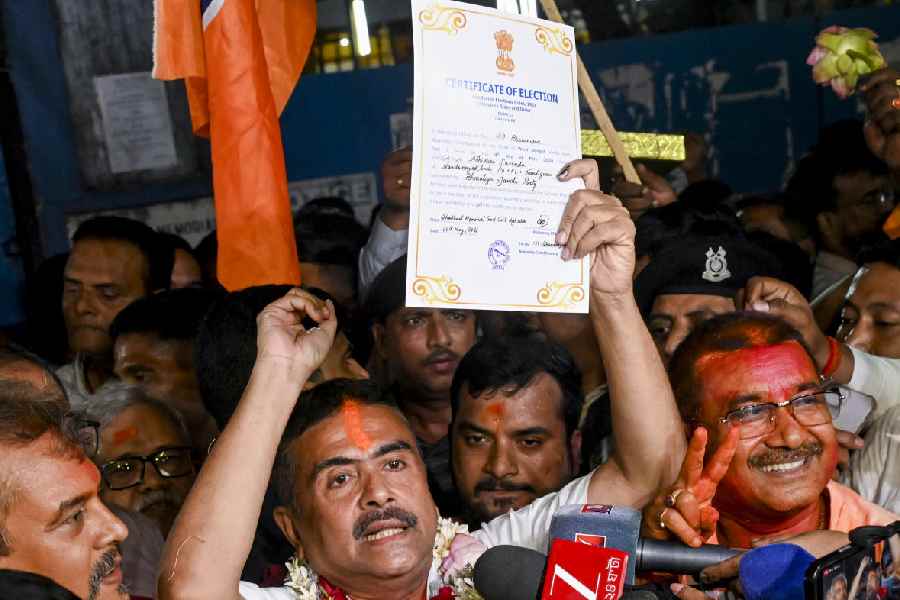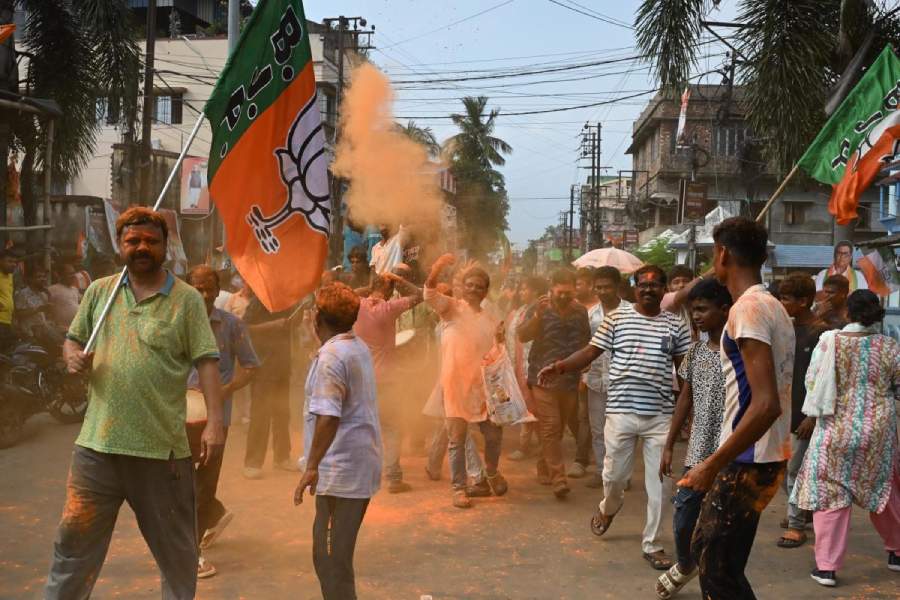
Days ahead of an election where Bengali identity has emerged as a key poll plank, both the Trinamool Congress and the BJP camps worked overtime on Poila Baisakh to showcase their admiration for all things Bengali.
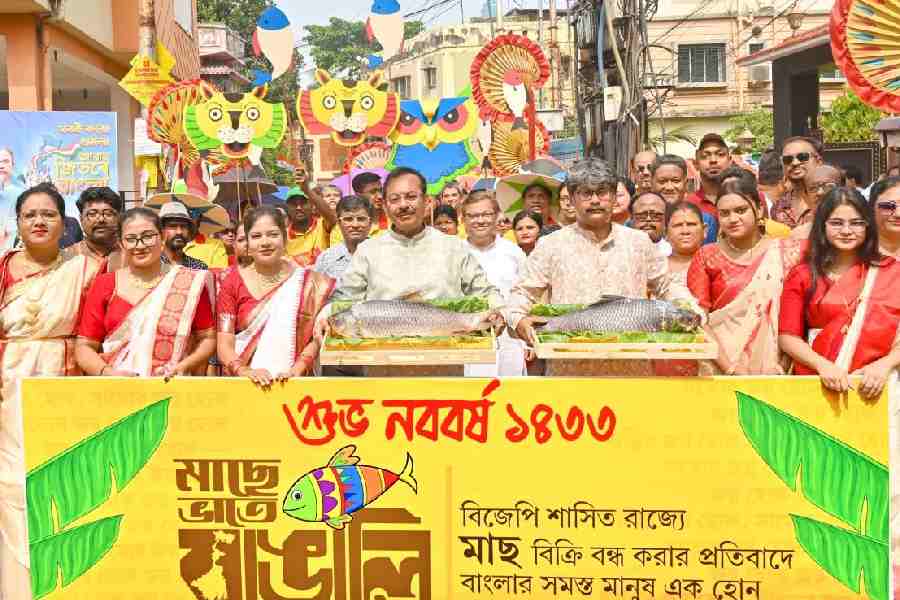
In Tollygunge, Trinamool candidate Aroop Biswas walked with giant rohu fish arranged on trays.
In Barrackpore in the north, BJP candidate Kaustav Bagchi carried a large fish in his hand, frequently holding it up for onlookers and people he met during the campaign trail.
In Kasba, Javed Khan went door to door accompanied by traditionally dressed women and men.
Elsewhere in the city, a BJP tableau featuring icons such as Rabindranath Tagore, Bankim Chandra Chattopadhyay, Satyajit Ray and Rammohan Roy moved through the streets, with “Shubha Nababarsha” written in large font on a banner across it.
The BJP’s avowed distaste for non-vegetarian food is believed to have sown doubts among sections of its sympathisers in Bengal.
In Bihar, deputy chief minister Vijay Kumar Sinha’s recent announcement of a ban on the open sale of fish and meat near religious places, schools and crowded areas “for health reasons and to maintain hygiene” has further complicated the BJP’s outreach efforts in Bengal.
At a rally in Haldia last week, Prime Minister Narendra Modi tried to dispel the perception. He promised to increase fish production in Bengal and criticised the Trinamool for failing to make the state self-reliant in fisheries.
“A double-engine government will make Bengal self-reliant in seafood and fisheries,” Modi said. “Despite such high demand for fish in Bengal, the state is still not self-reliant in fish production. Even today, Bengal imports fish from other states.”
On Wednesday, state minister and Tollygunge candidate Aroop Biswas used trays of fish during his outreach, holding one of them aloft. “The BJP has threatened against the consumption of fish, a Bengali staple, in states where the party is in power. Our campaign with fish is meant to emphasise the threat to our love for fish,” Biswas said.
Fish was not the only cultural marker on display.
Across the city and beyond, campaign rallies of both parties featured women in white saris with red borders and men in crisp dhuti-panjabi, carrying the kulo, the winnowing fan used to separate grain from chaff, now more often seen as wall decor in many homes.
Rabindrasangeet, now less frequently heard on Bengali occasions, also formed part of the processions.
Biswas said: “We did not carry a Trinamool flag in the rally. It was organised by a committee that organises a local book fair. But I walked because the rally is against the assault on fish-eaters elsewhere in the country.”
Across campaigns, Bengali identity, culture, food and iconic personalities have emerged as central themes for both principal contenders in the Assembly election.
While the Trinamool has accused the BJP of failing to understand the pulse of Bengali ethos, the BJP has countered by alleging that the Trinamool has weakened Bengal’s industrial eminence and cultural heritage.
Union home minister Amit Shah has promised a Bengali-speaking BJP chief minister if the party comes to power. He recently said the state’s first BJP chief minister would be one “born in Bengal, who speaks Bengali and is educated in Bengali-medium institutions”.
Political observers note that such identity-centric campaigning has marked a shift in Bengal politics. Subhamoy Maitra, a computer science professor and observer of state politics, said substantive issues were being overshadowed.
“Real issues have been replaced by the flaunting of identities,” Maitra said. “During the prime of the CPM and Congress, we did not see such competitive identity assertion. It stems from a nervousness and weakness of both parties.”
“Trinamool gets nervous when the BJP accuses it of appeasing Muslims. The BJP, in turn, is wary that voters may perceive it as anti-Bengali or disconnected from Bengali emotions and attachments,” he added.