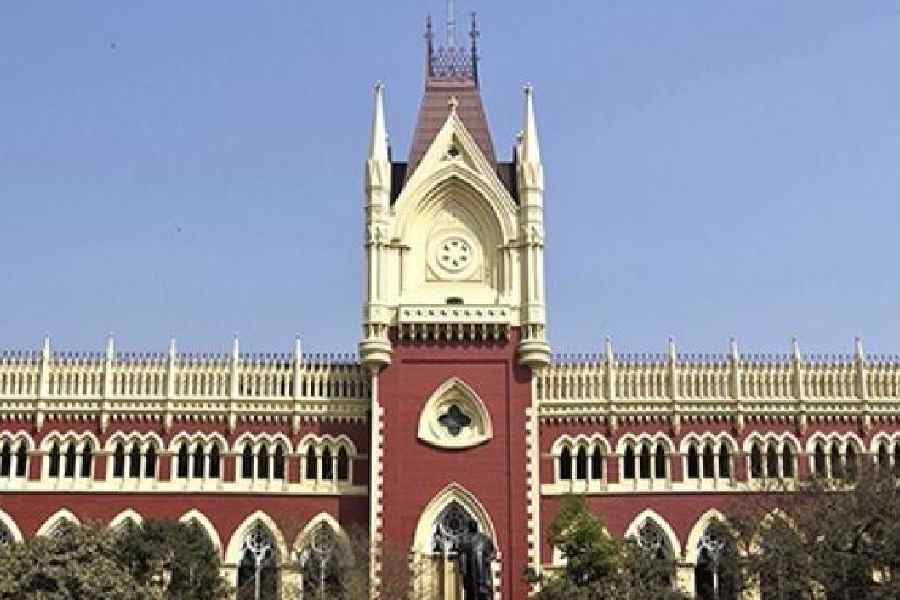
A division bench of the high court on Wednesday said that a citizen’s freedom can be curtailed only in accordance with law and held that the police observer in Bengal had “erred” in recommending action against around 800 people, many of them Trinamool Congress leaders, whom the Election Commission had identified as potential troublemakers.
“… in our prima facie view, the police observer in the office of Chief Election Officer, West Bengal, has erred in issuing blanket direction by treating certain citizens as ‘trouble-makers’. Hence, as an interim measure, we deem it proper to stay the effect and operation of the impugned order dated 21.04.2026 (Annexure – P/1) till the last day of June 2026 or till further order whichever is earlier,” the court said.
The order by the division bench of Chief Justice Sujoy Paul and Justice Partha Sarathi Sen came in response to an advocate’s PIL against the Election Commission.
This newspaper reported on Monday that the poll panel had prepared a list of “troublemakers” and informally shared it with police chiefs through police observers, asking for action.
On Tuesday, the EC issued a formal letter to the Bengal director-general of police, annexing a list of “troublemakers” and directing the police to take action.
Representing petitioner Danish Farooqui, senior advocate Kalyan Banerjee told the court that the list contained the names of about 800 people, including elected representatives such as councillors, members of panchayat bodies and municipalities, MLAs and MPs. Banerjee referred to Article 324 of the Constitution and said the “Election Commission does not have any unbridled powers”.
He said that an arrest by a police officer is based on his “discretion”, which helps the officer conduct a proper investigation, collect evidence and take action in accordance with the law. “Thus, the police authority must ask whether an arrest is necessary before undertaking the said exercise,” Banerjee said.
He added that he had no objection if the police took any action in accordance with the law against persons committing offences.
“The blanket direction dated 21.04.2026 is without any basis and is bad in law,” he said.
The state’s advocate-general, Kishore Datta, said that “troublemaker” is not defined in any penal law, and therefore, no blanket direction can be issued based on such categorisation.
Senior advocate D.S. Naidu, who represented the EC and appeared virtually, said the endeavour was to ensure “free, fair and peaceful elections.”
“In order to do the same, concerned police authorities are reminded of their duties. The EC has not directed the police authorities to do something without following due recourse of law,” Naidu said. He added that the petitioner had not disclosed where he sourced the list of troublemakers.
Advocate Joydip Kar, who appeared for the police, said it was the discretion and power of the police to take action in cases of the commission of cognisable offences.
After hearing all the parties, the division bench granted four weeks to the commission to file an affidavit on whether the Election Commission can issue such general instructions. “Constitution of India makes it clear that freedom of a citizen can be curtailed only in accordance with the procedure prescribed under the law,” the court said.
The court also said that the order should not restrict the civil or police authorities from proceeding against any person who commits an offence. “This interim order will not come in the way of the authorities to proceed against them in accordance with law as per their own independent discretion,” the court order said.
Reacting to the court’s stay, Trinamool spokesperson Arup Chakraborty said: “We have been saying that the term troublemaker is illegal, and so is this exercise to identify troublemakers by the ECI based on the BJP’s instructions.”