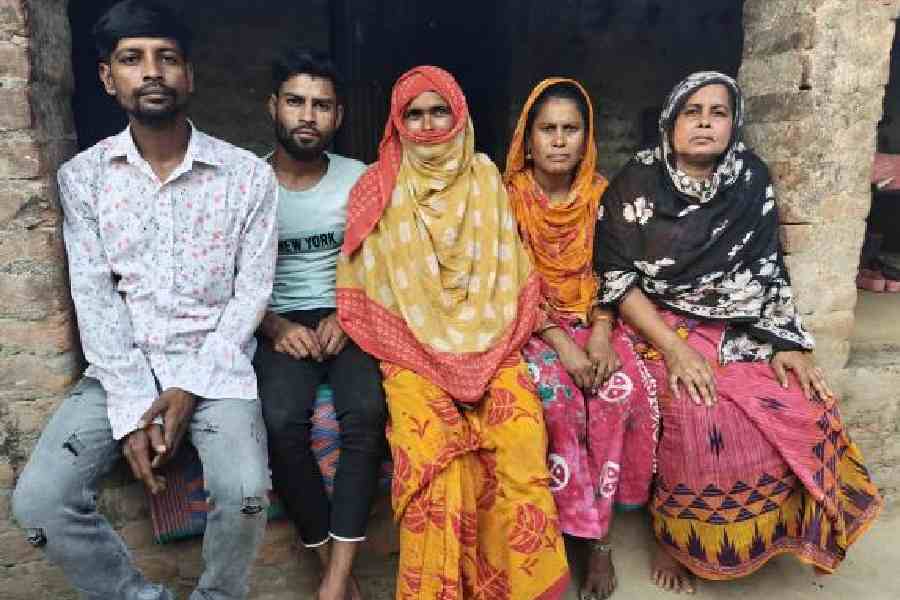
The Ramayan is playing out in post-SIR Bengal with a plot twist. Dasharath’s sons have been banished, not from Ayodhya but from the voter rolls, and Kaikeyi is not the agent provocateur.
The SIR axe wielded by the Election Commission has fallen on all six family members of Dasharath Sheikh in minority-dominated Murshidabad.
Dasharath, a poor marginal farmer and father of three, passed away 22 years ago. His name figured on the 2002 voter list, which was used to map eligible voters during the latest roll revision.
During the SIR, Dasharath’s wife Saunyara Bewa had mapped herself with her husband while their sons Hasibul and Hasan had mapped themselves with their mother. Their names were put in the under-adjudication category and deleted from the final roll. Dasharath’s daughter Sarjina Khatun and the wives of Hasibul and Hasan have also not made the cut.
“We fail to understand what our fault is. We have been voting for years. Now people are asking us to apply to the tribunal (set up to hear the appeals of deleted voters),” 30-year-old Hasibul told this reporter at a roadside tea stall at Subarnamrigi village in Murshidabad’s Bhagabangola Assembly constituency. Subarnamrigi is 238km from Calcutta.
The family now lives in fear, wondering if they have to give up their small plot of land and rights, including the government dole they receive.
“We are very poor. We can’t fight a legal battle. Local party leaders have been helping us apply to the tribunal. However, we don’t know what will happen after the election is over,” Saunyara Bewa said.
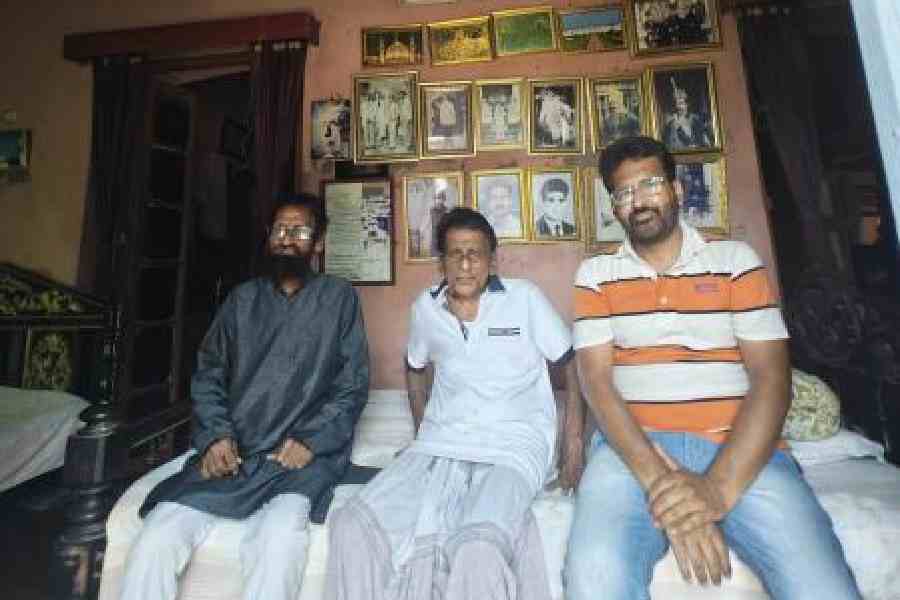
Nawab Syed Md Abbas Ali Meerza flanked by his brother Chhote Nawab Syed Reja Ali Meerza (black kurta) and son Syed Md Waquar Abbas Ali Meerza
Dasharath’s family used to cast their votes at the booth in Hafeznagar Primary School, where as many as 343 out of 987 electors have been deleted.
Murshidabad, with an average Muslim population of 66.27 per cent, has witnessed the highest number of deletions in Bengal.
According to data, Murshidabad had 57,64,085 registered voters before the SIR. The first round of deletions included 2,93,822 absent, shifted, dead and duplicate (ASDD) voters. Following adjudication, 4,55,137 voters were removed from the rolls, leaving the district with 50,07,996 electors.
The situation is similar in neighbouring Malda, which has a 51.27 per cent Muslim population.
As many as 4,59,530 ASDD voters were culled in the first round, while 2,39,375 were deleted during adjudication.
The disappointment over the deletions was palpable when this correspondent reached Malda’s Mothabari two days after nine judicial officials were held hostageon April 1.
Nafsul Sheikh, 51, a voter of Booth No. 134 in Mothabari gram panchayat, exemplifies how a clerical mistake can lead to the loss of voting rights.
In the 2002 list, he was registered as Nafsul Bibi, but marked as a male. After rectification, he was listed as a third gender and regained his original identity in 2011. However, during adjudication, he failed to establish that he was not a “Bibi”.
“I have no document to prove I am who I am,” he said.
The scale of anxiety became apparent when at least a dozen people mistook this correspondent for a poll panel official who could reinstate them to the rolls. “Write my name, write my name,” they clamoured in unison.
The requests grew louder, accompanied by cries detailing land ownership and ancestral roots. Like Dasharath, all these people are poor Muslims with marginal land holdings that they fear would be taken away.
Nawabs not spared
The SIR heat has also singed the Nawab’s palace in Murshidabad’s Lalbagh.Nawab Syed Md Abbas Ali Meerza, 83, is the current nawab of Murshidabad. After a long legal battle in the Supreme Court, the Nawab title was reinstated to his family in 2014.
His name remains on the roll, but he could not protect nearly 150 descendants of the Nawab family from deletion, including his younger brother Syed Reja Ali Meerza and son Syed Md Waquar Abbas Ali Meerza.
Members of the Nawab’s family said the deletion of names not only snatched away their voting rights but also brought a level of humiliation they had never experienced before.
“When the SIR hearings began, hundreds of locals queued up in front of our palace. They came with pieces of paper and requested us to certify that they were Indians,” Waquar said.
“They believed that if our family vouched for their identity, no one could delete their names. It was a matter of trust. However, we made them understand that our letter or guarantee would not work,” he added.
Now, Waquar’s name has been deleted from the list. “I wonder what I would tell those people when I meet them,” he said.
Additional reporting by Alamgir Hossain in Behrampore and Soumya De Sarkar in Malda