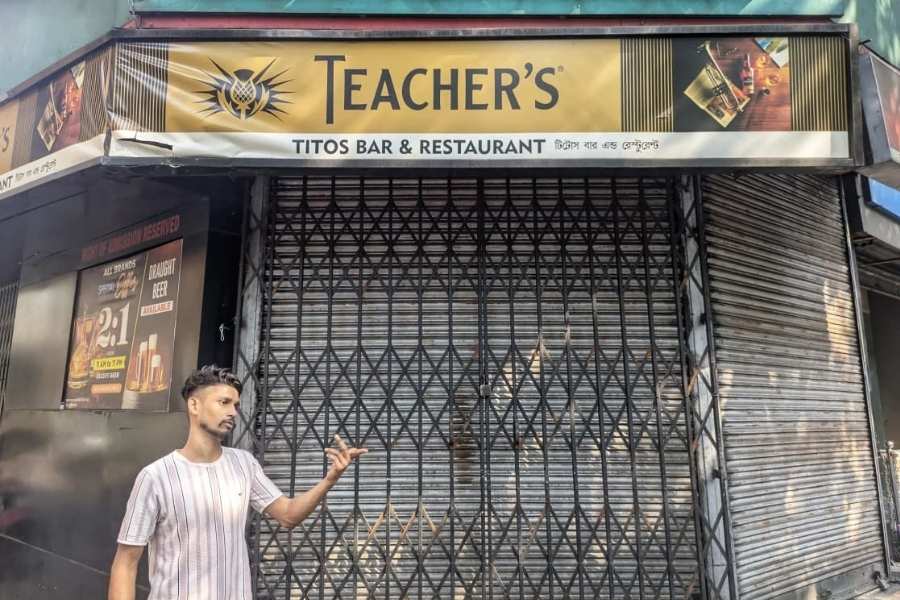
The Election Commission has invoked a 117-year-old, Raj-era law to impose an unprecedented 198-hour ban starting Monday on the sale and serving of liquor across Calcutta and other districts that vote in the second phase on April 29.
For the first-phase districts, the ban is effective 96 hours, from Monday till midnight of April 23, the date of polling. For the second-phase areas, the ban straddles this 96-hour period and then, after a gap, resumes from 6pm on April 25 and lasts till April 29 midnight, adding a further 102 hours.
This means the liquor ban for the first phase applies even to the second-phase districts.
Sources said the ban remains unparallelled on two counts. One, the duration: The standard poll-time ban, as imposed on most other states even in this round of Assembly polls, is of 48 hours till the scheduled conclusion of polling.
The poll-time ban is 56 hours in Tamil Nadu this time.
Two, the ambit: In a multi-phase election, never before has the liquor ban been clamped across the state for a single phase. At best, it has been extended to a contiguous district. However, Calcutta is not contiguous with any first-phase district.
Liquor will be out of bounds also on May 4, the day of counting.
Given the social taboo surrounding drinking among vast segments of Bengali society, the political parties are unlikely to turn the ban into a poll plank the way some of them have gone to town against the spectre of a meat and fish ban by a prospective BJP government.
A senior Trinamool Congress leader, though, joked that the alcohol ban could cause a big swing in his party’s favour among voters who like their tipple.
An order from the state excise commissioner reached officials on Sunday evening, imposing the 96-hour ban. On Monday, all the district authorities issued separate orders, with those for the second-phase districts clamping the 198-hour ban. By then, authorities had called up bar, restaurant, pub and alcohol shop owners and told them to down shutters.
While none of the orders was issued by the poll panel directly, excise commissioner Kaushik Bhattacharya, Calcutta police commissioner Ajay Nand and all the district magistrates are on deputation to the Election Commission.
“This decision was surely backed by the BJP high command. Such a bad idea, giving rise to fears of a wholesale prohibition (if the BJP comes to power),” the Trinamool leader said.
The excise commissioner’s order attributed the decision to an “unusual spurt” in liquor sales since the model code of conduct kicked in, and cited a “sudden growth” in packaged liquor lifted by retailers from WBSBCL depots and an increase in “sensitive shops” identified as hubs for potential voter bribery.
“…Given the gravity of the situation, the period of closure of retail establishments is required to be extended to 96 hours, which is beyond the (usual) period of 48 hours...,” it said.
“Therefore, to ensure that liquor is not used as an inducement... and a free and fair poll takes place, the special provisions of Section 26 of the (Bengal Excise) Act has to be invoked….”
Section 135C of the Representation of the People Act, 1951, restricts the election-time liquor ban to the 48-hour period ending with the hour fixed for the polling to conclude.
“While this 48-hour window had been notified for all the states (and Puducherry) going to the polls this month, the EC tore into the rulebook and bypassed its legislative constraints by invoking Section 26 of the British Raj-era Bengal Excise Act, 1909,” a source said.
Section 26 empowers district magistrates and the police commissioner (only Calcutta had one at the time) to issue written orders for the temporary closure of shops selling intoxicants to preserve public peace. It was usually invoked for emergencies like riots or localised unrest.
“The EC is effectively hiding behind this colonial-era legislation. Had this provision not existed, the move would have faced immediate challenges in court, potentially leading to the order being struck down,” a Trinamool source said.
A retired IAS officer with long experience in electioneering said he had never seen anything like this and wondered why Bengal had been singled out.
“It’s clear that the EC is going out of its way to raise hurdles before Mamata Banerjee,” he said.
“Having said that, very little about this current lot running Nirvachan Sadan makes sense to people like us, who have seen many a CEC and many a full bench but none so nakedly partisan as this one.”
In Calcutta, liquor shop owners received calls demanding compliance till police commissioner Nand issued the order. “As directed by higher authority, don’t open your liquor shop until further orders,” an off-shop owner quoted the caller as saying.
Retailers received the news with dismay.
“Again, like the demonetisation or the poorly planned hard lockdown during the pandemic, this overnight ban came as a rude shock, with no time for anybody to prepare,” the owner of a Bhowanipore off-shop said.
The Darjeeling hills remained nonchalant. “For a region that endured a 104-day shutdown in 2017, a 96-hour dry spell is little more than a pinprick,” said Sagar Tamang, a Darjeeling-basedbusinessman.
A BJP insider said the central leadership in Delhi seemed to have reckoned that any friction caused by this directive was a price worth paying to neutralise the threat of voter inducement by Trinamool.
“But we aren’t so sure this won’t backfire,” he said. “Why did we assume that our people don’t drink? I do. A great deal, to be frank,” he added, laughing.
Additional reporting by Vivek Chhetri in Darjeeling and Pheroze L. Vincentin Chennai