 |
 |
 |
 |
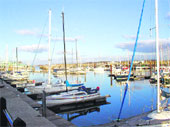
| (From top): A view of the marina at Fleetwood; the lighthouse adds a picturesque touch to the coastline; the famous Welcome Home sculpture; shops line the boardwalk at the marina |
Let’s get one thing straight: Fleetwood has nothing to do with Fleetwood Mac. It’s a small, sleepy, fishing town on the Lancashire coast, a dot on the map often ignored even by the detailed weather reports for north-west England. But it’s famous in the Indian merchant navy as the place where officers go to study and wives to holiday. Fleetwood’s greatest claim to fame is its ‘Fleetwood Style Fish and Chips’, which is advertised as far as Lancaster, almost 50 miles away.
Fleetwood’s also a seaside resort but that’s only for a few months in summer. The winters are dreary and from late October onwards, car owners start the day by flinging hot water on their windscreens to melt the sheet of ice that forms in a few hours. So during the winter months, it’s best to hop onto a bus for the 10-mile ride to Blackpool, the sea resort that thinks that it’s the Las Vegas of the UK.
For many merchant navy wives, two months in Fleetwood is a ritual that has to be undergone at some time or another. My husband spent his time at the town’s well-known educational institution: the nautical studies college. We stayed two streets away from the sea-front ? barely two minutes’ walk. Our working-class neighbourhood was idyllic with neat rows of red-brick houses, many owned by athletic young fishermen who littered the street with beer cans on Saturday.
The promenade by the sea is paved with fishy drawings on the tiles. And a fisherman’s family, cast in metal, awaits him back from a gruelling day on the high seas. There was also a miniature lighthouse, adding a picturesque touch to the shoreline.
Fleetwood isn’t exactly a bustling port and only two big ships docked each day. One of them was the Stena Leader. We learned to guess the time of day from when we first heard the Stena Leader around 3pm and when it finally docked half an hour later. On sunny days, when the sea looked like a painting, all the older folk came out to the sea front. On such a day in September, I made the mistake of sitting in the shade with a book. An old lady walked up to me sternly and said, “Please make the most of the sun while it lasts. Don’t sit in the shade!”
What perfected the bucolic bliss was the frying fish. The fresh air from the sea was scented further with the aroma from the small shops that dotted the seafront as well as the streets. They did not need to announce themselves by any name, as the trademark smell of batter-wrapped fish frying in vegetable oil would announce their ware. Still, they came with interesting names ? the one we visited first was simply called Beatty’s Kitchen, but the one diagonally opposite it was Fisherman’s Rest.
There was competition, too ? another shop, just opposite the Lancashire County library claimed in bold letters that it sold true Fleetwood fish-and-chips. Though we never got to know what the true Fleetwood fish was, we did our best. We raided the fish-and-chips shops the first few days and we learnt to sort the good from the bad.
Finally we figured out how to find the shops with the fresh haddock and light and crisp batter. Apparently, one secret is to cook the fish in beer.
Whatever the reports on British food, if you are discerning, you can get every penny’s worth out of fish-and-chips. But Fleetwood had one problem. Two, actually. The second one first. The sea-air was bracing and the smell of fish stimulating, but there was also a whiff of racism.
And the greater problem was that it closed down completely after 4.30 in the evening. The answer was Blackpool, a 20-minute drive, which we visited often.
The day we first visited Blackpool ? I had landed at Manchester airport the same morning and driven to Fleetwood ? my husband was on his job-hunting trip. He would need a part-time job to fund his studies. Blackpool was as corny as I had been told. On the long promenade by the famous Pleasure Beach, where is installed one of the oldest wooden roller coasters of Europe, built in 1909 and done up in 1933, we jostled ? happily drunk, singing, not minding the smell of fried fish that seemed a little too pungent.
Loud music blared out from one of the nightclubs, from which a group of young women wearing conical bras tumbled out. Neon lights glared from the casinos and a giant screen projected a vaudeville-style show that was going on inside one of the nightclubs.
When we came to the county council, a few jobs seemed to be on offer. My husband was told to go straight to a big nightclub, Funny Girls, which was looking for waiters. It was a swank three-storey building with impressive bouncers lurking at the entrance, where posh fresh-from-salon women were queuing up. But the women ? they were not quite women. They were cross-dressers. Funny Girls was the biggest gay nightclub in Blackpool. My husband didn’t get the waiter’s job.
Blackpool is famous for its illuminations and this was the time of year when the lights were turned on. A stretch of 4 miles, starting at the South Pier is lit up from September to November. We were cynical at first but when the lights were switched on, the effect was enchanting. Along the dark seafront, suddenly there were scenes from fairy tales like the Seven Dwarfs and Ali Baba.
But too much of Blackpool would be bad for health, so we gradually started going there less and looking around a bit. We tried to visit the Isle of Man, but the ferry had stopped plying from September. So, desperate one day to see the countryside, I went on a bus ride alone. The coach rambled through the countryside, stopping almost anywhere.
We went through Bowland Forest, with its picturesque springs and lush meadows and stopped to have lunch in a country pub near the Trough of Bowland. Then another woman and I began to look around, pushed a gate, and there was a narrow pathway. We walked up to the top of a small hill, and the entire forest lay at our feet!
Just before I left, we managed a trip to the Lake District. There wasn’t much time, so we made it a day trip and visited Windermere and Grasmere. It rained madly that day ? a friend later told me that there were 30 types of rain in the Lake District. But still it couldn’t dim the fall colours that rose in flames all around. Lake Windermere was a dream. But my husband was grumbling that he wasn’t wearing his hardiest pair of sneakers for this muddy trek. Clearly, the Lakes hadn’t stoked up his poetic spirit.