The Union government has proposed setting up a ₹1 lakh crore (trillion) Economic Stabilisation Fund to provide fiscal headroom to respond to global shocks and unforeseen crises, finance minister Nirmala Sitharaman told Parliament on Friday.
Sitharaman said the proposed fund would enable the government to respond quickly to external disruptions such as the ongoing conflict in West Asia, supply chain disturbances and sudden economic shocks affecting specific sectors.
The proposal forms part of the second batch of supplementary demands for grants, which provides for inter-account transfers of ₹1 lakh crore to establish the stabilisation mechanism.
“The Economic Stabilisation Fund will provide fiscal headroom to allow India to respond to global headwinds such as the recent crisis, unanticipated supply chain disruptions, unexpected shocks to sub-sectors in the Indian economy and any other event that may have significant fiscal implications. So in anticipation of what cannot be anticipated, we are coming up with an Economic Stabilisation Fund,” Sitharaman said.
She also emphasised that the additional spending proposed in the supplementary demands will not affect the fiscal deficit target for the financial year 2025-26.
Under the Revised Estimates (RE) for 2025-26, the fiscal deficit has been retained at 4.4 per cent of GDP, the same level projected in the Budget Estimates (BE).
The second batch of supplementary demands seeks parliamentary approval for additional gross expenditure of ₹2.81 lakh crore during the current fiscal year. After accounting for additional receipts of ₹80,000 crore, the net additional cash outgo is estimated at ₹2.01 lakh crore.
Apart from the proposed ₹1 lakh crore allocation for the Economic Stabilisation Fund, the supplementary demands include an additional ₹19,230 crore towards fertiliser subsidy and ₹23,641 crore for subsidies under the Pradhan Mantri Garib Kalyan Anna Yojana (PMGKAY).
Sitharaman assured Parliament that farmers would not face any shortage of fertilisers and that adequate provisions have been made in the supplementary demands to meet requirements.
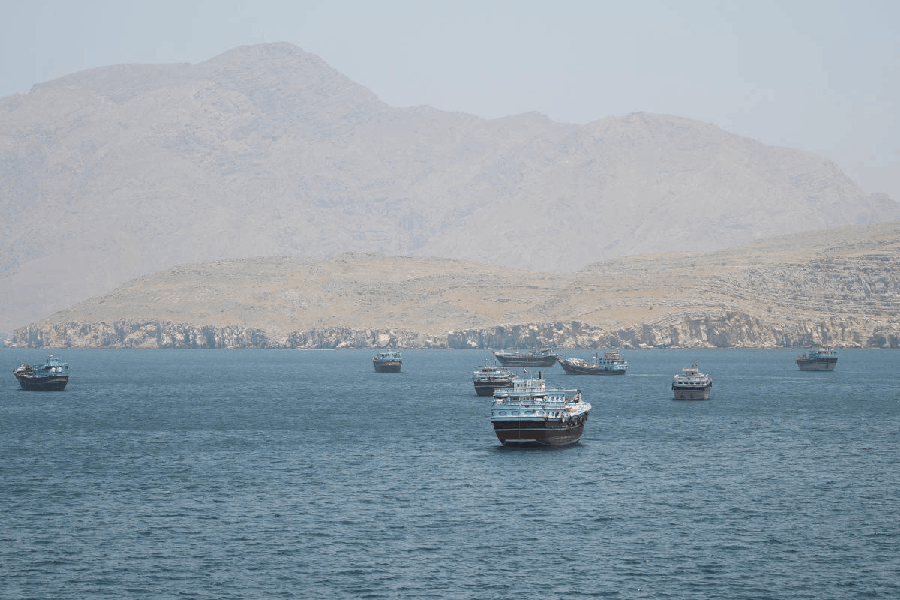
India’s fertiliser subsidy bill has come under pressure after the conflict involving Iran disrupted shipping routes through the Strait of Hormuz, a key global corridor for fertiliser trade. The disruption has pushed up prices of crop nutrients such as urea and ammonia, raising import costs for major consuming countries, including India.
In the Revised Estimates for the current fiscal year, the government reduced total expenditure to ₹49.65 lakh crore from ₹50.65 lakh crore projected in the Budget Estimates.
According to data from the Controller General of Accounts, the Centre had spent ₹36.90 lakh crore by the end of January.
Sitharaman reiterated that there would be no increase in overall expenditure beyond the levels projected in the budget for the current fiscal year.