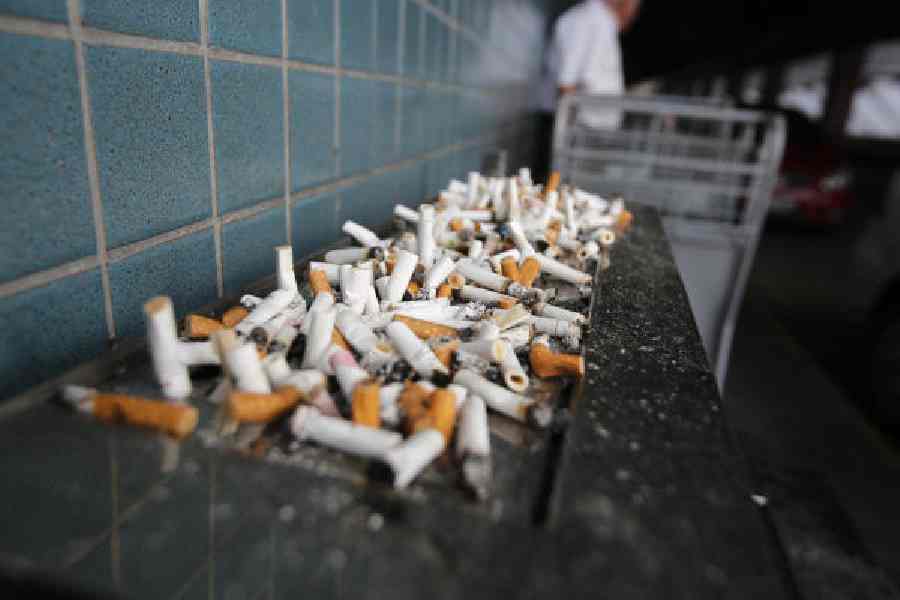
The habit of smoking is going to cost consumers way more with the Centre imposing a crushing excise duty on tobacco products (cigarettes) from February 1, potentially pushing up prices by ₹2-3 per stick if companies decide to pass on the full impact of tax burden to consumers.
A health and national security cess and excise duty on pan masala and tobacco products, respectively, will be over and above 40 per cent goods and services tax (GST) rate, while in case of ‘biris’ it would be on top of the 18 per cent GST rate effective February 1 according to notifications issued by the finance ministry late on Wednesday. The new tax will replace the compensation cess.
The Tobacco Institute of India, the industry body of cigarette manufacturers, warned that this unprecedented increase “will cause immense hardship and loss to millions of farmers, MSMEs, retailers and local value chains nurtured by the industry, besides providing a huge fillip to Illicit Industry and damaging national enterprises.”
Shares of tobacco companies subsequently took a deep cut, with Godfrey Phillips India tanked 17.09 per cent to settle at ₹2,289.65 on the BSE and shares of ITC tumbled 9.69 per cent to end at ₹363.95.
“This is a harsh increase and hence we forecast volumes/EBITDA in cigarettes business to decline YoY in FY27 after good volume growth in FY26 (almost 6 per cent). Historically, after such a sharp hike, volumes decrease 3–9 per cent,” Abneesh Roy of Nuvama wrote.
A new MRP-based valuation mechanism has been introduced for tobacco products (chewing tobacco, filter khaini, jarda scented tobacco, gutkha) whereby GST value shall be determined based on the retail sale price declared on the package.
An additional excise duty of 91 per cent on gutkha, 82 per cent on chewing tobacco and 82 per cent on jarda scented tobacco will be levied. Cigarettes, depending on length and filter, will be taxed in the range of ₹2,050-₹8,500 per 1,000 sticks.
Jefferies analysts also called the move “a clear negative,” saying it would hurt sales volumes and revive concerns about losing share to the illicit industry.
Nuvama believed the higher taxation was driven by the government’s desire to
make up for the shortfall from GST rate cut and also to contain sustained single digit growth in the legal cigarette industry.