Book: REBELLION IN VERSE: RESISTANCE AND DEVOTION IN THE TAMIL BHAKTI MOVEMENT
Author: Raghavan Srinivasan
Published by: Viking
Price: Rs 999
“Why chant the Vedas, or follow Vedic karma?
Why preach day after day the books of dharma?
Why learn the six Vedangas by rote?
One thing alone will to your rescue come —
Thinking always of the Lord supreme.”
This hymn, by the seventh-century poet, Appar, quoted in Raghavan Srinivasan’s book, exemplifies its rebellion against Vedic rigidity and ritual. “The saints of this movement were poets of the people, composing their hymns in Tamil, and their verses, brimming with simplicity and profundity, wrestled divine wisdom from the elite grip of Sanskrit and handed it to the masses.”
Rebellion in Verse traces the trajectory of that movement, which championed deep personal devotion, over the many centuries that it was active (primarily the sixth to the ninth centuries), beginning the narrative with the Sangam era (it flourished between c. 200 BCE and 300 CE) to contextualising the reasons that led to its inception. The 14 chapters of the book can be roughly categorised under five heads: how the Bhakti movement drew from Sangam foundations, the lives of the saints, the technical aspects of the poetry (including iconography), the female poets of the era, and comparisons with other spiritual systems (like Jainism and Buddhism) that had held sway over Tamilakam (as the Tamil region was known then).
Perhaps the most engaging part of the book comprises the stories of the lives of the saints. The two most captivating ones are those of Nandanar and Tiruppan Alwar, both of whom belonged to a lower caste and needed divine intervention to get access to the lord they worshipped in a temple. And once they entered the temple, “they pulled off the ultimate disappearing act… they merged with the god, vanishing into the sanctum as if they were part of the divine family all along.” This constituted, the author emphasises, “the pinnacle of devotion, the final goal for any Bhakti saint.” Of the many others described in the book, Tirumangai Alwar, who went from being military commander to bandit to saint, is another fascinating story.
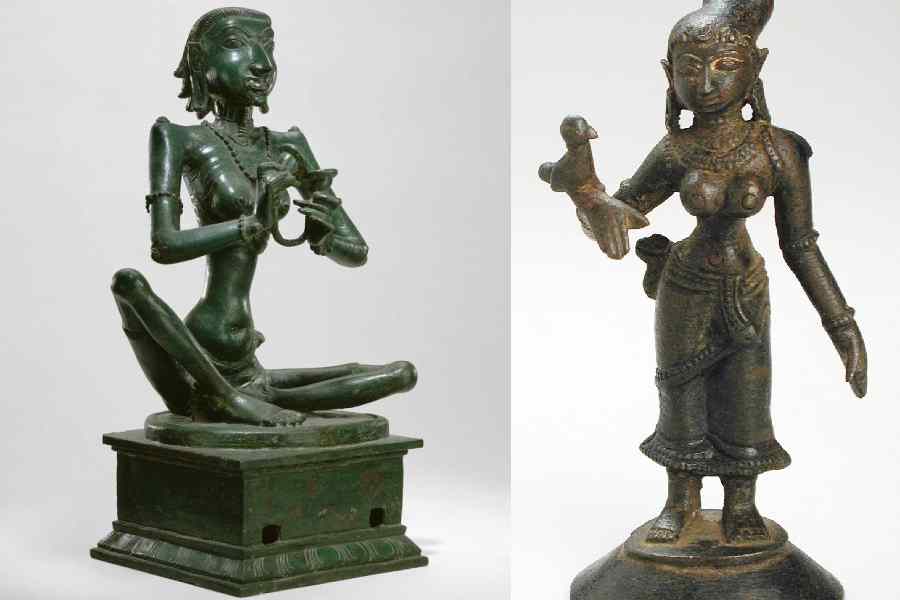
Andal and Karaikal Ammaiyar’s paths were more difficult as women saints as they had to navigate patriarchy and societal expectations. Ammaiyar (picture, left) was nicknamed ‘Peyar’, or ‘ghostly mother’, because of “her wish to shed physical beauty and adopt a ghoulish form”; Andal (picture, right) chose not to marry at all, aspiring to become the divine spouse of Krishna — like Mirabai eight centuries later.
Like the Sangam poets themselves, Srinivasan’s aim is manifestly to make the book accessible to a wide audience. In that effort, he not only writes in an accessible style but also adds humorous asides. For instance, he comments, “Why settle for Mr Right when you can have Mr Divine?” while talking of Andal’s aspiration to marry Krishna. Elsewhere, he says, “If the Pallavas were content with a spiritual handshake, the Cholas went for a bear hug”; this, while elucidating on the Cholas taking the Pallava strategy — of garnering the grassroots support of the Bhakti movement to their political advantage — to new heights.
There are several other features that go to make the book comprehensive and interesting — the exhaustive notes, biblio and chronological table (of the birth and the death dates of key saints, both from the Saivaite Nayanars and the Vaishnavaite Alwars) and the figures (numbering 20 in all) that add to the visual appeal of the book. Above all, the liberally sprinkled quotes from the Bhakti verses themselves give the book its sense of authenticity, some staying with the reader long after closing the book.