Book: EM, NO, NAHEEN
Author: Tarun Bhartiya
Published by: Yaarba
Price: Rs 1200
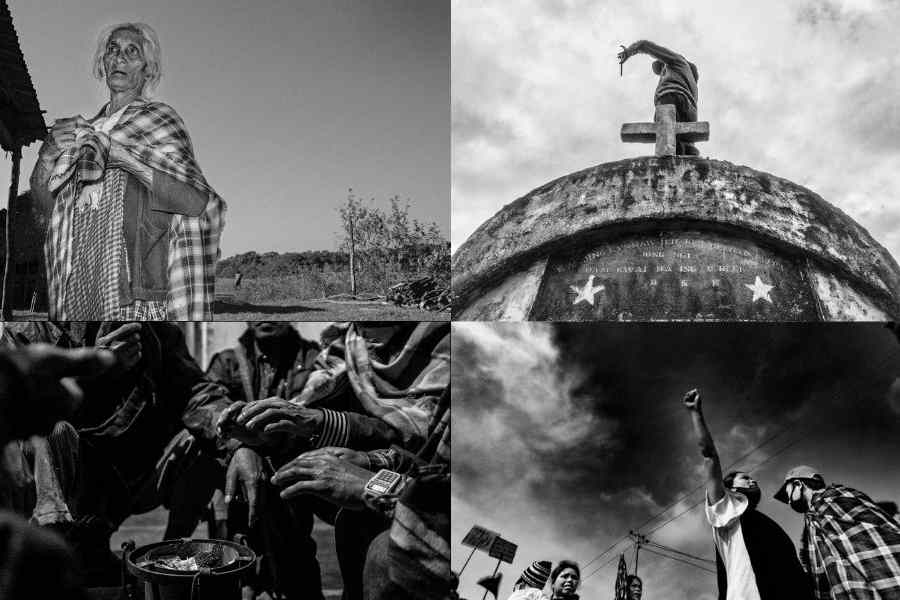
Tarun Bhartiya’s photobook, Em, No, Naheen, is a quiet masterpiece of black-and-white storytelling in still photographs that manages to evoke the best of a forgotten era of silent cinema. It tells the story of the West Khasi Hills of Meghalaya and the refusal of local people to give up their land for the lucrative (for the state, for mining interests and, to a somewhat lesser extent, for them) purpose of uranium mining. Like the silent film traditions the book draws upon, it tells the story with a minimum of text, dialogue, or linguistic intervention. To be sure, there are texts, in Khasi and in English, that give us the context for the pictures taken over nearly two decades, from 2006 to 2023. Separate texts tell us about uranium mining and its energetic and ecological consequences (a very informative accompanying booklet). Tarun’s own narrative, reconstructed and put together from his journal notes, accompany the photographs, as do poems written by others which relate to the events. At the end of the book, there is a timeline of events; and one must, of course, read Angela Rangad’s powerful Afterword to bring the effects of the photographs from the subconscious
to the more conscious level. But the burden of the narrative is carried by the photographs themselves, in terse contrast and counterpoint. They show us a life of a group of people, banal, profane, and commonplace, but, at the same time, powerful. ‘Resilience’ is a word that has suffered much from overuse, rendering it an annoyance encountered in anthropological and NGO texts; but it once had weight, and that weight is tangible in Tarun’s photographs.
The photographs themselves, of the trucks, churches, still-cooking pigs, lines of houses, interiors and exteriors, wall-signs, the landscapes and skies, and the people, celebrate lives that, through the lens of a lesser photographer, would be boring, commonplace. Why should we want to know anything about these people?
Perhaps this is because of the uranium story behind it. But, whereas this is often true of photo-reportage (it is the story that makes the photographs), in Traun’s case, it is the other way around: we want to know the story that goes with the pictures. We of the intellectual classes have been ground down by tales of environmental depredations, powerful mining corporations colluding with states, and are even cynical about the occasional story of successful resistance. We are still capable of being moved: through Tarun’s eyes, we want to be at the table of the people he sees, talks to, moves with. And we want to know the story because we have seen them.
The narrative starts with the funeral, in 2000, of Kong Spillity Lyngdoh Langrin, the woman under whose land uranium was found, and whose refusal to contemplate its mining gives the book its title. What sort of freedom, she asks, emanates from the loss of a way of life and the gain of a theoretical wealth that cannot be enjoyed? Her refusal sparked a movement to keep uranium mining away from the Khasi Hills. As we are listening to Tarun tell the story after his own untimely death in January 2025, we cannot but think analogously of the deaths of the main protagonist and the chronicler.
Uranium mining’s extremely disruptive impact is recorded, in the accompanying information, along with the comparative figures for other forms of power generation. The myth of ‘clean’ power, upon which the quest for nuclear energy for allegedly peaceful purposes had been built over generations, is, of course, unsustainable: the impossibility of dealing safely with radioactivity and the relative cheapness of thermal power are themes that we ought to address head-on rather than through the lens of ecological romanticism. Subliminally at least, we have also been told another important story; that of an insatiable quest for more and more energy that marks and mars human existence.
Reviewing this book involved, for me, looking back alone at a partially-shared past. I first met Tarun in Delhi in 1995; I had known him for just under thirty years when his death abruptly terminated our communications, sporadic at times, and intensely regular and argumentative at others. It was Tarun who ‘sold’ me my first proper camera in Cambridge. His was the most sensible voice in the evening discussions among opinionated university types; when asked what he was studying, he would say “oh, I am the accompanying spouse.” In the years to come, we would consult each other on various subjects, and he would commission me to write for Raiot, the journal he edited, on one occasion publishing the full text of a piece that editors at a more partisan publication had mutilated in order to protect its sect. I still miss him.