Book: PLACE: INTIMATE ENCOUNTERS WITH CITIES
Author: Ananya Vajpeyi
Published by: Women Unlimited
Price: Rs 625
Cities, like people, wear masks. Which mask do you see? What version do you know? The one in guidebooks, arranged for tourist’s eyes, perpetually pristine, perpetually distant? Or the one you discover through repetition, the routes worn into muscle memory, the seasonal shifts in light and smell? A city is a palimpsest, each layer written over the last, and the question isn’t which version is true. They all are. None is.
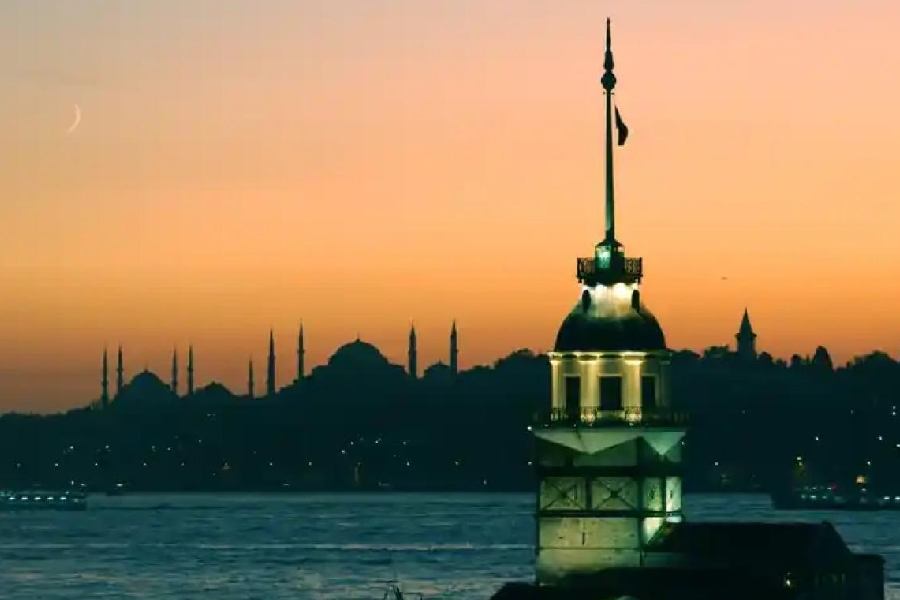
How do you write about a city that’s simultaneously itself and also every iteration that came before? Ananya Vajpeyi’s Place: Intimate Encounters with Cities does so by imbibing that very multiplicity of places — part memoir, part travelogue, part sociopolitical commentary. It’s a book of flux, in flux, in and of changing cities, of changing minds and changing times. Her cities carry histories, lived and literary, buried under pages of a novel, hidden under the verses of a poet from centuries ago. Her Istanbul (picture) is also Orhan Pamuk’s Istanbul, her Delhi also Amir Khusro’s. “[In Delhi] the summer heat is excruciating. When the monsoon arrives one can glimpse Paradise. Paradise is really a garden in the rain. Paradise is the crowding of the summer sky with clouds so dark they are almost black.”
Her prose shapes geography into something tangible, almost tactile. “[Kashmir] conceals its wounds in lovely flowers and snow peaks, like a woman concealing the gashes and bruises of domestic violence with clever makeup on her face and clothing that hides most of her body.”
That is, in a way, its central dilemma. How do you make sense of perpetual destruction? How do you reconcile with the domino chains of human horrors? “Every day one is reminded that any city can be destroyed; that neither its buildings, nor its history, its institutions or its natural environment can withstand the onslaught of deadly force.” How does one set aside a genocide that is telecast live? How does one live in peace knowing one’s country is becoming something beyond recognition? Vajpeyi asks, “How can we make it up to those we love, or learn to live with ourselves, injured and scarred as we are?” We remain witnesses and participants, both.
To quote John Vaillant from the book, “The world ends for every generation. It is continuously ending and never, in fact, ends.” Vajpeyi sees this pattern elsewhere, in Gaza, when she draws parallels to the Mahabharata: “There are no victors and no losers in a fratricidal war. There is only an ending, of the world that the protagonists once populated together, and of the relationships that defined them vis-à-vis one another.”
The novel is also a journey — a haphazard one, sure, having been written across the years, but a journey nonetheless — of making sense and coming to terms with death. An initial essay looks at 9/11, how it changed the Western world, its geopolitical reverberations, its never-ending retaliations, decades later. The final essay comes to Banaras, where bodies burn daily by the Ganges, that city of piety and salvation, that city of death and departure.
Throughout, her father’s words (he was a poet, Kailash Vajpeyi) recur: “Doobna to tai hai / Isliye naav nahin / Nadi pe bharosa karna”(Since drowning is inevitable, Never trust the boat, but do trust the river). Death, approached honestly, teaches what life spent avoiding it cannot. The boat — our certainties, our delicately-constructed identities — will fail. The river — time, death itself — will carry us regardless. Trust not in what promises safety but in what promises nothing except continuation.
Thus, in mapping external geography, Vajpeyi inevitably charts internal terrain. Making sense of cities means making sense of the self that observes them. Vajpeyi’s cartography operates on two planes simultaneously: the physical geography of places and the psychological geography of the person moving through them. The observer never stands outside what’s observed. Vajpeyi can’t describe Delhi neutrally because Delhi shaped her, just as her perception shapes the Delhi she describes. The city and the self exist in continuous feedback, each revising the other. She notes, “[reality] is a video game without vectors, without rules, without images, without winners and losers, without beginning or end — reality is a nightmare.”
What the finest literature possesses, what the greatest cities in the world are overflowing with, what the most resonant notes convey, what the most sumptuous delicacies supply, what the world today needs more, more, and more of, Place contains that.
With all its ghosts, violence, beauty, multiplicity. Place contains life.