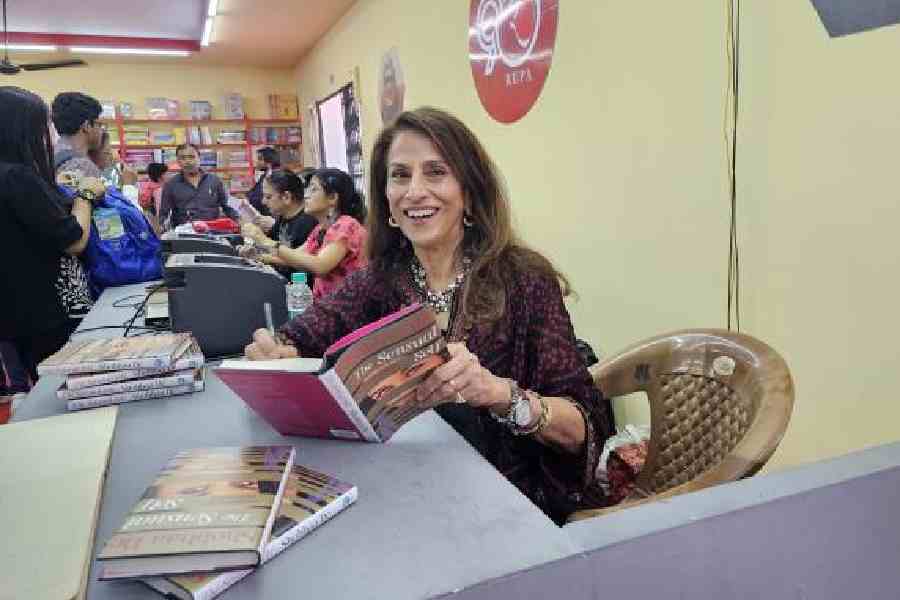
Shobhaa De breezed through the International Kolkata Book Fair exuding a joie de vivre that permeates through both her walk and talk. She spent time at the Rupa & Co stall in between her sessions at the two literary meets in town over the weekend, taking up a corner of the counter. Between obliging requests for selfies and autographs on her latest release, The Sensual Self: An Exploration of Love, Sex, and Romance, she chatted with t2. Excerpts from the conversation.
At a recent literary meet, you said that your new book, The Sensual Self: Exploration of Love, Sex and Romance, is not Kamasutra 2026.
It’s not a sex manual. Let’s put it that way. It’s a much deeper subject that I’m exploring, which is “why does intimacy scare everyone so much, especially in our society”. It’s a word that we’re not comfortable with, and it’s an experience we’re not comfortable with. Yet it’s really so fundamental to the human experience of living. It’s about time we had more conversations around it. That was one of the impetuses for me to write the book in the first place. It’s been a lifelong quest for me to figure out why we are denying ourselves something so basic and so beautiful.
From the time that you started writing with Socialite Evenings in 1989, is India still as prudish or have we made some progress?
The progress is very cosmetic. I wouldn’t even say prudish; I’d say more hypocritical and nervous about any expression of sexual feelings. Forget the demonstration of it, even within ourselves, we are not very comfortable dealing with the subject. Women and pleasure are somehow even more threatening to society — that a woman can demand pleasure, experience pleasure, talk about pleasure, write about pleasure. That is again a little surprising, because for centuries, we’ve had a tradition of women poets in Telugu, for example, in the 16th and 17th century, writing beautiful erotic poetry. No one misunderstood it. We have a tradition of erotica and sensuality. In India, everything about our lives as Indians, contributes to it. Our spices, our clothes, our fragrances, the way we walk, the way we dress, the colours, the weather are all contributory to celebrating sensuality, but we don’t. I have not understood that paradox at all.
Does that lead to repression in some ways?
Too many taboos and too much hypocrisy and too much fear, and, above all, too much ignorance. Because these conversations are never raised, most people don’t know enough. So where do you begin if we are going to be so judgmental about anyone even wishing to discuss the subject?
Is this an argument you are putting in this book?
Very much so, especially for the young, because we keep talking about women and their vulnerability, but I find men are equally vulnerable. The young men of today are not prepared for what adult life means, what an intimate life with a partner means. We tend to ignore them as a category. We expect that men are so entitled that they can deal with life, but it may not be so. They’re as vulnerable as women are. We should not use a different yardstick when it comes to men and their feelings, and their emotions and their expectations from life, their desires.
Coming to the setting of this conversation, the Book Fair, you must have been to quite a few around the world.
The thing is, the Kolkata Book Fair is unique. The Frankfurt Book Fair and Kolkata Book Fair are the two biggest, I’d say, the most prestigious book fairs in the world. To see the participation of the city of Calcutta, the readers here who save money so that they can come and buy books for the family at the Book Fair is something I find extraordinarily inspiring. That means they still value a book, they still value the written word, they still value ideas and debate, which is a shrinking space in the rest of the world.
But in the world of Reels and social media, is our attention span dwindling?
It is dwindling, but we shouldn’t be threatened by social media. We have to make peace with it, learn to live with it, and make it a compatible part of our lives, not in conflict with social media, because it’s here to stay. So the number of readers as I see here today, for example, they could as easily be sitting at home, scrolling on their phones, but they’re not. They’re here, they’re buying books, they’re engaging, they’re informed. They respect their writers and authors. So I don’t feel we should make that a comparison or a question of insecurity. Both will coexist.
We have two literary meets going on in the city at the same time as the Book Fair, so it’s apparent that people love to hear authors talk. But are they preferring to rather hear them talk than read their work, or is one fuelling the other?
It doesn’t matter, as long as ideas are being listened to attentively. Thoughtful discussions are the byproduct of lit fests and book fairs. I’m not here to sell books. Personally speaking, it doesn’t matter to me. I’m here for this energy that I get in a book fair or at a lit fest. Engaging with readers, whether or not they buy the book, is far more valid.
How frequently have you been here?
It’s the 49th edition (of the Kolkata Book Fair), I must have been here at least 10 times over the years.