After a 25 basis point rate cut in December, the RBI on Friday decided to pause on the policy rate front amid geopolitical uncertainties.
This is the first monetary policy review after Finance Minister Nirmala Sitharaman announced the Budget for financial year 2026-27.
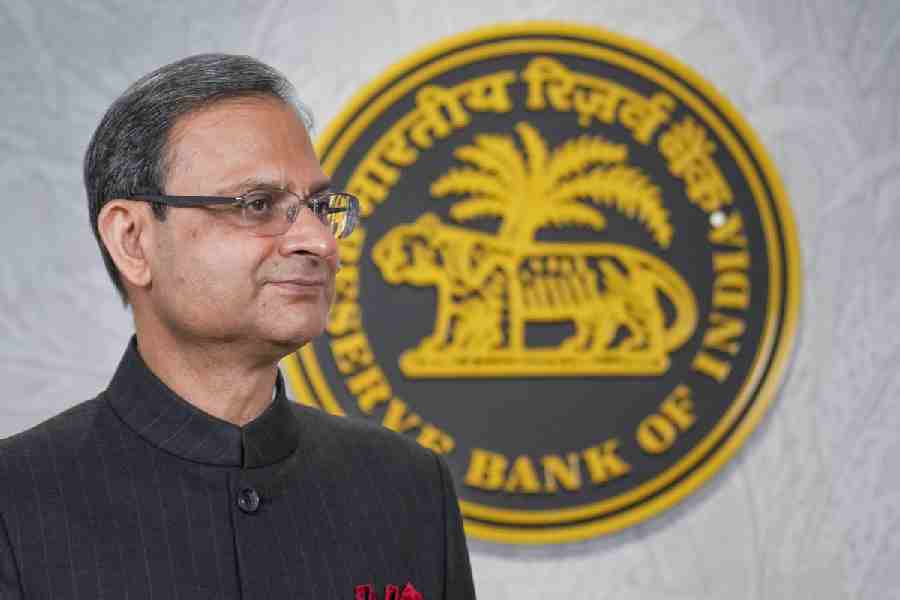
Announcing the sixth and final bi-monthly monetary policy for the current fiscal, RBI Governor Sanjay Malhotra said the Monetary Policy Committee (MPC) has decided to retain short-term lending rate or repo rate at 5.25 per cent with a neutral stance.
The rate cut pause comes on the back of the CPI-based headline retail inflation ruling below the 2 per cent lower band mandated by the government for the last four months.
US President Donald Trump earlier this week announced a cut in tariffs on Indian goods to 18 per cent from 50 per cent, easing a key pressure point on India's economy and markets.
Malhotra said external headwinds have intensified, but the successful completion of the trade deal with the United States bodes well for the economy.
While inflation remains benign, economic activity remains resilient.
"Amidst heightened geo-political tensions and elevated uncertainty, the Indian economy is in a good spot with strong growth and low inflation. Inflation remains below the tolerance band and its outlook continues to be benign," he said.
"With the signing of a landmark trade deal with the European Union and the US trade agreement in sight, growth momentum is likely to be sustained for a longer period." Inflation is expected to average close to 2 per cent in the current financial year, below the central bank's target of 4 per cent. GDP growth for the current fiscal year ending March 31 is forecast at 7.4 per cent.
Announcing additional measures, Malhotra said RBI will issue three draft guidelines relating to mis-selling, recovery of loans and engagement of recovery agents, and on limiting liability of customers in un-authorised electronic banking transactions.
"It is also proposed to introduce a framework to compensate customers up to an amount of Rs 25,000 for loss incurred in small-value fraudulent transactions," he said.
It will also publish a discussion paper on possible measures to enhance the safety of digital payments. Such measures may include lagged credits and additional authentication for specific classes of users like senior citizens.
He also proposed doubling the limit for collateral-free loans to MSMEs Rs 20 lakh and allowing banks to lend to REITs to promote financing to the real estate sector.
Also, NBFCs having no public funds and customer interface, with asset size not exceeding Rs 1,000 crore, are proposed to be exempted from the requirement of registration.
The requirement for certain NBFCs to obtain prior approval to open more than 1,000 branches is also to be dispensed with.
For financial markets, Malhotra said RBI proposes to remove the limit of Rs 2.5 lakh crore for investments under the Voluntary Retention Route (VRR). Investment through the VRR in each category of securities will be subject to the investment ceiling for the respective category under the General Route.
"The Indian economy continues to register high growth despite a challenging external environment clouded by geo-political uncertainties. Benign inflation provides the leeway to remain growth-supportive while preserving financial stability. We remain committed to meet the productive requirements of the economy and sustain the growth momentum," he added.
The central bank has been tasked by the government to ensure that consumer price index (CPI) based retail inflation remains at 4 per cent with a margin of 2 per cent on either side.
Since February 2025, the RBI has reduced the policy rate by 125 basis points. In its previous policy review in December, it had trimmed the repo rate by 25 basis points to 5.25 per cent.
Based on the recommendation of the MPC, the RBI reduced the repo rate by 25 bps each in February, 2025 and April, and 50 basis points in June amidst easing retail inflation. However, the central bank halted its rate cut in August.
In the last MPC meeting, the RBI again went for reduction in repo rate by 25 basis points to 5.25 per cent.
India's retail inflation dropped to a historic low of 0.25 per cent in October 2025, marking the lowest level since the CPI series was introduced. Besides, the Indian economy has clocked better-than-expected GDP growth of 8.2 per cent in the second quarter.
As per the government estimate, India's economy is estimated to grow at 7.4 per cent during the ongoing financial year.
However, the rupee declined to historic low and crossed 92 against a dollar last week making imports costlier, raising fears of rise in inflation.
Rupee has depreciated by about 6 per cent in calendar year 2025.
Commenting on the MPC decisions, Upasna Bhardwaj, Chief Economist, Kotak Mahindra Bank said, "The MPC delivered completely in line with expectations across rates and stance. The inflation outlook in H1,FY27 has been revised up marginally." Inflation projection for H1,FY27 has been revised slightly higher to 4.1 per cent from 3.95 per cent but inflation outlook has remained benign.
"While uncertainty remains on the growth-inflation figures as we await the new series, the uptick in commodity prices and weaker currency may pose upside risks to inflation. We therefore see limited room for additional easing on the repo rate front, with RBIs focus expected to be on ensuring stability on the liquidity front in the year ahead," Bhardwaj said.