Book: THE ARCHITECT’S DREAM
Author: Nikhil Kumar
Published by: Penguin
Price: Rs 499
The Architect’s Dream, Nikhil Kumar’s debut novel, is a triangular love story where the woman (Tanya) remains an enigma to the men who love her: both the one she desires (Vidhu) and the one she eventually marries (Hanif). The narrative spans more than four decades: from the early 1970s, when the trio were architecture students at Delhi’s SPA, to the time Vidhu returns to the city as a celebrity architect based in New York, invited by Prime Minister Manmohan Singh to design a new public library.
After graduation, Vidhu had left for a Fellowship to London and, thereafter, to New York where he landed a job. Finding the separation unbearable and unsure of its duration, Tanya found herself drawn towards Hanif, who was all concern and sympathy for her. But soon after, she realised he couldn’t tolerate conversations about Vidhu. She stopped corresponding with Vidhu then, lying to him that she was relocating to her parents in Bombay for a while and that she would get back after she had figured out a few things for herself. She never communicated with him again. She never forgot him either. His last postcard from London, in particular, was a special memento for her, hidden in a coat pocket which was accidentally discovered by Hanif years into their marriage. Unfortunately, it coincides with a time when he also chances upon her diary, replete with plans of escape to the US where her brother, Anil, lived, implicating her family and her best friend, Salma, in it. These two events combined transform Hanif into a veritable Othello who comes to his senses only after his Desdemona dies, in an advanced stage of pregnancy, as it happens, a pregnancy she wanted to terminate, while he clutched onto with wild hope. Vidhu never knew about her marriage; and when, after coming to Delhi for the library project, he spots her (or so he thinks) in a park, with (whom he takes to be) her daughter (because of the latter’s uncanny resemblance to her), he is desperate to meet her and ends up stalking the young woman without realising it. This costs him and his library project — already under fire from right-wing politicians — dearly. In a twist at the end, we find the two men meeting — with Hanif still keeping Vidhu in the dark about his marriage to Tanya. Ultimately, none of the three reveals his/her true self: that is reserved for the friend and the therapist.
The narrative structure of The Architect’s Dream is complex: it alternates among the three protagonists in first person even as it moves back and forth in time. This demands a certain alertness from the reader, otherwise it gets a little confusing.
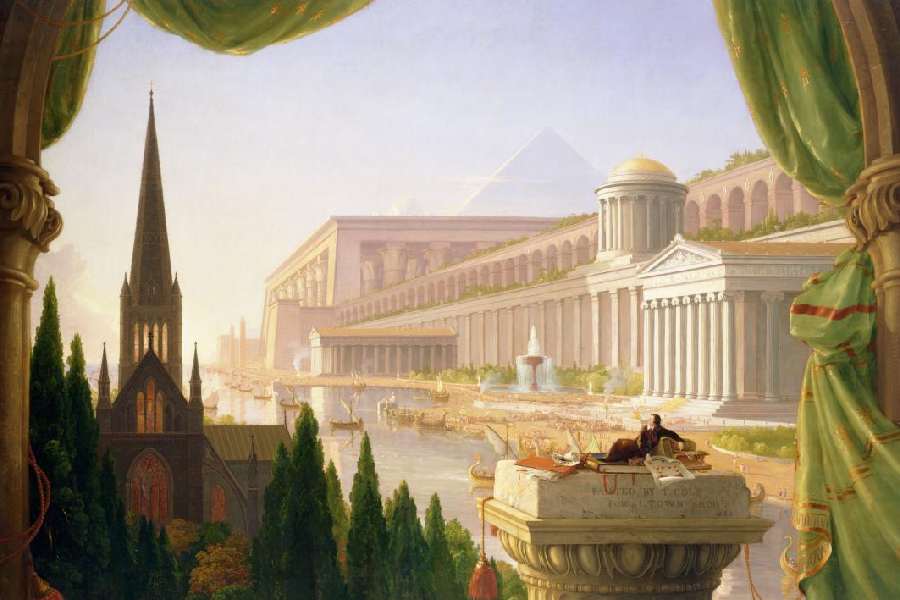
The title of the novel is inspired by a famous painting by the American artist, Thomas Cole, where canonical buildings from across different geographies and epochs — Egyptian Pyramid, Ionic temple, Roman aqueduct, Gothic cathedral — are all gathered together (with Cole himself reclining on a column) and look untouched by time, projecting an unrealistic ideal of architectural perfection. Vidhu refers to this painting in an early chapter of the novel while addressing a press conference in Paris, announcing a fashion museum to be designed by him backed by the house of Chanel. He is critical of Cole’s vision — to “build statements against nature” — offering instead to “work with nature” as that meant “thinking about ways to accommodate change”.
But nobody accommodates change gracefully in the novel — neither buildings (in Delhi) nor humans, including Vidhu himself. He is haunted by the void left by Tanya when she vanished into thin air after he moved to New York. And much later, Hanif is haunted by the possibility that his wife’s heart still belonged to her first love. They become the epitome of a loveless, disconnected couple who wear each other out — he, being suspicious and she, fearful of his volatile temper. It is, however, Hanif’s obsessive fear of losing Tanya — who keeps visiting Salma in Bombay as an excuse to be away from him — palpably dramatised, that stays most with the reader. Because it’s a fear that comes true.