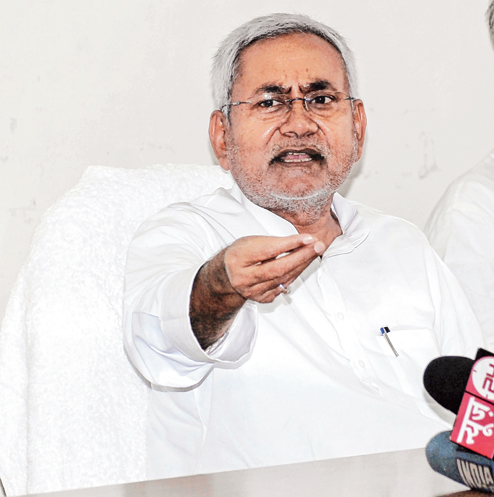

Nitish Kumar clamping the most rigorous prohibition on Bihar is ironic, because he came up with the excise policy in 2006 that led to an extensive network of country liquor shops in the state's hinterlands. And in both his "democratising" the liquor business and crackdown on it, there were factors beyond the obvious at play.
In November 2005, when Nitish took over the reins of a virtually bankrupt state with its annual budget size reduced to barely about Rs 400 crore, he was desperate to raise funds to fulfil his promises - roads, hospitals and welfare schemes. With his canny economic sense, he saw scope in the liquor business which was then largely unorganised.
He created the Bihar State Beverages Corporation Limited (BSBCL), turning the "shady" liquor business into a transparent industry, giving licences for one liquor outlet for every three village panchayats and setting up breweries.
"As many as 6,500 retails country liquor shops - an all-time high - came into existence all across the state hinterlands within a month after the new policy was put in place," a senior excise department official revealed.
Over years, revenue from just country liquor rose to Rs 2,500 crore allowing Nitish to pursue his schemes like scholarships, bicycles to students, old-age pension to underprivileged sections.
Why then did Nitish, who used the IAS officer Brajesh Mehrotra (then excise secretary and now principal secretary, cabinet coordination) to script the excise policy and promote the liquor industry, use K.K. Pathak, principal secretary excise department, to "demonise" his own "baby"?
The Telegraph put this question to several top country liquor barons, who were engaged in the trade for generations and who are now left clueless about recovering investment worth crores. These country liquor barons, who have at least four of their representatives in the BJP and the Grand Alliance in the Legislative Council, described it as a "politically motivated" action.
An MLC trade revealed that contrary to the perception that the Yadavs have outnumbered others in the country liquor trade, it was a section of Banias - primarily Sudhis, Telis and Kanus -who controlled 60 percent of the country liquor manufacturing. "The Yadavs occupied 20 per cent share in the retail trade only," the MLC added.
The liquor barons said that after Nitish parted ways with the BJP and lost heavily in 2014, he got the perception that these Banias prospering through the liquor trade had shifted to the BJP. Around the same time, his then rivals including Lalu castigated Nitish for allowing the "mushrooming" of liquor shops at the cost of poor people's health. The women's groups too began protesting against the "menace".
"Nitish, instead of sensitising the people and the traders, decided to prohibit it using the women's protests as a fig leaf in an obvious bid to fix the class he perceived as his political detractors," said a liquor baron belonging to the RJD. Lalu - not famous for his sympathies for the business community - backed Nitish.
The chief minister was not hostile to the foreign liquor trade, but what led him to ban that too suddenly "was his government's ill preparedness to sell it through the BSBCL outlets," said a BJP MLC. "Sensing that the inability of the BSBCL to run its shops might lead to further chaos, Nitish suddenly decided to impose total prohibition."