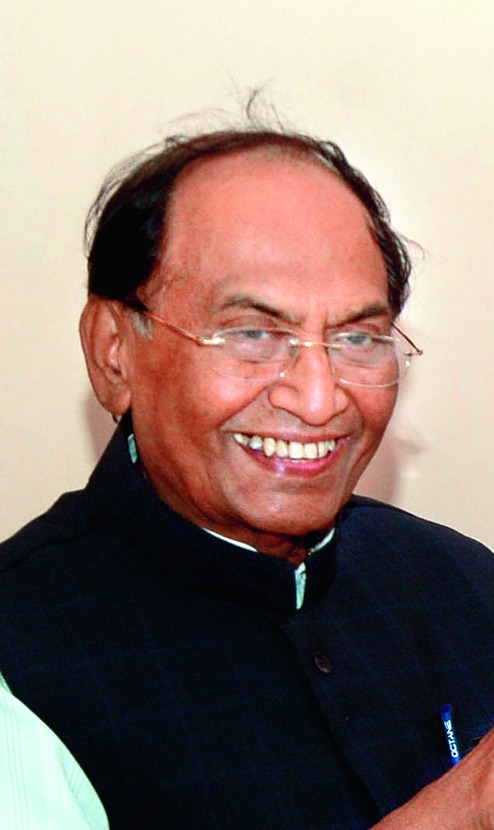

Former Union health minister C.P. Thakur, who is also a doctor, will get a lifetime achievement award in recognition of his work on kala-azar.
The World Health Organisation (WHO) will confer the award on him at a programme in Spain on May 16. Thakur left for Spain with his family on April 30.
Kala-azar or black fever, caused by sandflies, was earlier considered a deadly disease. When Thakur - who had suffered from a bout of the disease himself - started working on kala-azar, few doctors and fewer medicines were available. He played a key role in introducing new medicines, after successful trials. Experts confirm his major role in controlling the disease.
Health department sources said Bihar accounts for around 70 per cent of kala-azar cases in India, but the number has dropped from 33,187 in 2011 to 6,245 in 2016.
"The mortality rate has also come down. While 80 deaths were reported in 2011, no death was reported last year (2016)," said a health department official on the condition of anonymity.
Thakur could not be contacted for comment but Sanjeev Mishra, his close aide, said Thakur himself had suffered a bout of kala-azar when he was preparing for his matriculation exam. "Very few people know about this. Thakur sir had to be confined to bed for 3-4 months because of the disease," Sanjeev said. "It was then that he decided to become a doctor and find a cure for the disease. He tried new kala-azar-related drugs on patients and found them to be very effective. Thakur sir fully deserves the WHO award."
Kala-azar expert Prabhat Kumar Sinha, who worked with Thakur during trials of new kala-azar related medicines on patients in Bihar, said Thakur played a major role in the rationalisation of doses, which helped eliminate the disease to a large extent. "Earlier, the drugs were given in low quantity, because of which they were not very effective on patients," Prabhat said. "Thakur conducted research on this and suggested the right amount of the dose to be given to patients. Kala-azar dose was earlier fixed at 1-2ml, but later, on Thakur's initiation, it was fixed at 20mg per kg body weight."
Prabhat is now medical superintendent at the Indira Gandhi Institute of Medical Sciences (IGIMS). He said Thakur carried out intensive research on effectiveness of kala-azar-related medicines in which he came across patients developing resistance to certain drugs that were given to patients at that time (in 90s). "Dr Thakur discovered many patients who had developed resistance to drugs sodium stibogluconate and pentamidine," Prabhat said. "On his initiation, the trial of the oral drug milfetosin was initiated on kala-azar patients in Bihar. The trial was successful after which WHO approved it as the first oral drug for kala-azar. Later on, Dr Thakur conducted trial of intra-venous drug Amphotericin B on kala-azar patients, which too proved successful. The drug is still used for treatment of kala-azar and is said to give 97 per cent results. Later on, Prabhat also conducted trial of paromomycin IM injection on patients and it too proved successful."
Sources said that apart from conducting research on kala-azar and conducting trial of new drugs, Thakur also organised kala-azar elimination programmes in Muzaffarpur, Sitamarhi and Khagaria districts among others where he created awareness about the disease.