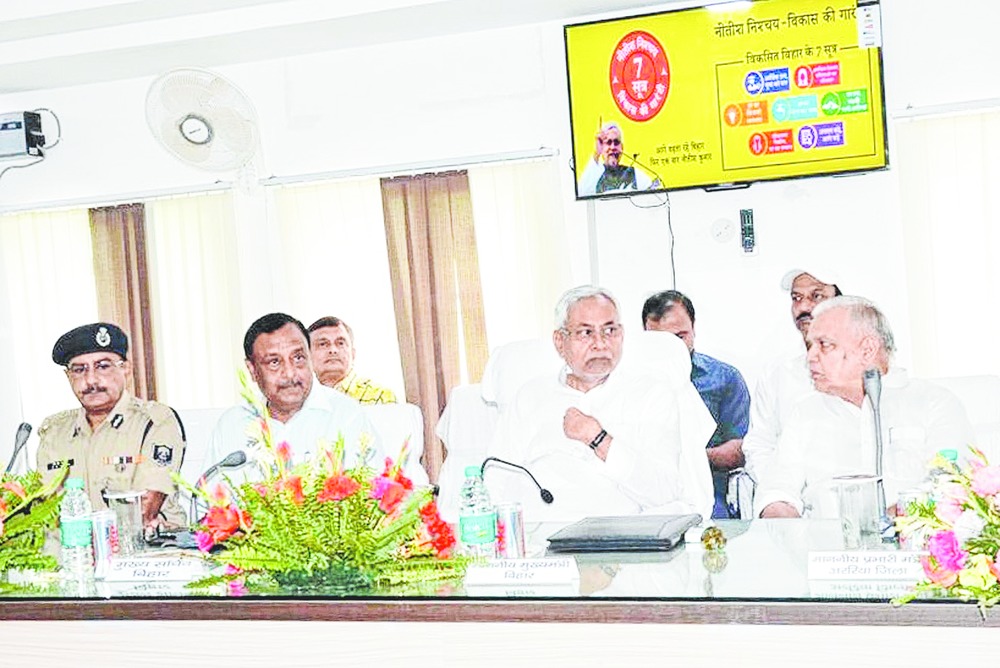

Chief minister Nitish Kumar on Monday announced the setting up of a university in Purnea for which a bill would be tabled in the monsoon session of the legislature if needed.
"We will build a university in Purnea soon, and if the law requires, a bill would be brought in the next session of the Legislative Assembly. The local public representatives and the district administration must take steps to identify the land needed," Nitish said.
He made the announcement at a meeting of parliamentarians and legislators of the Purnea division, which comprises Purnea, Araria, Katihar and Kishanganj districts. Most of the four MPs, three MLCs and 24 MLAs the division has was present on the occasion.
Cutting across party lines, all public representatives at the event, had unanimously demanded the creation of a university with its headquarters at Purnea, and Nitish decided to agree to it. Colleges in the division are affiliated to BN Mandal University with its seat in Madhepura.
Nitish said Purnea division had the maximum number of madarsas in the state and declared that a regional office of the Bihar State Madarsa Education Board would be set up there. The legislators made a slew of demands to the chief minister and pointed out towards various development issues in their areas.
Purnea MP Santosh Kumar Kushwaha, MLA Vijay Khemka and a few other legislators insisted on the setting up of a branch of All India Institute of Medical Sciences there and demanded the renovation of Gulabbagh wholesale market, which boasts of being the biggest grain market in eastern India, and construction as well as repair of important roads in the region.
Araria MP Mohammad Taslimuddin pointed out to the delay in implementation of Centre-sponsored scheme for the development of the Mahananda river basin so that issues related to floods and erosion in the area are resolved. He also demanded the setting up of establishment of undergraduate colleges and strengthening of qualitative education in the area.
The parliamentarians and legislators also provided written copies of problems in their areas and demands to the chief minister, who assured them that suitable action would be taken.