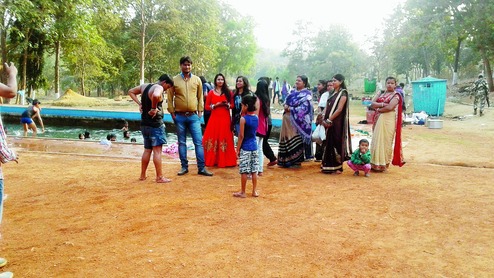

Bhimbandh (Munger): Sanitary napkins and tourists have reached and women are coming out of homes to speak with government officials - a lot has changed in the past couple of years around the densely forested Bhimbandh area in Munger, around 200km east of Patna, where once only security forces would dare to tread.
Phoolmani, 36, from Bhimbandh Basti, a sleepy hamlet inside the dense Bhimbandh Wildlife Sanctuary, an erstwhile bastion of Maoists, has recently started using sanitary napkins. She has given up on the traditional measures after girls from the village moved out to Jamui to study in residential schools .
"After completing primary classes at the middle school in nearby Sonarwa village, I study at Kasturba School in Barhet from 2016," said Suggi Kumari, whose home is in Bhimbandh Basti, 41km south of the Munger district headquarters and 8km from her residential school in Jamui. "There I learnt about hygienic practices we didn't know."
Sia Devi's granddaughter Chhoti Kumari studies at SSVM School in Lakshmipur, 12km from Munger, since last year. Sia said girls like Chhoti have introduced new concepts to the women in the villages .
Sita Devi was recently seen discussing with Haveli Kharagpur sub-divisional officer (SDO) Sanjeev Kumar problems in getting ration cards and old-age pensions for her in-laws when the official visited the village for inspection .
"Chief minister Nitish Kumar visited Bhimbandh for the first time in May 2017 and recently in Munger, he instructed officials to focus on the area to develop it as a tourist spot. Since then the local officials have become active and been visiting us for the first time in our memory," said Bhairabh Thakur, 34.
The forest village was cut off from the outside world when Maoists killed then Munger superintendent of police (SP) KC Surendra Babu on January 5, 2005. Aklu Thakur, another local resident, said apart from the rebels, no one came here till a CRPF camp was opened in 2013.
Neelkamal, the commandant of the camp , said: "Bhimbandh is a popular tourist destination for its hot water springs but the village was abandoned after the murder of the SP. The rebels created a safe Red corridor. With the camp we countered the rebels and on January 1 this year nearly 5,000 tourist vehicles came to the hot springs."
Sub-divisional officer Sanjeev said the government has sanctioned Rs 9 lakh to develop infrastructure for tourists .
"We executed work through private agencies and the forest department maintains the hot springs, diverting water for irrigation," he said. "The Munger district administration gifted the village a cemented road, hand-pump and solar light."
Now, 16 people from the Bhimbandh Basti have been engaged to maintain cleanliness around the hot springs. Sanjeev said that 111 Indira Awas Yojana units have been sanctioned in Bhimbandh Basti and Sonarwa as well.