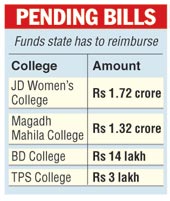
A state government policy to encourage women to pursue education has become an albatross around the neck of city colleges.
Several colleges are facing funds crisis because of the failure of the state government to reimburse the fee that the colleges had to waive off, according to a government directive, while admitting girl students.
The state government has made education up to postgraduation free for SC/ST and girl students. The women's colleges are the worst hit because of the obvious reason that all its students are girls and the institutions are not getting any fee from the students. The government's failure to reimburse the waived-off fee has made worsened the crisis.

As most of the colleges affiliated to different universities are facing acute shortage of teaching and non-teaching staff, these institutions depend on ad-hoc arrangements to meet their needs.
The payment of the non-regular teachers and non-teaching staff is made through the college internal resources. The internal resources are the money collected from admission and tuition fees from students. Since the state government has not reimbursed the funds for the past two years, colleges' internal resources have dried up.
Magadh Mahila College principal Dharamshila Prasad said: "We are worried about the payment to ad-hoc teachers, as internal resources are at rock bottom. On several occasions, the college had raised the issue at the varsity level, which later informed the education department. But no action has been initiated."
The Jitan Ram Manjhi government in February 2015, had decided to provide free education to Scheduled Castes (SC), Scheduled Tribes (ST) and girl students till postgraduation. The announcement was made when Manjhi was the chief minister. Later, when Nitish Kumar took over the reigns from Manjhi he continued with the policy.
According to the policy, no fees will be charged from SC/ST and girl students at the time of admission at government universities and colleges. It was decided that the government would reimburse the financial loss to such universities and colleges. This would cost the exchequer Rs 29 crore annually. Though the state introduced the policy in 2015, the colleges have not received the money for once.
Magadh Mahila College teacher Suheli Mehta said: "Because of the financial crunch, the college has stopped appointing ad-hoc staff and this led to severe staff crunch. There's shortage in the computer section, library and other departments."
At Magadh Mahila College there are around 2,500 undergraduate and postgraduate students. The annual tuition fee of first-year undergraduate course is Rs 6,100, for second-year undergraduate course is Rs 6,800, and for the postgraduation-level it is around Rs 7,000.
The situation in other city colleges is similar. At JD Women's College, a constituent of Magadh University, the funds crisis is similar. As the state has not reimbursed the money, JD Women's College this month decided to charge examination fees from students, despite opposition from them.
Student bodies such as All India Students' Federation (AISF) and All India Students' Association (AISA) supported the protest. AISF state general secretary Sushil Kumar said: "Around a fortnight back, the JD Women's College, in the name of re-admission, took money from students. When we came to know about the incident we protested. The administration rolled back its decision."
Education department special secretary K. Senthil Kumar is, however, optimistic that the government will reimburse the money to the colleges. "We have asked the colleges to provide the number of students who fall in the waive-off category. Once the department gets the information, payments will be made."
Denying Senthil's claims, a senior professor with a women's college said: "We have provided all information on SC/ST students and girl students for the academic year 2015-16. But not a single penny has come our way."
Asha Singh, the officer on special duty of colleges of Magadh University in Patna division, said: "The matter is serious because we have come to know that colleges under the MU in Patna, especially colleges such as JD Women's College, Arvind Mahila College, Ganga Devi College, are facing severe funds crisis. We have asked the varsity to solve the crisis as soon as possible because any further deepening of the crisis will lead to bigger problems."
The government's decision to provide free education has not gone down well with teachers of the varsity. A senior teacher of Patna University said: "Populist schemes such as free distribution of cycles, uniforms, waiving off girl students' fees and other such schemes will not help impart quality education. The government should have focused on providing quality education to students through regular appointment of teachers at colleges and strengthening the infrastructure of the institutions."