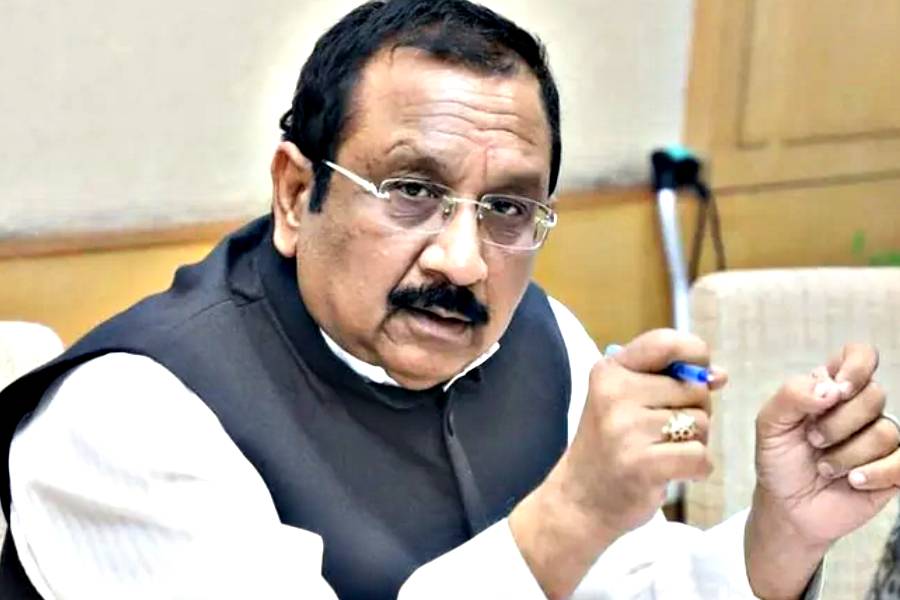
New Delhi, June 5: Chief minister Nitish Kumar and his Gujarat counterpart Narendra Modi once again ignored each other today at the national meet on internal security.
The two leaders passed each other in silence to take their seats during the meeting called by Prime Minister Manmohan Singh. They did not even see eye-to-eye.
Many present in the meet interpreted the growing fissure between the two leaders as a sign of widening rift between the NDA partners — the BJP and the JD(U).The two leaders were in different frames of mind in the meeting, as the bypoll result trends started trickling in from the morning. Modi was upbeat after the clean sweep in Gujarat bypolls, while Nitish’s JD(U) suffered a setback in the Maharajganj Lok Sabha seat. But they were on the same page on exchanging pleasantries. Neither budged.
“It was a kind of déjà vu for many of us as Nitishji did not congratulate Modiji for the victory. We saw a similar scene during the National Development Council meeting in December last year, the last time the two had shared same platform,” said a senior official attached with Bihar Information Centre.
The duo, however, were almost in the same frequency while opposing the Centre’s proposal to set up the National Counter Terrorism Centre (NCTC). While Modi pushed for strengthening of the multi-agency centre of the intelligence bureau, Nitish said the NCTC draft still suffered from serious flaws.
“First, what is the use of creating an operation division within the NCTC and giving powers of conducting operations if they are to be conducted either through or in conjunction with state police? Second, the draft order still retains the absolute and arbitrary provision regarding mandate to civil authorities within the states to provide documents and information,” said Nitish in the meeting attended by several chief ministers and Union home minister Sushil Kumar Shinde apart from the Prime Minister.
“Also, the new NCTC has been proposed though the National Investigation Agency (NIA) is already functional to discharge similar functions. Finally, we believe that when the Unlawful Activities (Prevention) Act is available, then any institution being created to further its objectives should be made through a motion of law. Thus, if the Centre still considers it expedient to form an organisation like NCTC, then it should be done through legislation in Parliament, which will ensure a wider debate on the subject,” he said.
Outlining various measures and steps that have been taken in the state to improve the law and order situation, Nitish demanded that Integrated Action Plan should be expanded to more districts to tackle Naxalism and the basic unit for its implementation should be changed to panchayats selected on relevant criteria rather than district as a whole. “This will lead to a more integrated and focused approach to saturate the developmental needs of the selected area without thinning of resources,” he said.