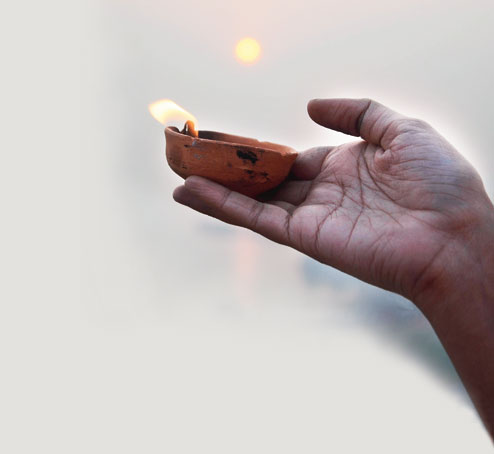

Imagine a million people congregating on both sides of the Ganga without any police to control them. Chhath, named so since it falls on the sixth day after Diwali, is a self-policed festival of Bihar and subsequently the most peaceful. What about all the dirt and garbage of a city where 2.5 million people live? Amazingly, the city of Patna is resplendent on the eve of Chhath with volunteers of various wards and puja committees vying among themselves to wash their roads and clean up the city.
No accurate records are available as to when this festival caught the imagination of the people. The British Gazetteers usually carried the socio-cultural life of the people. Scant attention paid to the Chhath festival by these voluminous Gazetteers points to the fact that it evolved into a major festival gradually. Traditionally, Chhath was deemed a women’s festival; there were no political overtones like for Durga Puja in Bengal or the Ganapati festival
in Maharashtra.
Today, the family Chhath celebrations are led by the matriarchs of the family when they undertake fasting and pray for the entire family during the festival. The children are extra excited about the festival since it involves walking in procession to the ghats in the evening and morning, helping their mothers to prepare food items like the rural biscuit, thekua. The ardent devotees stand in the water the whole night waiting for the morning Sun.
Sun salute
Chhath is celebrated around the Sun. At the end of autumn and at beginning of the winter season, the Sun would start its journey into the southern hemisphere on September 23 and cold would set in. In ancient times, there was fear at the height of winter that the sun might not even come back, which would mean untold misery for the people.
Chhath remains the best felicitation of Father Sun. Millions of devotees greet the Sun in the mornings and evenings and they pray zealously seeking blessings of health for the entire family. Autumn turning into winter has been a cardinal point of time transition. Our Chinese neighbours observe the lantern festival of the new moon during this period seeking blessings from the moon for family and fertility. The moon cakes, similar to thekua, are made by rural families to be shared among neighbours during this festival. The Europeans would celebrate the feast of the protectors of humanity, the angels Michael, Raphael, and Gabriel, seeking blessings for the difficult times of winter.
Timing tweak
Generally Hindu scholars rate Diwali to mark the turning of seasons. Diwali, while it is celebrated in the cities, is not a big event in rural Bihar. Probably this has to do with the timing. The major crop of rice has started flowering and the farmer has to protect them from insect attacks and provide for sought-after water. He is still busy.
When Chhath comes around, he is a little freer. The harvest is still ripening and perhaps the critical stage is over. He breathes a sigh of relief and can indulge in the Festival of the Sun and make it a point to seek blessings from the Lord of Life.
Women power
Chhatt traditionally has been a home-spun celebration without needing the help of the Brahmin priests. In fact, the main celebrants and officiating priests are the women. The offering at these Pujas are not bought from markets, but fruits and grains collected from their fields.
Of late we see many families have started to employ priests for the event. Sociologically, Chhath is perhaps a festival started by the little traditions in the state and since then has become the biggest festival. Twenty years back one of my priest friends confided in me that he did not have special prayers to chant for the festival. “I would chant the Surya-Savitri hymns a few times from the Rig Ved, since the Vedic Sanskrit is difficult to understand, I suppose nobody paid attention to my repetitions!”
Chants since then have been adapted, but it does not matter since it is the women who recite their prayers without depending on men priests. Perhaps Bihar has honoured the integrity of women in major festivals by appreciating them to act as chief priestesses and main functionaries of this biggest festival. This is a new trend in India. And the ubiquitous migrating Bihari families will carry this women-centred festival to other parts of the country and beyond.
Water woes
When a million people gather around it for a few days, the Ganga is bound to suffer. Unprecedented pollution has made the holy river unfit for bathing or for whole-night vigils. I don't think the powers that be are yet ready to tackle this problem. Even Lalu Prasad started offering Chhath prayers around the small swimming pool in his house. Today innumerable families have started this custom of building a small water tank on their roof and offering aarti to
the Sun from there. The poor families cannot afford to do that and they still throng the river in large crowds.
To conclude, Chhatt is an interesting festival for the whole country. Age-old Vedic rituals break down to give way to informal unsophisticated household prayers mainly led by women. Often it is a direct prayer to Gods almost nondependent on rituals. The festival is gaining more popularity both in Bihar, Bengal and UP to start with. Delhi and Mumbai are also hosting large-scale celebrations every year.