
Bhagalpur, April 23: The Kosi and Seemanchal regions have always been vulnerable to natural calamities because of silt deposit in riverbeds, formation of large numbers of waterbodies haphazardly with large-scale deforestation.
During the past five years, at least 7,000 people have lost their lives to natural disasters. Experts concerned in the field of climate and geography have held the topographic changes responsible for an increase in such incidents.
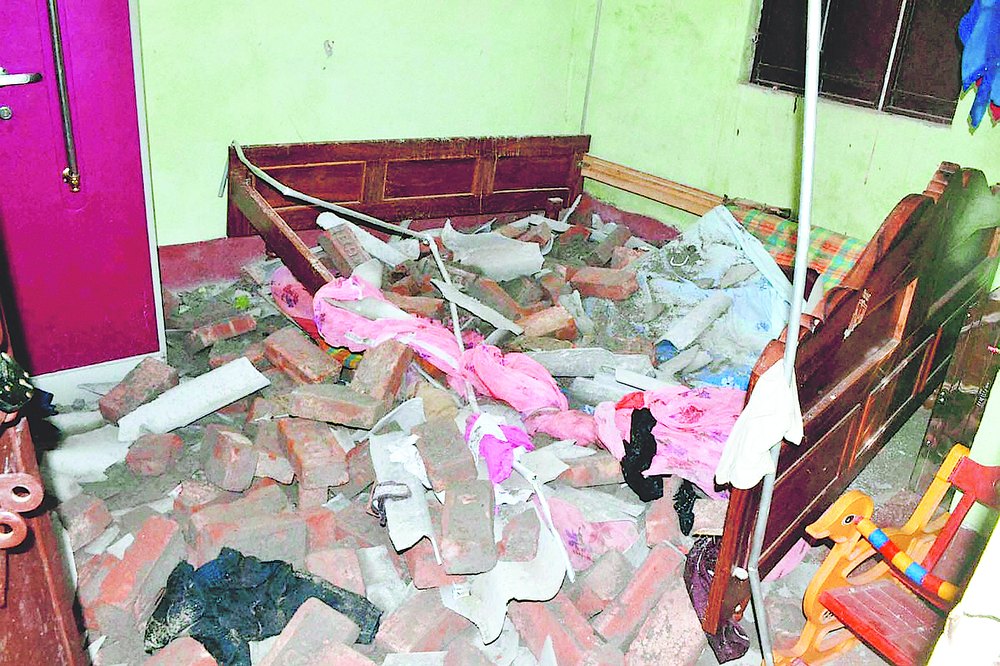
Chief minister Nitish Kumar, while talking to reporters on here Thursday afternoon about the destruction caused by the sudden thunder squall accompanied by gusty wind on Tuesday night in the northeastern parts of the state, said nobody in the state had any such apprehension earlier. Nitish, who arrived in Bhagalpur to unveil a 12.5ft statue of Veer Kunwar Singh on a horse at Zero Mile Chawk, the entry point to the Silk City, said: "The intensity of the cyclone on Tuesday night was very high, causing loss of human lives, property and crops. On Wednesday, I took an aerial survey and conducted a video-conferencing with district magistrates concerned. I instructed them to initiate relief work immediately."
He said the government was ready to provide sufficient compensation to victims who lost their relatives and properties. "The government would also provide compensation for damaged houses and the process would be completed quickly," Nitish assured.
On the loss of rabi and other crops owing to unseasonal thundershowers in the recent past, Nitish said officials concerned have been told to complete the compensation process within 10 days. "A list of the victims would be put up on the districts' websites and local newspapers," he said.
On the other hand, experts said the metrological department had warned about the possibility of such incidents some 15 days ago. "It is not the time for blaming rather we should think deeply why such natural calamities became common phenomena in the Kosi and Seemanchal regions. Some parts of eastern Bihar districts too affected by it," said Anuj Kumar, a climate expert. "The Kusaha (on the Kosi) tragedy in 2008 brought huge deposit of silt in the riverbeds and resulted in formation of large number of waterbodies in the entire region," he added. While citing previous disasters from 2010 in which Araria district had to witness an immense loss of property and human lives to the Tuesday night incident, he said the deposit of silt helps additional radiation in the region. Formation of unregulated waterbodies along with changing course of the Kosi have made the entire zone as low-pressure belt.
Echoing Anuj, Akhilesh, a research scholar at postgraduate department of geography in Tilka Manjhi Bhagalpur University, said the temperature rises due to global warming and also for presence of large number of waterbodies, which help evaporate air and subsequent formation of low-pressure areas. Such frequent low pressures during summer often invite such natural disasters with greater intensity. He also apprehended such phenomena cannot be checked unless works would are done to clear the river channels. He has strengthened the need of proper management for waterbodies in the region.
An official in the Patna Met office said the chances of lightning and thunder could be increased in a plane land, which is located higher from the sea level and continuous source of water like rivers are available. The official, however, has blamed the rising tendency of temperatures in these areas mainly due to large-scale deforestation and other environmental hazards like formation of waterbodies in abnormal proportionate.